

7.6 Note on Pressure and Incompressibility
203
Navier-Stokes equations without invoking continuity. We wish to create a new
velocity field v which:
0 satisfies continuity,
0 is as close as possible to the original field v*.
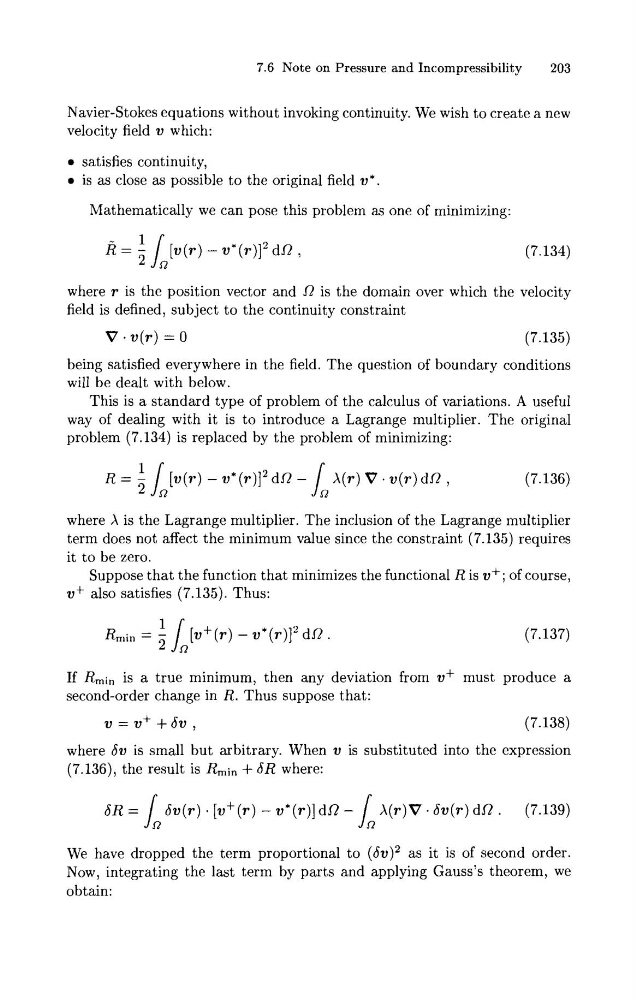
Mathematically we can pose this problem as one of minimizing:
where r is the position vector and R is the domain over which the velocity
field is defined, subject to the continuity constraint
being satisfied everywhere in the field. The question of boundary conditions
will be dealt with below.
This is a standard type of problem of the calculus of variations. A useful
way of dealing with it is to introduce a Lagrange multiplier. The original
problem (7.134) is replaced by the problem of minimizing:
where X is the Lagrange multiplier. The inclusion of the Lagrange multiplier
term does not affect the minimum value since the constraint (7.135) requires
it to be zero.
Suppose that the function that minimizes the functional R is v i ; of course,
vf also satisfies (7.135). Thus:
Rmin = - [ v f ( r ) - v*(r)I3 d R
: S,
If Rmi, is a true minimum, then any deviation from v f must produce a
second-order change in R. Thus suppose that:
where 6v is small but arbitrary. When v is substituted into the expression
(7.136), the result is R,;, + 6 R where:
We have dropped the term proportional to ( 6 ~ ) ~
as it is of second order.
Now, integrating the last term by parts and applying Gauss's theorem, we
obtain:
203
Navier-Stokes equations without invoking continuity. We wish to create a new
velocity field v which:
0 satisfies continuity,
0 is as close as possible to the original field v*.
Mathematically we can pose this problem as one of minimizing:
where r is the position vector and R is the domain over which the velocity
field is defined, subject to the continuity constraint
being satisfied everywhere in the field. The question of boundary conditions
will be dealt with below.
This is a standard type of problem of the calculus of variations. A useful
way of dealing with it is to introduce a Lagrange multiplier. The original
problem (7.134) is replaced by the problem of minimizing:
where X is the Lagrange multiplier. The inclusion of the Lagrange multiplier
term does not affect the minimum value since the constraint (7.135) requires
it to be zero.
Suppose that the function that minimizes the functional R is v i ; of course,
vf also satisfies (7.135). Thus:
Rmin = - [ v f ( r ) - v*(r)I3 d R
: S,
If Rmi, is a true minimum, then any deviation from v f must produce a
second-order change in R. Thus suppose that:
where 6v is small but arbitrary. When v is substituted into the expression
(7.136), the result is R,;, + 6 R where:
We have dropped the term proportional to ( 6 ~ ) ~
as it is of second order.
Now, integrating the last term by parts and applying Gauss's theorem, we
obtain: