

204
7. Solution of the Navier-Stokes Equations
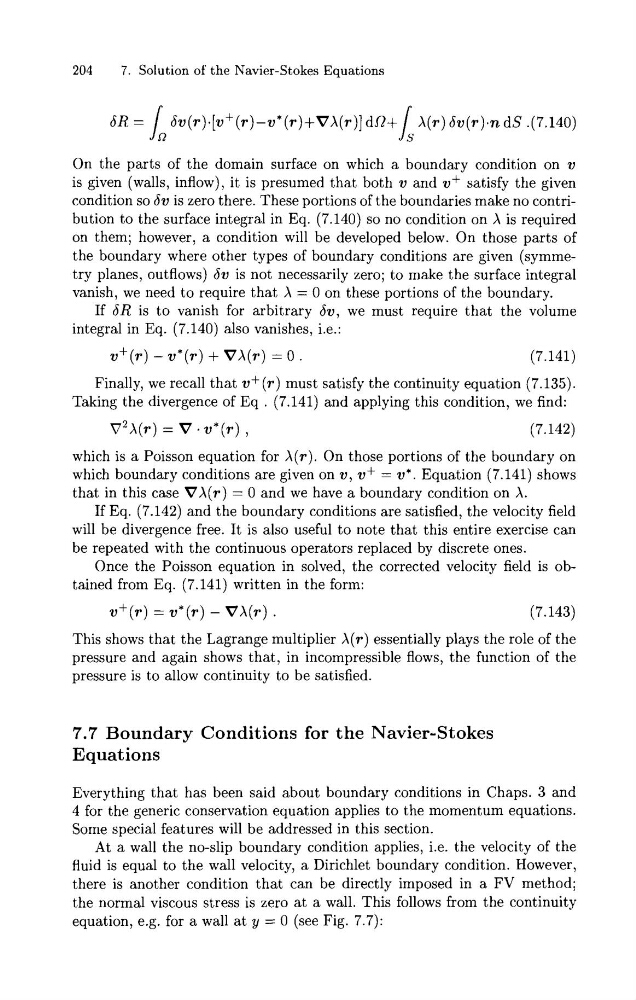
On the parts of the domain surface on which a boundary condition on v
is given (walls, inflow), it is presumed that both v and v+ satisfy the given
condition so 6v is zero there. These portions of the boundaries make no contribution to the surface integral in Eq. (7.140) so no condition on X is required
on them; however, a condition will be developed below. On those parts of
the boundary where other types of boundary conditions are given (symmetry planes, outflows) 6v is not necessarily zero; to make the surface integral
vanish, we need to require that X = 0 on these portions of the boundary.
If 6R is to vanish for arbitrary 6v, we must require that the volume
integral in Eq. (7.140) also vanishes, i.e.:
Finally, we recall that v + ( r ) must satisfy the continuity equation (7.135).
Taking the divergence of Eq . (7.141) and applying this condition, we find:
which is a Poisson equation for X(r). On those portions of the boundary on
which boundary conditions are given on v, v+ = v*. Equation (7.141) shows
that in this case VX(r) = 0 and we have a boundary condition on A.
If Eq. (7.142) and the boundary conditions are satisfied, the velocity field
will be divergence free. It is also useful to note that this entire exercise can
be repeated with the continuous operators replaced by discrete ones.
Once the Poisson equation in solved, the corrected velocity field is obtained from Eq. (7.141) written in the form:
This shows that the Lagrange multiplier X(r) essentially plays the role of the
pressure and again shows that, in incompressible flows, the function of the
pressure is to allow continuity to be satisfied.
7.7 Boundary Conditions for the Navier-Stokes
Equations
Everything that has been said about boundary conditions in Chaps. 3 and
4 for the generic conservation equation applies to the momentum equations.
Some special features will be addressed in this section.
At a wall the no-slip boundary condition applies, i.e. the velocity of the
fluid is equal to the wall velocity, a Dirichlet boundary condition. However,
there is another condition that can be directly imposed in a FV method;
the normal viscous stress is zero at a wall. This follows from the continuity
equation, e.g. for a wall at y = 0 (see Fig. 7.7):
7. Solution of the Navier-Stokes Equations
On the parts of the domain surface on which a boundary condition on v
is given (walls, inflow), it is presumed that both v and v+ satisfy the given
condition so 6v is zero there. These portions of the boundaries make no contribution to the surface integral in Eq. (7.140) so no condition on X is required
on them; however, a condition will be developed below. On those parts of
the boundary where other types of boundary conditions are given (symmetry planes, outflows) 6v is not necessarily zero; to make the surface integral
vanish, we need to require that X = 0 on these portions of the boundary.
If 6R is to vanish for arbitrary 6v, we must require that the volume
integral in Eq. (7.140) also vanishes, i.e.:
Finally, we recall that v + ( r ) must satisfy the continuity equation (7.135).
Taking the divergence of Eq . (7.141) and applying this condition, we find:
which is a Poisson equation for X(r). On those portions of the boundary on
which boundary conditions are given on v, v+ = v*. Equation (7.141) shows
that in this case VX(r) = 0 and we have a boundary condition on A.
If Eq. (7.142) and the boundary conditions are satisfied, the velocity field
will be divergence free. It is also useful to note that this entire exercise can
be repeated with the continuous operators replaced by discrete ones.
Once the Poisson equation in solved, the corrected velocity field is obtained from Eq. (7.141) written in the form:
This shows that the Lagrange multiplier X(r) essentially plays the role of the
pressure and again shows that, in incompressible flows, the function of the
pressure is to allow continuity to be satisfied.
7.7 Boundary Conditions for the Navier-Stokes
Equations
Everything that has been said about boundary conditions in Chaps. 3 and
4 for the generic conservation equation applies to the momentum equations.
Some special features will be addressed in this section.
At a wall the no-slip boundary condition applies, i.e. the velocity of the
fluid is equal to the wall velocity, a Dirichlet boundary condition. However,
there is another condition that can be directly imposed in a FV method;
the normal viscous stress is zero at a wall. This follows from the continuity
equation, e.g. for a wall at y = 0 (see Fig. 7.7):