

202
7. Solution of the Navier-Stokes Equations
In a second order scheme, the pressure derivative at the cell face is calculated
using CDS, see Eq. (7.125). If the CDS approximation (7.125) is used on nonuniform grids, the cell-center pressure gradients should be interpolated with
weights 112, since this approximation does not 'see' the grid non-uniformity.
The correction will be large if the pressure oscillates rapidly; the third
derivative is then large and will activate the pressure-correction and smooth
out the pressure.
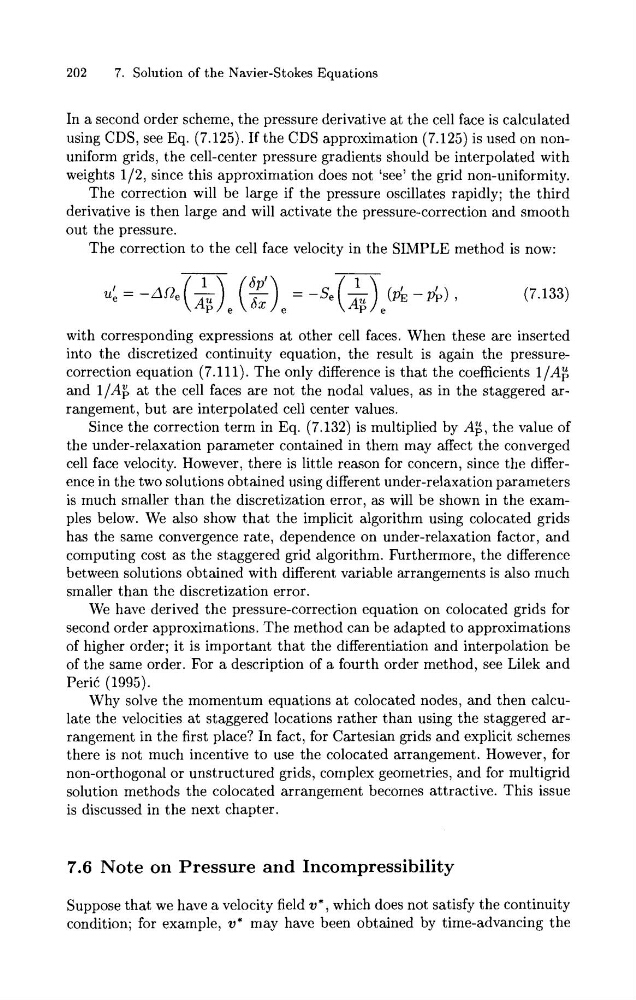
The correction to the cell face velocity in the SIMPLE method is now:
with corresponding expressions at other cell faces. When these are inserted
into the discretized continuity equation, the result is again the pressurecorrection equation (7.1 11). The only difference is that the coefficients 1/A;
and 1/Ag at the cell faces are not the nodal values, as in the staggered arrangement, but are interpolated cell center values.
Since the correction term in Eq. (7.132) is multiplied by A;, the value of
the under-relaxation parameter contained in them may affect the converged
cell face velocity. However, there is little reason for concern, since the difference in the two solutions obtained using different under-relaxation parameters
is much smaller than the discretization error, as will be shown in the examples below. We also show that the implicit algorithm using colocated grids
has the same convergence rate, dependence on under-relaxation factor, and
computing cost as the staggered grid algorithm. Furthermore, the difference
between solutions obtained with different variable arrangements is also much
smaller than the discretization error.
We have derived the pressure-correction equation on colocated grids for
second order approximations. The method can be adapted to approximations
of higher order; it is important that the differentiation and interpolation be
of the same order. For a description of a fourth order method, see Lilek and
PeriC (1995).
Why solve the momentum equations a t colocated nodes, and then calculate the velocities at staggered locations rather than using the staggered arrangement in the first place? In fact, for Cartesian grids and explicit schemes
there is not much incentive to use the colocated arrangement. However, for
non-orthogonal or unstructured grids, complex geometries, and for multigrid
solution methods the colocated arrangement becomes attractive. This issue
is discussed in the next chapter.
7.6 Note on Pressure and Incompressibility
Suppose that we have a velocity field v*, which does not satisfy the continuity
condition; for example, v* may have been obtained by time-advancing the
7. Solution of the Navier-Stokes Equations
In a second order scheme, the pressure derivative at the cell face is calculated
using CDS, see Eq. (7.125). If the CDS approximation (7.125) is used on nonuniform grids, the cell-center pressure gradients should be interpolated with
weights 112, since this approximation does not 'see' the grid non-uniformity.
The correction will be large if the pressure oscillates rapidly; the third
derivative is then large and will activate the pressure-correction and smooth
out the pressure.
The correction to the cell face velocity in the SIMPLE method is now:
with corresponding expressions at other cell faces. When these are inserted
into the discretized continuity equation, the result is again the pressurecorrection equation (7.1 11). The only difference is that the coefficients 1/A;
and 1/Ag at the cell faces are not the nodal values, as in the staggered arrangement, but are interpolated cell center values.
Since the correction term in Eq. (7.132) is multiplied by A;, the value of
the under-relaxation parameter contained in them may affect the converged
cell face velocity. However, there is little reason for concern, since the difference in the two solutions obtained using different under-relaxation parameters
is much smaller than the discretization error, as will be shown in the examples below. We also show that the implicit algorithm using colocated grids
has the same convergence rate, dependence on under-relaxation factor, and
computing cost as the staggered grid algorithm. Furthermore, the difference
between solutions obtained with different variable arrangements is also much
smaller than the discretization error.
We have derived the pressure-correction equation on colocated grids for
second order approximations. The method can be adapted to approximations
of higher order; it is important that the differentiation and interpolation be
of the same order. For a description of a fourth order method, see Lilek and
PeriC (1995).
Why solve the momentum equations a t colocated nodes, and then calculate the velocities at staggered locations rather than using the staggered arrangement in the first place? In fact, for Cartesian grids and explicit schemes
there is not much incentive to use the colocated arrangement. However, for
non-orthogonal or unstructured grids, complex geometries, and for multigrid
solution methods the colocated arrangement becomes attractive. This issue
is discussed in the next chapter.
7.6 Note on Pressure and Incompressibility
Suppose that we have a velocity field v*, which does not satisfy the continuity
condition; for example, v* may have been obtained by time-advancing the