

7.5 Solution Methods for the Navier-Stokes Equations
201
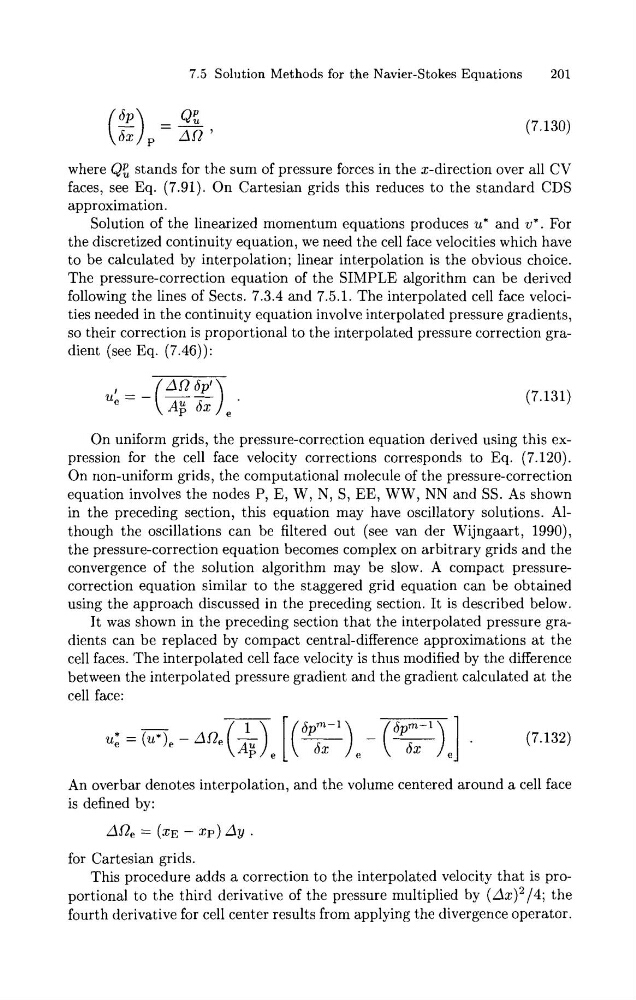
where QP, stands for the sum of pressure forces in the x-direction over all CV
faces, see Eq. (7.91). On Cartesian grids this reduces to the standard CDS
approximation.
Solution of the linearized momentum equations produces u* and v*. For
the discretized continuity equation, we need the cell face velocities which have
to be calculated by interpolation; linear interpolation is the obvious choice.
The pressure-correction equation of the SIMPLE algorithm can be derived
following the lines of Sects. 7.3.4 and 7.5.1. The interpolated cell face velocities needed in the continuity equation involve interpolated pressure gradients,
so their correction is proportional to the interpolated pressure correction gradient (see Eq. (7.46)):
On uniform grids, the pressure-correction equation derived using this expression for the cell face velocity corrections corresponds to Eq. (7.120).
On non-uniform grids, the computational molecule of the pressure-correction
equation involves the nodes P, E, W, N, S, EE, WW, NN and SS. As shown
in the preceding section, this equation may have oscillatory solutions. Although the oscillations can be filtered out (see van der Wijngaart, 1990),
the pressure-correction equation becomes complex on arbitrary grids and the
convergence of the solution algorithm may be slow. A compact pressurecorrection equation similar to the staggered grid equation can be obtained
using the approach discussed in the preceding section. It is described below.
It was shown in the preceding section that the interpolated pressure gradients can be replaced by compact central-difference approximations a t the
cell faces. The interpolated cell face velocity is thus modified by the difference
between the interpolated pressure gradient and the gradient calculated at the
cell face:
An overbar denotes interpolation, and the volume centered around a cell face
is defined by:
for Cartesian grids.
This procedure adds a correction to the interpolated velocity that is proportional to the third derivative of the pressure multiplied by AX)^/^; the
fourth derivative for cell center results from applying the divergence operator.
201
where QP, stands for the sum of pressure forces in the x-direction over all CV
faces, see Eq. (7.91). On Cartesian grids this reduces to the standard CDS
approximation.
Solution of the linearized momentum equations produces u* and v*. For
the discretized continuity equation, we need the cell face velocities which have
to be calculated by interpolation; linear interpolation is the obvious choice.
The pressure-correction equation of the SIMPLE algorithm can be derived
following the lines of Sects. 7.3.4 and 7.5.1. The interpolated cell face velocities needed in the continuity equation involve interpolated pressure gradients,
so their correction is proportional to the interpolated pressure correction gradient (see Eq. (7.46)):
On uniform grids, the pressure-correction equation derived using this expression for the cell face velocity corrections corresponds to Eq. (7.120).
On non-uniform grids, the computational molecule of the pressure-correction
equation involves the nodes P, E, W, N, S, EE, WW, NN and SS. As shown
in the preceding section, this equation may have oscillatory solutions. Although the oscillations can be filtered out (see van der Wijngaart, 1990),
the pressure-correction equation becomes complex on arbitrary grids and the
convergence of the solution algorithm may be slow. A compact pressurecorrection equation similar to the staggered grid equation can be obtained
using the approach discussed in the preceding section. It is described below.
It was shown in the preceding section that the interpolated pressure gradients can be replaced by compact central-difference approximations a t the
cell faces. The interpolated cell face velocity is thus modified by the difference
between the interpolated pressure gradient and the gradient calculated at the
cell face:
An overbar denotes interpolation, and the volume centered around a cell face
is defined by:
for Cartesian grids.
This procedure adds a correction to the interpolated velocity that is proportional to the third derivative of the pressure multiplied by AX)^/^; the
fourth derivative for cell center results from applying the divergence operator.