

200
7. Solution of the Navier-Stokes Equations
Use of this approximation eliminates the oscillation in the pressure field but,
in order to accomplish this, we have introduced an inconsistency in the treatment of the pressure gradient in the momentum and pressure equations. Let
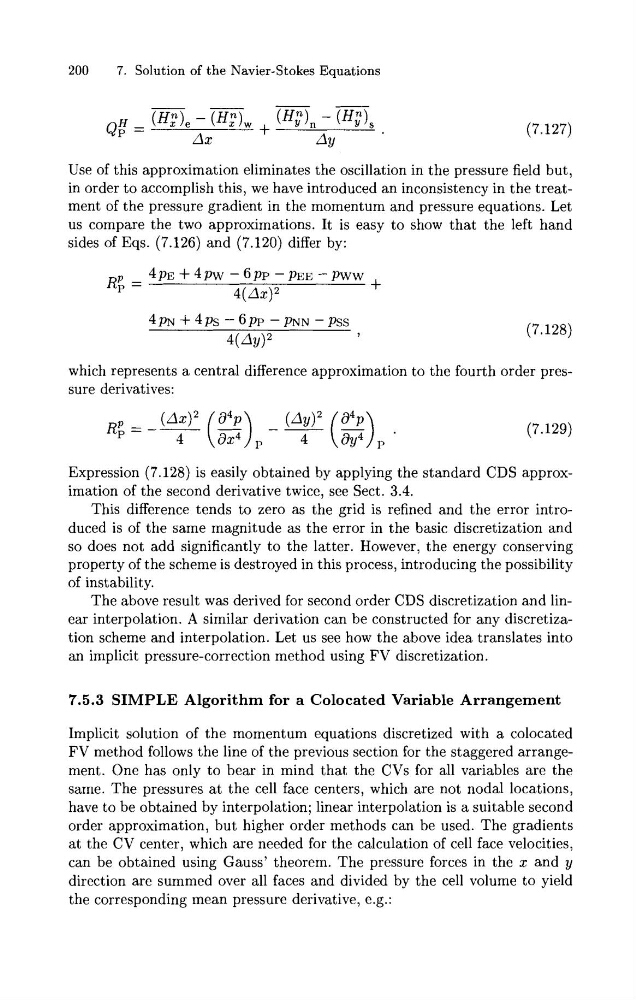
us compare the two approximations. It is easy to show that the left hand
sides of Eqs. (7.126) and (7.120) differ by:
which represents a central difference approximation to the fourth order pressure derivatives:
Expression (7.128) is easily obtained by applying the standard CDS approximation of the second derivative twice, see Sect. 3.4.
This difference tends to zero as the grid is refined and the error introduced is of the same magnitude as the error in the basic discretization and
so does not add significantly to the latter. However, the energy conserving
property of the scheme is destroyed in this process, introducing the possibility
of instability.
The above result was derived for second order CDS discretization and linear interpolation. A similar derivation can be constructed for any discretization scheme and interpolation. Let us see how the above idea translates into
an implicit pressure-correction method using FV discretization.
7.5.3 SIMPLE Algorithm for a Colocated Variable Arrangement
Implicit solution of the momentum equations discretized with a colocated
FV method follows the line of the previous section for the staggered arrangement. One has only to bear in mind that the CVs for all variables are the
same. The pressures a t the cell face centers, which are not nodal locations,
have to be obtained by interpolation; linear interpolation is a suitable second
order approximation, but higher order methods can be used. The gradients
at the CV center, which are needed for the calculation of cell face velocities,
can be obtained using Gauss' theorem. The pressure forces in the x and y
direction are summed over all faces and divided by the cell volume to yield
the corresponding mean pressure derivative, e.g.:
7. Solution of the Navier-Stokes Equations
Use of this approximation eliminates the oscillation in the pressure field but,
in order to accomplish this, we have introduced an inconsistency in the treatment of the pressure gradient in the momentum and pressure equations. Let
us compare the two approximations. It is easy to show that the left hand
sides of Eqs. (7.126) and (7.120) differ by:
which represents a central difference approximation to the fourth order pressure derivatives:
Expression (7.128) is easily obtained by applying the standard CDS approximation of the second derivative twice, see Sect. 3.4.
This difference tends to zero as the grid is refined and the error introduced is of the same magnitude as the error in the basic discretization and
so does not add significantly to the latter. However, the energy conserving
property of the scheme is destroyed in this process, introducing the possibility
of instability.
The above result was derived for second order CDS discretization and linear interpolation. A similar derivation can be constructed for any discretization scheme and interpolation. Let us see how the above idea translates into
an implicit pressure-correction method using FV discretization.
7.5.3 SIMPLE Algorithm for a Colocated Variable Arrangement
Implicit solution of the momentum equations discretized with a colocated
FV method follows the line of the previous section for the staggered arrangement. One has only to bear in mind that the CVs for all variables are the
same. The pressures a t the cell face centers, which are not nodal locations,
have to be obtained by interpolation; linear interpolation is a suitable second
order approximation, but higher order methods can be used. The gradients
at the CV center, which are needed for the calculation of cell face velocities,
can be obtained using Gauss' theorem. The pressure forces in the x and y
direction are summed over all faces and divided by the cell volume to yield
the corresponding mean pressure derivative, e.g.: