

7.5 Solution Methods for the Navier-Stokes Equations
197
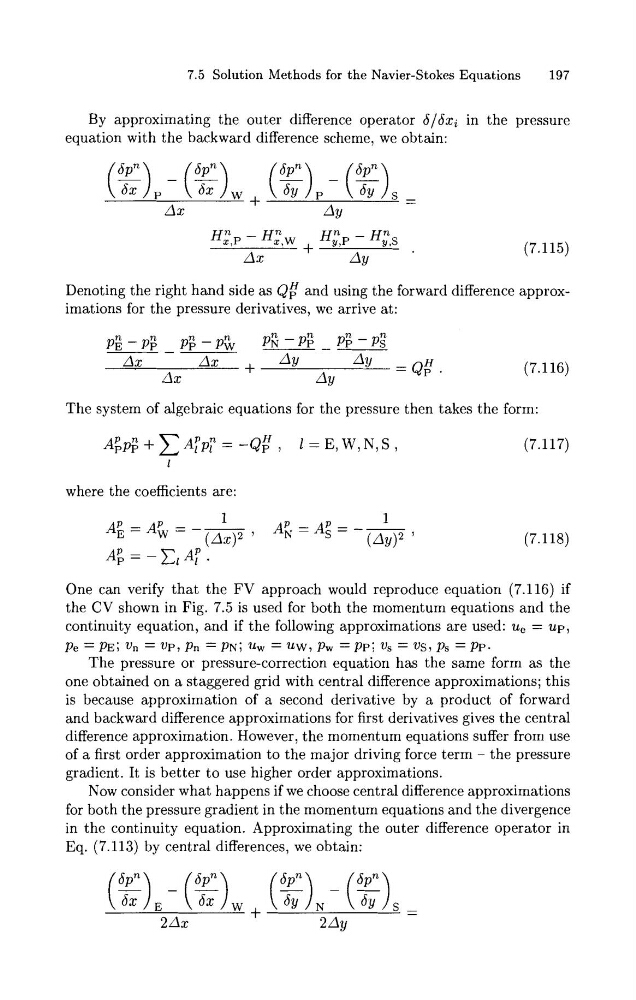
By approximating the outer difference operator 6/6xi in the pressure
equation with the backward difference scheme, we obtain:
Denoting the right hand side as Q ~ H and using the forward difference approximations for the pressure derivatives, we arrive at:
The system of algebraic equations for the pressure then takes the form:
where the coefficients are:
One can verify that the FV approach would reproduce equation (7.116) if
the CV shown in Fig. 7.5 is used for both the momentum equations and the
continuity equation, and if the following approximations are used: u, = up,
Pe = PE; Vn = UP, Pn = PN; uw = UW, Pw = PP; vs = US, Ps = PP.
The pressure or pressure-correction equation has the same form as the
one obtained on a staggered grid with central difference approximations; this
is because approximation of a second derivative by a product of forward
and backward difference approximations for first derivatives gives the central
difference approximation. However, the momentum equations suffer from use
of a first order approximation to the major driving force term - the pressure
gradient. It is better to use higher order approximations.
Now consider what happens if we choose central difference approximations
for both the pressure gradient in the momentum equations and the divergence
in the continuity equation. Approximating the outer difference operator in
Eq. (7.113) by central differences, we obtain:
197
By approximating the outer difference operator 6/6xi in the pressure
equation with the backward difference scheme, we obtain:
Denoting the right hand side as Q ~ H and using the forward difference approximations for the pressure derivatives, we arrive at:
The system of algebraic equations for the pressure then takes the form:
where the coefficients are:
One can verify that the FV approach would reproduce equation (7.116) if
the CV shown in Fig. 7.5 is used for both the momentum equations and the
continuity equation, and if the following approximations are used: u, = up,
Pe = PE; Vn = UP, Pn = PN; uw = UW, Pw = PP; vs = US, Ps = PP.
The pressure or pressure-correction equation has the same form as the
one obtained on a staggered grid with central difference approximations; this
is because approximation of a second derivative by a product of forward
and backward difference approximations for first derivatives gives the central
difference approximation. However, the momentum equations suffer from use
of a first order approximation to the major driving force term - the pressure
gradient. It is better to use higher order approximations.
Now consider what happens if we choose central difference approximations
for both the pressure gradient in the momentum equations and the divergence
in the continuity equation. Approximating the outer difference operator in
Eq. (7.113) by central differences, we obtain: