

196
7. Solution of the Navier-Stokes Equations
Discretizations of higher order are easily incorporated into the above solution strategy. The implementation of boundary conditions will be described
after discussing the solution methods using colocated arrangement of variables.
7.5.2 Treatment of Pressure for Colocated Variables
It was mentioned earlier that a colocated arrangement of variables on a numerical grid creates problems which caused it to be out of favor until recently.
Here, we shall first show why the problems occur and then present a cure.
We start by looking a t a finite-difference scheme and the simple timeadvance method presented in Sect. 7.3.2. There we derived the discrete Poisson equation for the pressure, which can be written:
where H," is the shorthand notation for the sum of the advective and viscous
terms:
(summation on j is implied). The discretization scheme used to approximate
the derivatives is not important in Eq. (7.113), that is why symbolic notation
is used. Also, the equation is not specific to any grid arrangement.
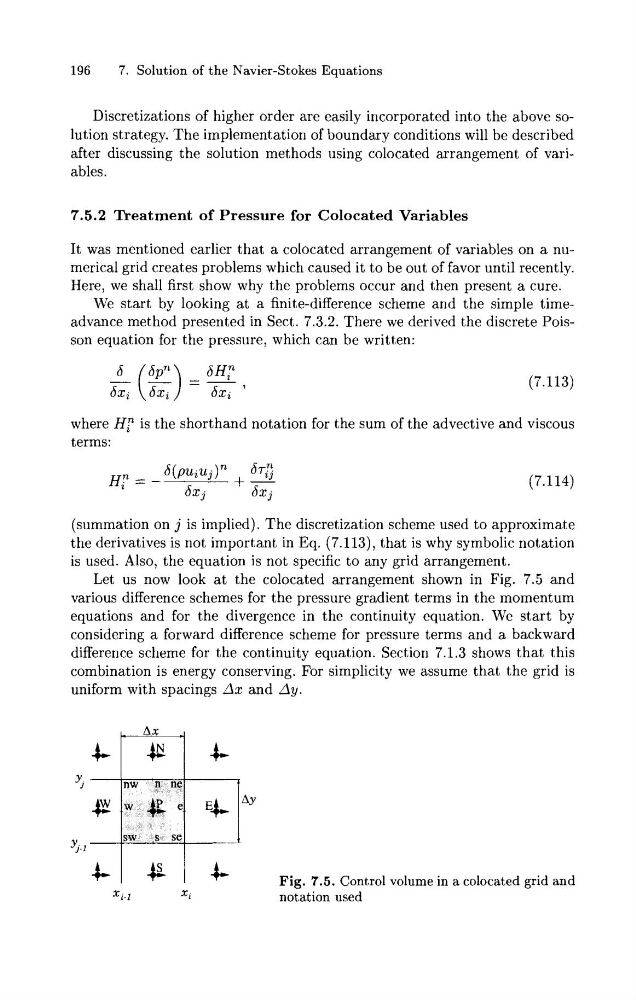
Let us now look a t the colocated arrangement shown in Fig. 7.5 and
various difference schemes for the pressure gradient terms in the momentum
equations and for the divergence in the continuity equation. We start by
considering a forward difference scheme for pressure terms and a backward
difference scheme for the continuity equation. Section 7.1.3 shows that this
combination is energy conserving. For simplicity we assume that the grid is
uniform with spacings Ax and Ay.
1 * 1 Fig. 1.5. Control volume in a colocated grid and
X L - I
X ,
notation used
7. Solution of the Navier-Stokes Equations
Discretizations of higher order are easily incorporated into the above solution strategy. The implementation of boundary conditions will be described
after discussing the solution methods using colocated arrangement of variables.
7.5.2 Treatment of Pressure for Colocated Variables
It was mentioned earlier that a colocated arrangement of variables on a numerical grid creates problems which caused it to be out of favor until recently.
Here, we shall first show why the problems occur and then present a cure.
We start by looking a t a finite-difference scheme and the simple timeadvance method presented in Sect. 7.3.2. There we derived the discrete Poisson equation for the pressure, which can be written:
where H," is the shorthand notation for the sum of the advective and viscous
terms:
(summation on j is implied). The discretization scheme used to approximate
the derivatives is not important in Eq. (7.113), that is why symbolic notation
is used. Also, the equation is not specific to any grid arrangement.
Let us now look a t the colocated arrangement shown in Fig. 7.5 and
various difference schemes for the pressure gradient terms in the momentum
equations and for the divergence in the continuity equation. We start by
considering a forward difference scheme for pressure terms and a backward
difference scheme for the continuity equation. Section 7.1.3 shows that this
combination is energy conserving. For simplicity we assume that the grid is
uniform with spacings Ax and Ay.
1 * 1 Fig. 1.5. Control volume in a colocated grid and
X L - I
X ,
notation used