

70
2 Water at Rest and in Motion
2.7.2 Laminar Flow in Ducts
Consider a long, straight pipe with a circular cross-section and constant diameter D. Fluid enters the pipe upstream and flows steadily through it. Let
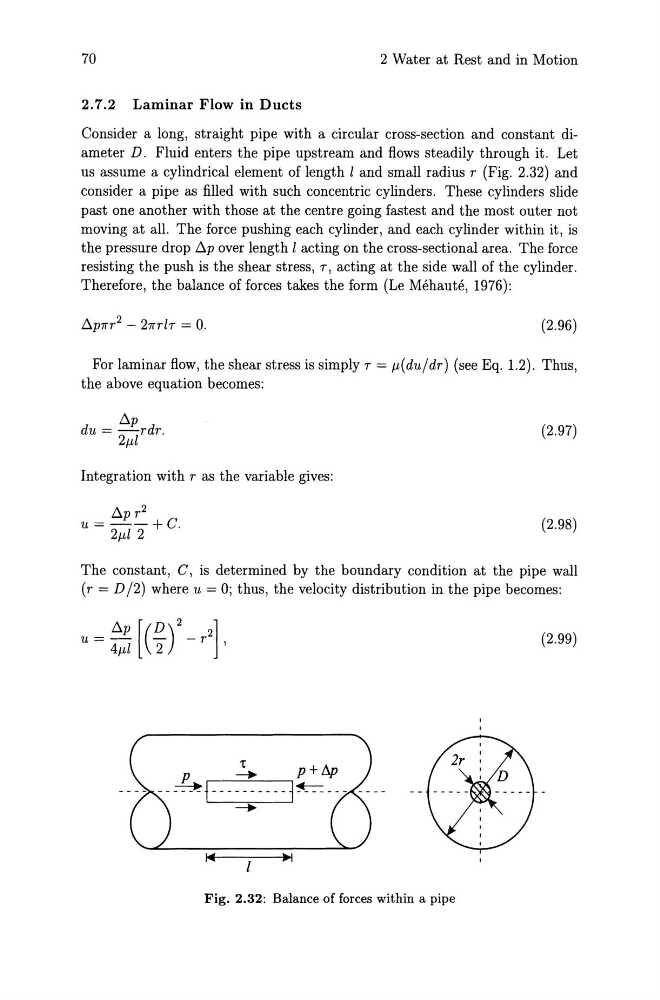
us assume a cylindrical element of length I and small radius r (Fig. 2.32) and
consider a pipe as filled with such concentric cylinders. These cylinders slide
past one another with those at the centre going fastest and the most outer not
moving at all. The force pushing each cylinder, and each cylinder within it, is
the pressure drop /:1p over length I acting on the cross-sectional area. The force
resisting the push is the shear stress, T, acting at the side wall of the cylinder.
Therefore, the balance of forces takes the form (Le Mehaute, 1976):
(2.96)
For laminar flow, the shear stress is simply T = J-L(du/dr) (see Eq. 1.2). Thus,
the above equation becomes:
/:1p
du = -rdr.
2J-Ll
Integration with r as the variable gives:
/:1p r2
u = --+c.
2J-Ll 2
(2.97)
(2.98)
The constant, C, is determined by the boundary condition at the pipe wall
(r = D /2) where u = 0; thus, the velocity distribution in the pipe becomes:
(2.99)
p
...::..
p + /).p
--~ t ----------~~ ------.
I ..
I
Fig. 2.32: Balance of forces within a pipe
2 Water at Rest and in Motion
2.7.2 Laminar Flow in Ducts
Consider a long, straight pipe with a circular cross-section and constant diameter D. Fluid enters the pipe upstream and flows steadily through it. Let
us assume a cylindrical element of length I and small radius r (Fig. 2.32) and
consider a pipe as filled with such concentric cylinders. These cylinders slide
past one another with those at the centre going fastest and the most outer not
moving at all. The force pushing each cylinder, and each cylinder within it, is
the pressure drop /:1p over length I acting on the cross-sectional area. The force
resisting the push is the shear stress, T, acting at the side wall of the cylinder.
Therefore, the balance of forces takes the form (Le Mehaute, 1976):
(2.96)
For laminar flow, the shear stress is simply T = J-L(du/dr) (see Eq. 1.2). Thus,
the above equation becomes:
/:1p
du = -rdr.
2J-Ll
Integration with r as the variable gives:
/:1p r2
u = --+c.
2J-Ll 2
(2.97)
(2.98)
The constant, C, is determined by the boundary condition at the pipe wall
(r = D /2) where u = 0; thus, the velocity distribution in the pipe becomes:
(2.99)
p
...::..
p + /).p
--~ t ----------~~ ------.
I ..
I
Fig. 2.32: Balance of forces within a pipe