

48
LO 1.0
"- N
0
0.9
<..l
§
.... 0.8
en
:a
"0 0.7
0
N
;;
0.6
E 0
Z 0.5
0.4
0.3
0.2
0.1
0.0
0.0
0= 0.1 m
d= 0.001 m
0.5
1.0
1.5
2 Water at Rest and in Motion
2.0
2.5
3.0
Normalized velocity difference
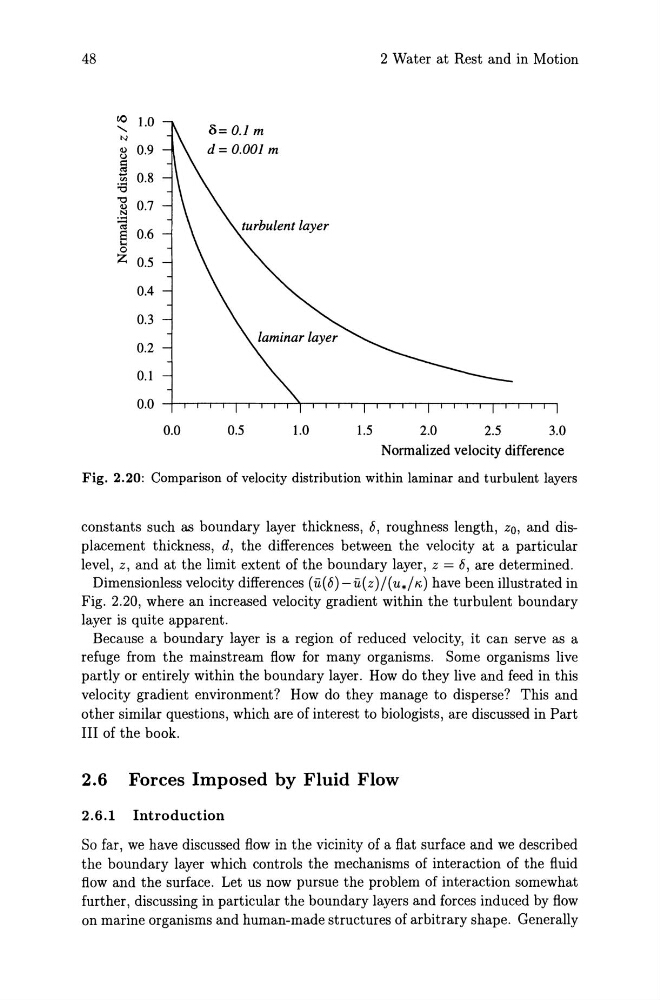
Fig. 2.20: Comparison of velocity distribution within laminar and turbulent layers
constants such as boundary layer thickness, 8, roughness length, zo, and displacement thickness, d, the differences between the velocity at a particular
level, z, and at the limit extent of the boundary layer, z = 8, are determined.
Dimensionless velocity differences (u(8)-u(z)/(U./K) have been illustrated in
Fig. 2.20, where an increased velocity gradient within the turbulent boundary
layer is quite apparent.
Because a boundary layer is a region of reduced velocity, it can serve as a
refuge from the mainstream flow for many organisms. Some organisms live
partly or entirely within the boundary layer. How do they live and feed in this
velocity gradient environment? How do they manage to disperse? This and
other similar questions, which are of interest to biologists, are discussed in Part
III of the book.
2.6 Forces Imposed by Fluid Flow
2.6.1 Introduction
So far, we have discussed flow in the vicinity of a flat surface and we described
the boundary layer which controls the mechanisms of interaction of the fluid
flow and the surface. Let us now pursue the problem of interaction somewhat
further, discussing in particular the boundary layers and forces induced by flow
on marine organisms and human-made structures of arbitrary shape. Generally
LO 1.0
"- N
0
0.9
<..l
§
.... 0.8
en
:a
"0 0.7
0
N
;;
0.6
E 0
Z 0.5
0.4
0.3
0.2
0.1
0.0
0.0
0= 0.1 m
d= 0.001 m
0.5
1.0
1.5
2 Water at Rest and in Motion
2.0
2.5
3.0
Normalized velocity difference
Fig. 2.20: Comparison of velocity distribution within laminar and turbulent layers
constants such as boundary layer thickness, 8, roughness length, zo, and displacement thickness, d, the differences between the velocity at a particular
level, z, and at the limit extent of the boundary layer, z = 8, are determined.
Dimensionless velocity differences (u(8)-u(z)/(U./K) have been illustrated in
Fig. 2.20, where an increased velocity gradient within the turbulent boundary
layer is quite apparent.
Because a boundary layer is a region of reduced velocity, it can serve as a
refuge from the mainstream flow for many organisms. Some organisms live
partly or entirely within the boundary layer. How do they live and feed in this
velocity gradient environment? How do they manage to disperse? This and
other similar questions, which are of interest to biologists, are discussed in Part
III of the book.
2.6 Forces Imposed by Fluid Flow
2.6.1 Introduction
So far, we have discussed flow in the vicinity of a flat surface and we described
the boundary layer which controls the mechanisms of interaction of the fluid
flow and the surface. Let us now pursue the problem of interaction somewhat
further, discussing in particular the boundary layers and forces induced by flow
on marine organisms and human-made structures of arbitrary shape. Generally