

2.5 Boundary Layer Flows
47
u(z)
o~ ______________________________________ ~
~
~
..s
~
~
..s
In IZ - d l - - - - - -,
\' J
I
, 1
, , '
~ .. ~------------------------~
lnz ' ~
u(z) - u(z)
o
extrapolation
-I
In (z - d)
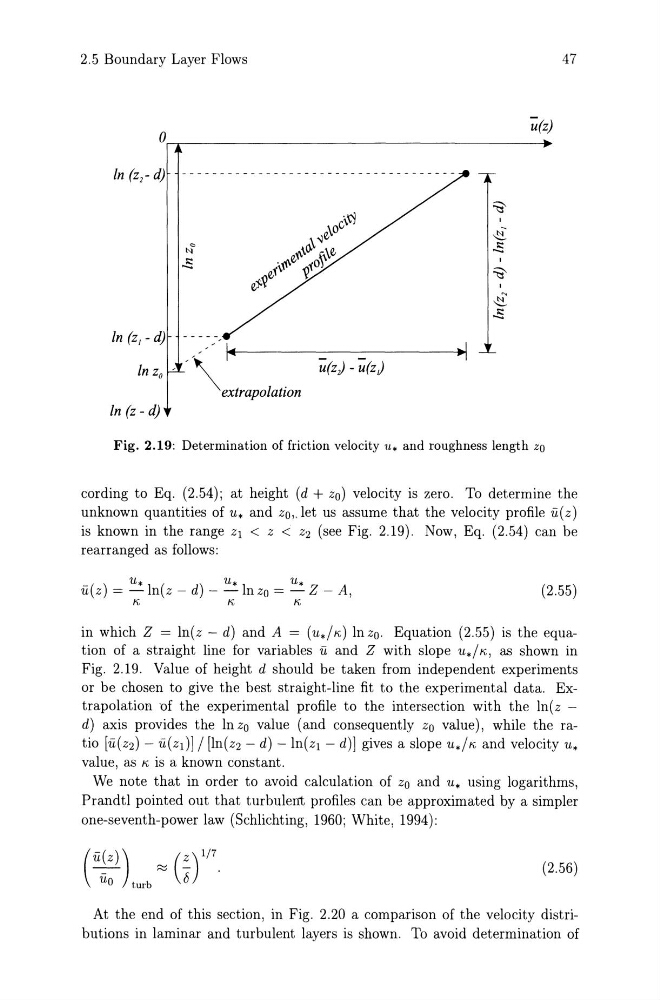
Fig. 2.19: Determination of friction velocity 1L. and roughness length zo
cording to Eq. (2.54); at height (d + zo) velocity is zero. To determine the
unknown quantities of u. and zo,Jet us assume that the velocity profile u(z)
is known in the range Zl < z < Z2 (see Fig. 2.19). Now, Eq. (2.54) can be
rearranged as follows:
u.
u.
u.
u(z) = -In(z - d) - -lnzo = - Z - A,
~
~
~
(2.55)
in which Z = In(z - d) and A = (u./~) lnzo. Equation (2.55) is the equation of a straight line for variables u and Z with slope u./~, as shown in
Fig. 2.19. Value of height d should be taken from independent experiments
or be chosen to give the best straight-line fit to the experimental data. Extrapolation Df the experimental profile to the intersection with the In(z -
d) axis provides the In Zo value (and consequently Zo value), while the ratio [U(Z2) - uh)] / [In(z2 - d) -In(zl - d)] gives a slope u./~ and velocity u.
value, as ~ is a known constant.
We note that in order to avoid calculation of Zo and u. using logarithms,
Prandtl pointed out that turbulent profiles can be approximated by a simpler
one-seventh-power law (Schlichting, 1960; White, 1994):
(2.56)
At the end of this section, in Fig. 2.20 a comparison of the velocity distributions in laminar and turbulent layers is shown. To avoid determination of
47
u(z)
o~ ______________________________________ ~
~
~
..s
~
~
..s
In IZ - d l - - - - - -,
\' J
I
, 1
, , '
~ .. ~------------------------~
lnz ' ~
u(z) - u(z)
o
extrapolation
-I
In (z - d)
Fig. 2.19: Determination of friction velocity 1L. and roughness length zo
cording to Eq. (2.54); at height (d + zo) velocity is zero. To determine the
unknown quantities of u. and zo,Jet us assume that the velocity profile u(z)
is known in the range Zl < z < Z2 (see Fig. 2.19). Now, Eq. (2.54) can be
rearranged as follows:
u.
u.
u.
u(z) = -In(z - d) - -lnzo = - Z - A,
~
~
~
(2.55)
in which Z = In(z - d) and A = (u./~) lnzo. Equation (2.55) is the equation of a straight line for variables u and Z with slope u./~, as shown in
Fig. 2.19. Value of height d should be taken from independent experiments
or be chosen to give the best straight-line fit to the experimental data. Extrapolation Df the experimental profile to the intersection with the In(z -
d) axis provides the In Zo value (and consequently Zo value), while the ratio [U(Z2) - uh)] / [In(z2 - d) -In(zl - d)] gives a slope u./~ and velocity u.
value, as ~ is a known constant.
We note that in order to avoid calculation of Zo and u. using logarithms,
Prandtl pointed out that turbulent profiles can be approximated by a simpler
one-seventh-power law (Schlichting, 1960; White, 1994):
(2.56)
At the end of this section, in Fig. 2.20 a comparison of the velocity distributions in laminar and turbulent layers is shown. To avoid determination of