

46
S 0.5
'-'
S
~ en 0.4
.&J
::s
en
s o
Cl.l
u
§
en
a 0.2
0.1
o
u.= 0.3 m/s
zo= 0.005 m
d= 0.05m
2
2 Water at Rest and in Motion
3
4
Velocity (mJs)
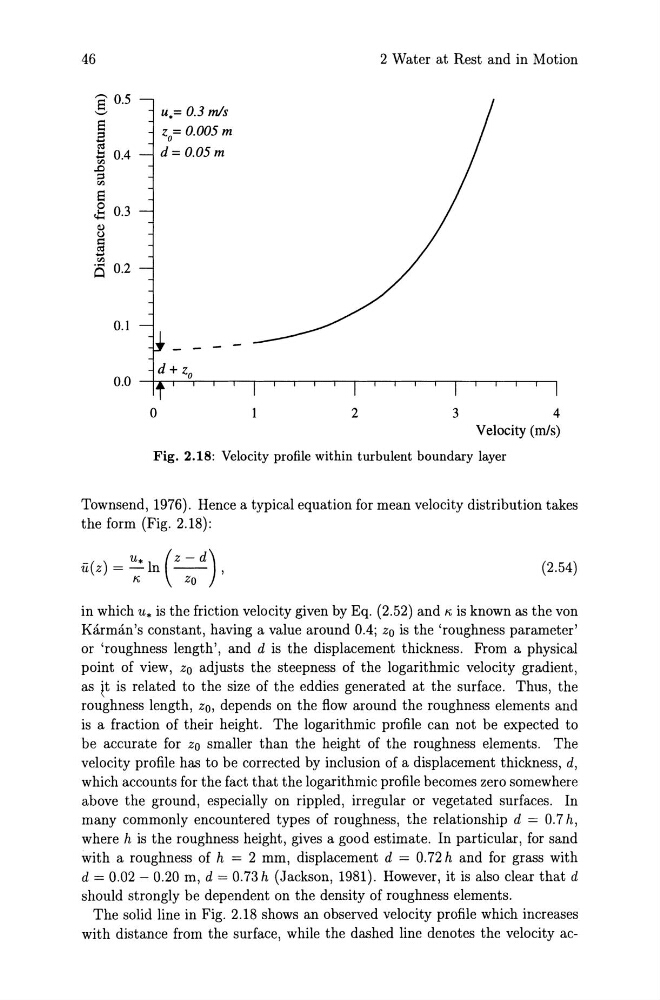
Fig. 2.18: Velocity profile within turbulent boundary layer
Townsend, 1976). Hence a typical equation for mean velocity distribution takes
the form (Fig. 2.18):
u (z - d)
u(z) = ~ln - - ,
K
Zo
(2.54)
in which u* is the friction velocity given by Eq. (2.52) and K is known as the von
Karman's constant, having a value around 0.4; Zo is the 'roughness parameter'
or 'roughness length', and d is the displacement thickness. From a physical
point of view, Zo adjusts the steepness of the logarithmic velocity gradient,
as tt is related to the size of the eddies generated at the surface. Thus, the
roughness length, zo, depends on the flow around the roughness elements and
is a fraction of their height. The logarithmic profile can not be expected to
be accurate for Zo smaller than the height of the roughness elements. The
velocity profile has to be corrected by inclusion of a displacement thickness, d,
which accounts for the fact that the logarithmic profile becomes zero somewhere
above the ground, especially on rippled, irregular or vegetated surfaces. In
many commonly encountered types of roughness, the relationship d = 0.7 h,
where h is the roughness height, gives a good estimate. In particular, for sand
with a roughness of h = 2 mm, displacement d = 0.72 h and for grass with
d = 0.02 - 0.20 m, d = O.73h (Jackson, 1981). However, it is also clear that d
should strongly be dependent on the density of roughness elements.
The solid line in Fig. 2.18 shows an observed velocity profile which increases
with distance from the surface, while the dashed line denotes the velocity ac-
S 0.5
'-'
S
~ en 0.4
.&J
::s
en
s o
Cl.l
u
§
en
a 0.2
0.1
o
u.= 0.3 m/s
zo= 0.005 m
d= 0.05m
2
2 Water at Rest and in Motion
3
4
Velocity (mJs)
Fig. 2.18: Velocity profile within turbulent boundary layer
Townsend, 1976). Hence a typical equation for mean velocity distribution takes
the form (Fig. 2.18):
u (z - d)
u(z) = ~ln - - ,
K
Zo
(2.54)
in which u* is the friction velocity given by Eq. (2.52) and K is known as the von
Karman's constant, having a value around 0.4; Zo is the 'roughness parameter'
or 'roughness length', and d is the displacement thickness. From a physical
point of view, Zo adjusts the steepness of the logarithmic velocity gradient,
as tt is related to the size of the eddies generated at the surface. Thus, the
roughness length, zo, depends on the flow around the roughness elements and
is a fraction of their height. The logarithmic profile can not be expected to
be accurate for Zo smaller than the height of the roughness elements. The
velocity profile has to be corrected by inclusion of a displacement thickness, d,
which accounts for the fact that the logarithmic profile becomes zero somewhere
above the ground, especially on rippled, irregular or vegetated surfaces. In
many commonly encountered types of roughness, the relationship d = 0.7 h,
where h is the roughness height, gives a good estimate. In particular, for sand
with a roughness of h = 2 mm, displacement d = 0.72 h and for grass with
d = 0.02 - 0.20 m, d = O.73h (Jackson, 1981). However, it is also clear that d
should strongly be dependent on the density of roughness elements.
The solid line in Fig. 2.18 shows an observed velocity profile which increases
with distance from the surface, while the dashed line denotes the velocity ac-