

2.5 Boundary Layer Flows
a z
smooth bed
turbulent layer
laminar
sublayer
--/ -
flow velocity
u
45
b z
rough bed
turbulent layer
flow velocity
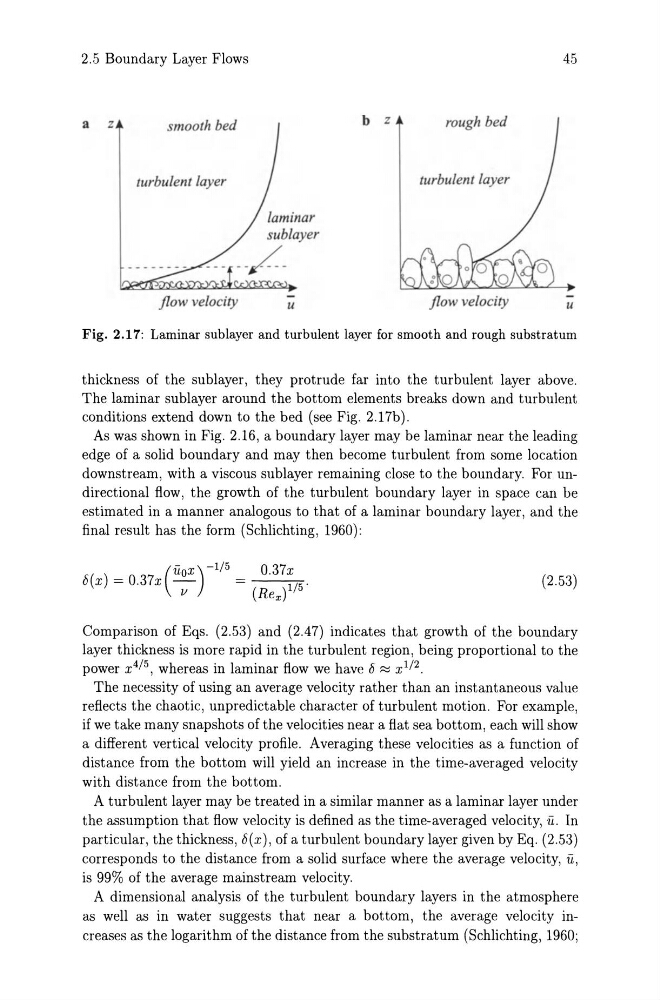
Fig. 2.17: Laminar sublayer and turbulent layer for smooth and rough substratum
thickness of the sublayer, they protrude far into the turbulent layer above.
The laminar sublayer around the bottom elements breaks down and turbulent
conditions extend down to the bed (see Fig. 2.17b).
As was shown in Fig. 2.16, a boundary layer may be laminar near the leading
edge of a solid boundary and may then become turbulent from some location
downstream, with a viscous sublayer remaining close to the boundary. For undirectional flow, the growth of the turbulent boundary layer in space can be
estimated in a manner analogous to that of a laminar boundary layer, and the
final result has the form (Schlichting, 1960):
(
iiOX)-1/5
0.37x
5(x) = 0.37x -
=
1/5'
II
(Rex)
(2.53)
Comparison of Eqs. (2.53) and (2.47) indicates that growth of the boundary
layer thickness is more rapid in the turbulent region, being proportional to the
power x 4 / 5 , whereas in laminar flow we have 5 ~ x 1 / 2 .
The necessity of using an average velocity rather than an instantaneous value
reflects the chaotic, unpredictable character of turbulent motion. For example,
if we take many snapshots of the velocities near a flat sea bottom, each will show
a different vertical velocity profile. Averaging these velocities as a function of
distance from the bottom will yield an increase in the time-averaged velocity
with distance from the bottom.
A turbulent layer may be treated in a similar manner as a laminar layer under
the assumption that flow velocity is defined as the time-averaged velocity, ii. In
particular, the thickness, 5(x), of a turbulent boundary layer given by Eq. (2.53)
corresponds to the distance from a solid surface where the average velocity, ii,
is 99% of the average mainstream velocity.
A dimensional analysis of the turbulent boundary layers in the atmosphere
as well as in water suggests that near a bottom, the average velocity increases as the logarithm of the distance from the substratum (Schlichting, 1960;
a z
smooth bed
turbulent layer
laminar
sublayer
--/ -
flow velocity
u
45
b z
rough bed
turbulent layer
flow velocity
Fig. 2.17: Laminar sublayer and turbulent layer for smooth and rough substratum
thickness of the sublayer, they protrude far into the turbulent layer above.
The laminar sublayer around the bottom elements breaks down and turbulent
conditions extend down to the bed (see Fig. 2.17b).
As was shown in Fig. 2.16, a boundary layer may be laminar near the leading
edge of a solid boundary and may then become turbulent from some location
downstream, with a viscous sublayer remaining close to the boundary. For undirectional flow, the growth of the turbulent boundary layer in space can be
estimated in a manner analogous to that of a laminar boundary layer, and the
final result has the form (Schlichting, 1960):
(
iiOX)-1/5
0.37x
5(x) = 0.37x -
=
1/5'
II
(Rex)
(2.53)
Comparison of Eqs. (2.53) and (2.47) indicates that growth of the boundary
layer thickness is more rapid in the turbulent region, being proportional to the
power x 4 / 5 , whereas in laminar flow we have 5 ~ x 1 / 2 .
The necessity of using an average velocity rather than an instantaneous value
reflects the chaotic, unpredictable character of turbulent motion. For example,
if we take many snapshots of the velocities near a flat sea bottom, each will show
a different vertical velocity profile. Averaging these velocities as a function of
distance from the bottom will yield an increase in the time-averaged velocity
with distance from the bottom.
A turbulent layer may be treated in a similar manner as a laminar layer under
the assumption that flow velocity is defined as the time-averaged velocity, ii. In
particular, the thickness, 5(x), of a turbulent boundary layer given by Eq. (2.53)
corresponds to the distance from a solid surface where the average velocity, ii,
is 99% of the average mainstream velocity.
A dimensional analysis of the turbulent boundary layers in the atmosphere
as well as in water suggests that near a bottom, the average velocity increases as the logarithm of the distance from the substratum (Schlichting, 1960;