

2.6 Forces Imposed by Fluid Flow
49
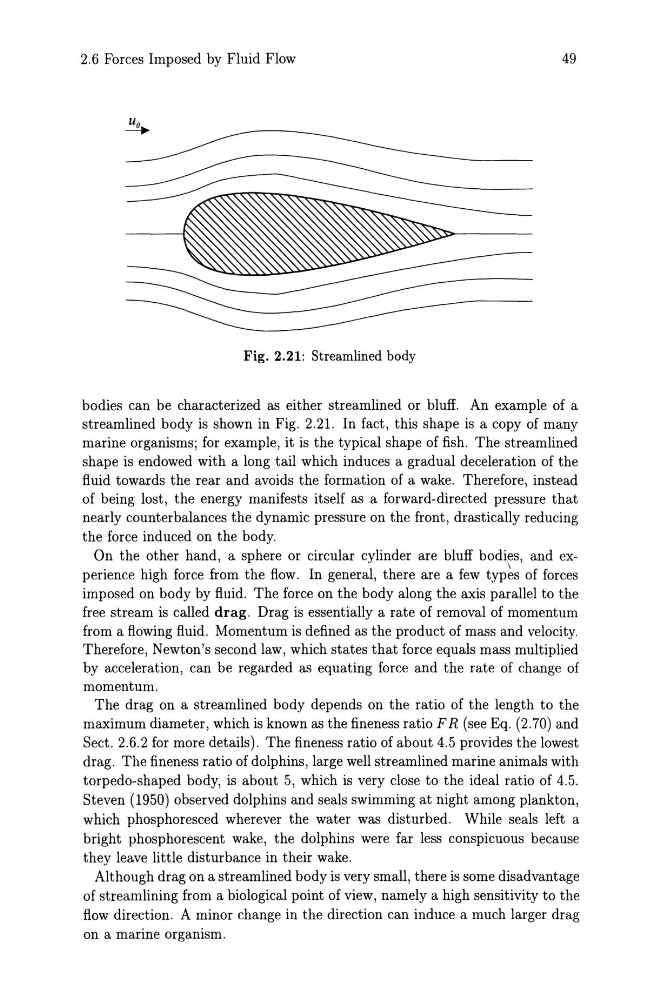
Fig. 2.21: Streamlined body
bodies can be characterized as either streamlined or bluff. An example of a
streamlined body is shown in Fig. 2.21. In fact, this shape is a copy of many
marine organisms; for example, it is the typical shape of fish. The streamlined
shape is endowed with a long tail which induces a gradual deceleration of the
fluid towards the rear and avoids the formation of a wake. Therefore, instead
of being lost, the energy manifests itself as a forward-directed pressure that
nearly counterbalances the dynamic pressure on the front, drastically reducing
the force induced on the body.
On the other hand, a sphere or circular cylinder are bluff bodies, and experience high force from the flow. In general, there are a few typ~s of forces
imposed on body by fluid. The force on the body along the axis parallel to the
free stream is called drag. Drag is essentially a rate of removal of momentum
from a flowing fluid. Momentum is defined as the product of mass and velocity.
Therefore, Newton's second law, which states that force equals mass multiplied
by acceleration, can be regarded as equating force and the rate of change of
momentum.
The drag on a streamlined body depends on the ratio of the length to the
maximum diameter, which is known as the fineness ratio F R (see Eq. (2.70) and
Sect. 2.6.2 for more details). The fineness ratio of about 4.5 provides the lowest
drag. The fineness ratio of dolphins, large well streamlined marine animals with
torpedo-shaped body, is about 5, which is very close to the ideal ratio of 4.5.
Steven (1950) observed dolphins and seals swimming at night among plankton,
which phosphoresced wherever the water was disturbed. While seals left a
bright phosphorescent wake, the dolphins were far less conspicuous because
they leave little disturbance in their wake.
Although drag on a streamlined body is very small, there is some disadvantage
of streamlining from a biological point of view, namely a high sensitivity to the
flow direction. A minor change in the direction can induce a much larger drag
on a marine organism.
49
Fig. 2.21: Streamlined body
bodies can be characterized as either streamlined or bluff. An example of a
streamlined body is shown in Fig. 2.21. In fact, this shape is a copy of many
marine organisms; for example, it is the typical shape of fish. The streamlined
shape is endowed with a long tail which induces a gradual deceleration of the
fluid towards the rear and avoids the formation of a wake. Therefore, instead
of being lost, the energy manifests itself as a forward-directed pressure that
nearly counterbalances the dynamic pressure on the front, drastically reducing
the force induced on the body.
On the other hand, a sphere or circular cylinder are bluff bodies, and experience high force from the flow. In general, there are a few typ~s of forces
imposed on body by fluid. The force on the body along the axis parallel to the
free stream is called drag. Drag is essentially a rate of removal of momentum
from a flowing fluid. Momentum is defined as the product of mass and velocity.
Therefore, Newton's second law, which states that force equals mass multiplied
by acceleration, can be regarded as equating force and the rate of change of
momentum.
The drag on a streamlined body depends on the ratio of the length to the
maximum diameter, which is known as the fineness ratio F R (see Eq. (2.70) and
Sect. 2.6.2 for more details). The fineness ratio of about 4.5 provides the lowest
drag. The fineness ratio of dolphins, large well streamlined marine animals with
torpedo-shaped body, is about 5, which is very close to the ideal ratio of 4.5.
Steven (1950) observed dolphins and seals swimming at night among plankton,
which phosphoresced wherever the water was disturbed. While seals left a
bright phosphorescent wake, the dolphins were far less conspicuous because
they leave little disturbance in their wake.
Although drag on a streamlined body is very small, there is some disadvantage
of streamlining from a biological point of view, namely a high sensitivity to the
flow direction. A minor change in the direction can induce a much larger drag
on a marine organism.