

510
Appendix C Useful Theoretical Approaches and Formulas
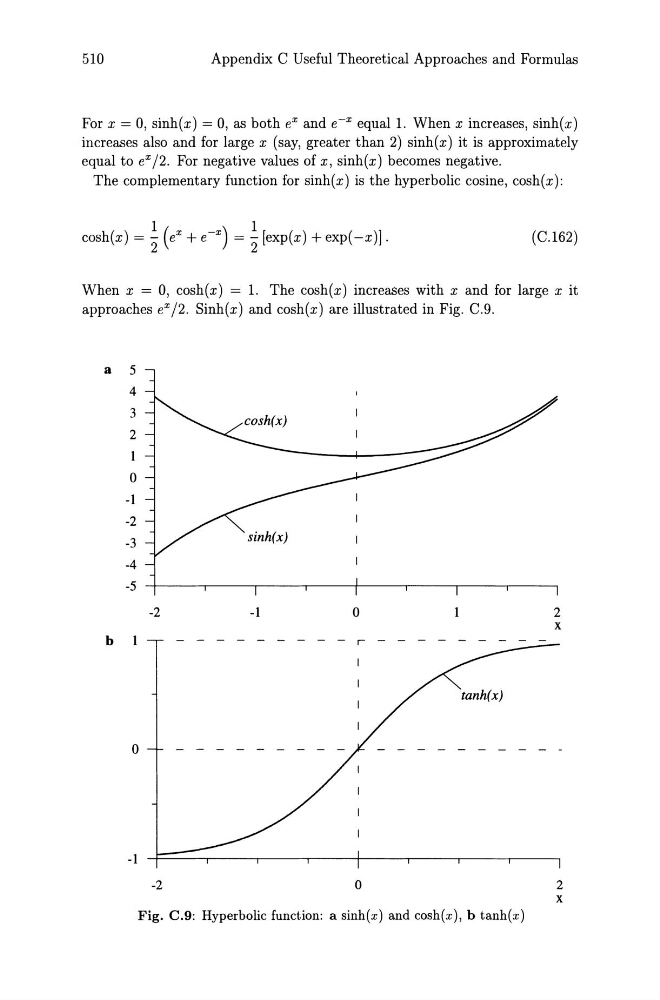
For x = 0, sinh(x) = 0, as both eX and e- X equal 1. When x increases, sinh(x)
increases also and for large x (say, greater than 2) sinh(x) it is approximately
equal to eX /2. For negative values of x, sinh(x) becomes negative.
The complementary function for sinh(x) is the hyperbolic cosine, cosh(x):
cosh(x) = ~ (ex + e- x ) = ~ [exp(x) + exp( -x)].
(C.162)
When x = 0, cosh(x) = 1. The cosh(x) increases with x and for large x it
approaches eX /2. Sinh(x) and cosh(x) are illustrated in Fig. C.g.
a 5
4
3
2
1
0
-1
-2
-3
-4
-5
-2
-1
o
b
o
-1
-2
o
Fig. C.g: Hyperbolic function: a sinh(x) and cosh(x), b tanh(x)
2
x
2
x
Appendix C Useful Theoretical Approaches and Formulas
For x = 0, sinh(x) = 0, as both eX and e- X equal 1. When x increases, sinh(x)
increases also and for large x (say, greater than 2) sinh(x) it is approximately
equal to eX /2. For negative values of x, sinh(x) becomes negative.
The complementary function for sinh(x) is the hyperbolic cosine, cosh(x):
cosh(x) = ~ (ex + e- x ) = ~ [exp(x) + exp( -x)].
(C.162)
When x = 0, cosh(x) = 1. The cosh(x) increases with x and for large x it
approaches eX /2. Sinh(x) and cosh(x) are illustrated in Fig. C.g.
a 5
4
3
2
1
0
-1
-2
-3
-4
-5
-2
-1
o
b
o
-1
-2
o
Fig. C.g: Hyperbolic function: a sinh(x) and cosh(x), b tanh(x)
2
x
2
x