

Appendix C Useful Theoretical Approaches and Formulas
511
Tanh(x) is defined as a ratio of functions (C.161) and (C.162), i.e.:
sinh(x)
cosh(x)
tanh(x) =
( )' and coth(x) = . ()"
cosh x
smh x
(C.163)
When x ---7 00, tanh(x) ---7 1 , and at negative values of x, tanh(x) becomes
negative. When x is very small, sinh(x) ---7 x, cosh(x) ---7 1, and tanh(x) ---7 x.
Function (C.163) is also shown in Fig. C.9.
A few important relationships related to hyperbolic functions are given below:
cosh 2 (x) - sinh2(x) = 1,
(C.164)
sinh(-x) = -sinh(x), cosh(-x) = cosh(x), tanh(x) = -tanh(x), (C.165)
sinh(2x) = 2sinh(x) cosh(x) , cosh(2x) = cosh 2 (x) -1.
(C.166)
A very comprehensive list of relationships and tables for circular and hyperbolic
functions is given in the handbook by Abramowitz and Stegun (1975).
C.7 Evaluation of Integral (8.60)
A concentration c(x, t) in a moving front of contaminants is given by Eq. (8.60),
i. e.:
_
Qi
lot 1
{[x - u(t - T)]2}
c(x,t) = ~
~exp -
(
)
dT.
41r K x 0 y t - T
4K x t - T
(C.167)
After substitution z = t-T, and saving the same integration variable Eq. (C.167)
becomes:
_
Qi
lot 1 {(X-UT)2}
c(x,t) = ~
;;:::-exp -
dT.
41rKx 0 yT
4KxT
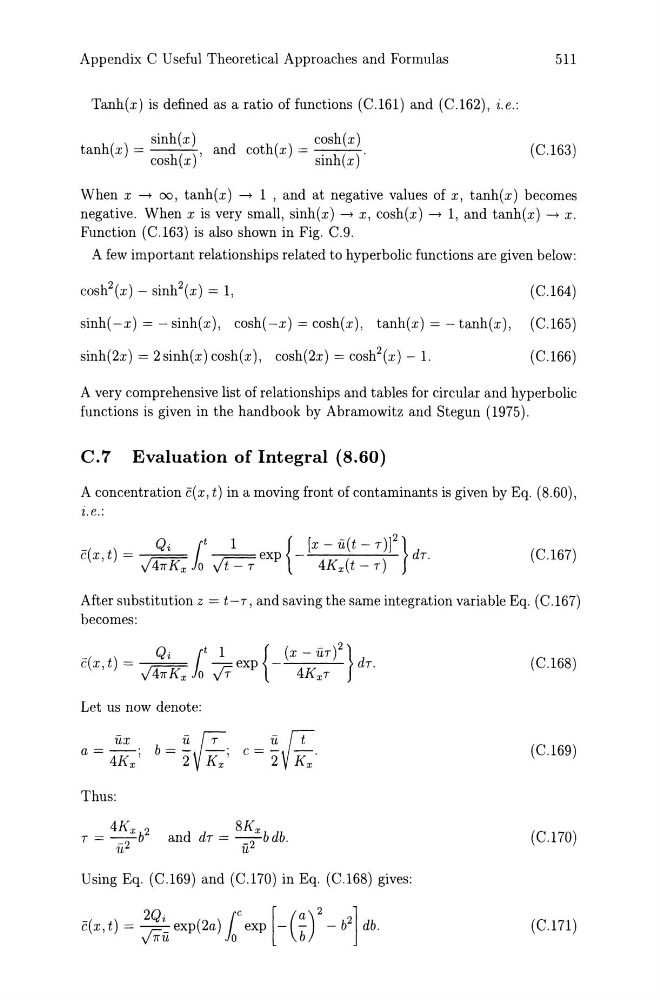
Let us now denote:
Thus:
4Kx 2
T=-b
ii 2
8Kx
and dT = --=-2b db.
u
Using Eq. (C.169) and (C.170) in Eq. (C.168) gives:
2Q
fC
[(a)2 ]
c(x, t) = ,;;~ exp(2a) io exp - b - b 2 db.
(C.168)
(C.169)
(C.170)
(C.171)
511
Tanh(x) is defined as a ratio of functions (C.161) and (C.162), i.e.:
sinh(x)
cosh(x)
tanh(x) =
( )' and coth(x) = . ()"
cosh x
smh x
(C.163)
When x ---7 00, tanh(x) ---7 1 , and at negative values of x, tanh(x) becomes
negative. When x is very small, sinh(x) ---7 x, cosh(x) ---7 1, and tanh(x) ---7 x.
Function (C.163) is also shown in Fig. C.9.
A few important relationships related to hyperbolic functions are given below:
cosh 2 (x) - sinh2(x) = 1,
(C.164)
sinh(-x) = -sinh(x), cosh(-x) = cosh(x), tanh(x) = -tanh(x), (C.165)
sinh(2x) = 2sinh(x) cosh(x) , cosh(2x) = cosh 2 (x) -1.
(C.166)
A very comprehensive list of relationships and tables for circular and hyperbolic
functions is given in the handbook by Abramowitz and Stegun (1975).
C.7 Evaluation of Integral (8.60)
A concentration c(x, t) in a moving front of contaminants is given by Eq. (8.60),
i. e.:
_
Qi
lot 1
{[x - u(t - T)]2}
c(x,t) = ~
~exp -
(
)
dT.
41r K x 0 y t - T
4K x t - T
(C.167)
After substitution z = t-T, and saving the same integration variable Eq. (C.167)
becomes:
_
Qi
lot 1 {(X-UT)2}
c(x,t) = ~
;;:::-exp -
dT.
41rKx 0 yT
4KxT
Let us now denote:
Thus:
4Kx 2
T=-b
ii 2
8Kx
and dT = --=-2b db.
u
Using Eq. (C.169) and (C.170) in Eq. (C.168) gives:
2Q
fC
[(a)2 ]
c(x, t) = ,;;~ exp(2a) io exp - b - b 2 db.
(C.168)
(C.169)
(C.170)
(C.171)