

Appendix C Useful Theoretical Approaches and Formulas
509
Recall from calculus that the polar form of the point (x, y) is (r, (J), where
x, y, r, and (J are related by x = r cos (J and y = r sin (J. Thus, a complex number
z = x + iy in polar form can be written as:
z = r ( cos (J + i sin (J).
(C.154)
Complex numbers are also used in combination with exponential functions.
However, we need first to give a meaning to the expression e Z when z = x + iy
is a complex number, i.e.:
(C.155)
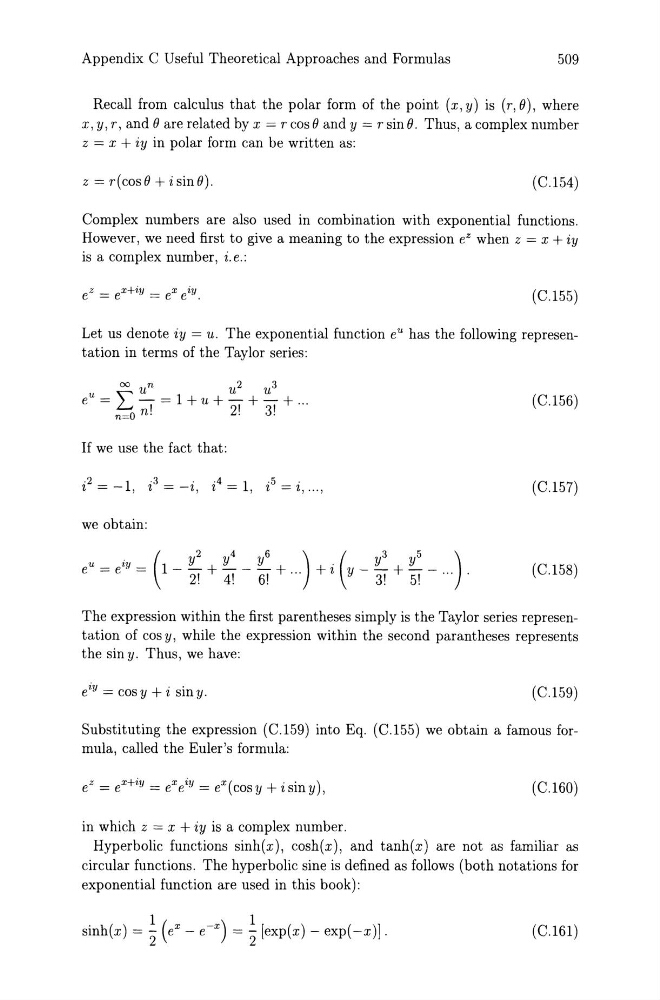
Let us denote iy = u. The exponential function e U has the following representation in terms of the Taylor series:
(C.156)
If we use the fact that:
·5
.
t = t, ... ,
(C.157)
we obtain:
(C.158)
The expression within the first parentheses simply is the Taylor series representation of cos y, while the expression within the second parantheses represents
the sin y. Thus, we have:
e iy = cos Y + i sin y.
(C.159)
Substituting the expression (C.159) into Eq. (C.155) we obtain a famous formula, called the Euler's formula:
(C.160)
in which z = x + iy is a complex number.
Hyperbolic functions sinh(x), cosh(x), and tanh(x) are not as familiar as
circular functions. The hyperbolic sine is defined as follows (both notations for
exponential function are used in this book):
sinh(x) = ~ (ex - e- x ) = ~ [exp(x) - exp(-x)].
(C.161)
509
Recall from calculus that the polar form of the point (x, y) is (r, (J), where
x, y, r, and (J are related by x = r cos (J and y = r sin (J. Thus, a complex number
z = x + iy in polar form can be written as:
z = r ( cos (J + i sin (J).
(C.154)
Complex numbers are also used in combination with exponential functions.
However, we need first to give a meaning to the expression e Z when z = x + iy
is a complex number, i.e.:
(C.155)
Let us denote iy = u. The exponential function e U has the following representation in terms of the Taylor series:
(C.156)
If we use the fact that:
·5
.
t = t, ... ,
(C.157)
we obtain:
(C.158)
The expression within the first parentheses simply is the Taylor series representation of cos y, while the expression within the second parantheses represents
the sin y. Thus, we have:
e iy = cos Y + i sin y.
(C.159)
Substituting the expression (C.159) into Eq. (C.155) we obtain a famous formula, called the Euler's formula:
(C.160)
in which z = x + iy is a complex number.
Hyperbolic functions sinh(x), cosh(x), and tanh(x) are not as familiar as
circular functions. The hyperbolic sine is defined as follows (both notations for
exponential function are used in this book):
sinh(x) = ~ (ex - e- x ) = ~ [exp(x) - exp(-x)].
(C.161)