

508
Appendix C Useful Theoretical Approaches and Formulas
a
o
-1
b
o
I joo
I
rc/2
I
I joo
I
3rc/4
I
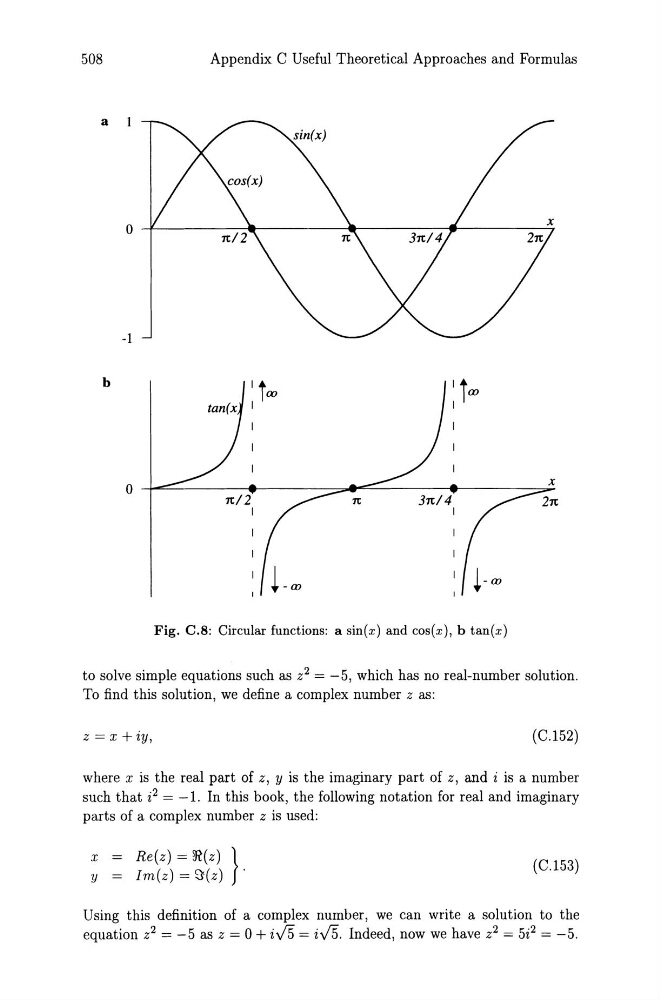
Fig. C.S: Circular functions: a sin(x) and cos(x), b tan(x)
x
2rc
to solve simple equations such as z2 = -5, which has no real-number solution.
To find this solution, we define a complex number z as:
z = x + iy,
(C.152)
where x is the real part of z, y is the imaginary part of z, and i is a number
such that i 2 = -1. In this book, the following notation for real and imaginary
parts of a complex number z is used:
x = Re(z) = ~(z) }
y = Im(z) = SS(z) .
(C.153)
Using this definition of a complex number, we can write a solution to the
equation z2 = -5 as z = 0 + iv's = iv's. Indeed, now we have z2 = 5i 2 = -5.
Appendix C Useful Theoretical Approaches and Formulas
a
o
-1
b
o
I joo
I
rc/2
I
I joo
I
3rc/4
I
Fig. C.S: Circular functions: a sin(x) and cos(x), b tan(x)
x
2rc
to solve simple equations such as z2 = -5, which has no real-number solution.
To find this solution, we define a complex number z as:
z = x + iy,
(C.152)
where x is the real part of z, y is the imaginary part of z, and i is a number
such that i 2 = -1. In this book, the following notation for real and imaginary
parts of a complex number z is used:
x = Re(z) = ~(z) }
y = Im(z) = SS(z) .
(C.153)
Using this definition of a complex number, we can write a solution to the
equation z2 = -5 as z = 0 + iv's = iv's. Indeed, now we have z2 = 5i 2 = -5.