

Appendix C Useful Theoretical Approaches and Formulas
507
C.6 Circular, Hyperbolic and Complex Functions
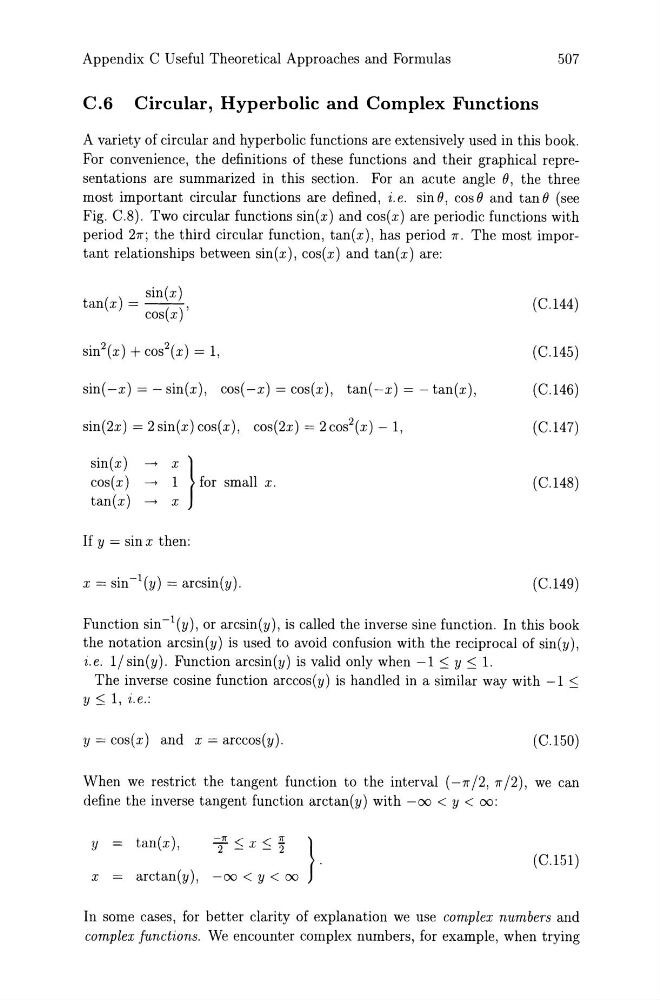
A variety of circular and hyperbolic functions are extensively used in this book.
For convenience, the definitions of these functions and their graphical representations are summarized in this section. For an acute angle (), the three
most important circular functions are defined, i. e. sin (), cos () and tan () (see
Fig. C.8). Two circular functions sin(x) and cos(x) are periodic functions with
period 2Jr; the third circular function, tan(x), has period Jr. The most important relationships between sin( x), cos( x) and tan( x) are:
sin (x )
tan(x) = -(-) ,
cos x
sin(-x)=-sin(x), cos(-x)=cos(x), tan(-x)=-tan(x),
sin(2x) = 2sin(x)cos(x), cos(2x) = 2cos 2 (x) - 1,
sin(x) ---+ X}
cos( x) ---+ 1 for small x.
tan( x) ---+ x
If y = sin x then:
x = sin-1(y) = arcsin(y).
(C.144)
(C.145)
(C.146)
(C.147)
( C.148)
(C.149)
Function sin -1 (y), or arcsin(y), is called the inverse sine function. In this book
the notation arcsin(y) is used to avoid confusion with the reciprocal of sin(y),
i. e. 1/ sin(y). Function arcsin(y) is valid only when -1 :::; y :::; 1.
The inverse cosine function arccos(y) is handled in a similar way with -1 :::;
y :::; 1, i.e.:
y=cos(x) and x=arccos(y).
(C.150)
When we restrict the tangent function to the interval (-Jr /2, Jr /2), we can
define the inverse tangent function arctan(y) with -00 < y < 00:
y
x
tan(x),
arctan(y),
=1I
- 2
-00 < y < 00
(C.151)
In some cases, for better clarity of explanation we use complex numbers and
complex functions. We encounter complex numbers, for example, when trying
507
C.6 Circular, Hyperbolic and Complex Functions
A variety of circular and hyperbolic functions are extensively used in this book.
For convenience, the definitions of these functions and their graphical representations are summarized in this section. For an acute angle (), the three
most important circular functions are defined, i. e. sin (), cos () and tan () (see
Fig. C.8). Two circular functions sin(x) and cos(x) are periodic functions with
period 2Jr; the third circular function, tan(x), has period Jr. The most important relationships between sin( x), cos( x) and tan( x) are:
sin (x )
tan(x) = -(-) ,
cos x
sin(-x)=-sin(x), cos(-x)=cos(x), tan(-x)=-tan(x),
sin(2x) = 2sin(x)cos(x), cos(2x) = 2cos 2 (x) - 1,
sin(x) ---+ X}
cos( x) ---+ 1 for small x.
tan( x) ---+ x
If y = sin x then:
x = sin-1(y) = arcsin(y).
(C.144)
(C.145)
(C.146)
(C.147)
( C.148)
(C.149)
Function sin -1 (y), or arcsin(y), is called the inverse sine function. In this book
the notation arcsin(y) is used to avoid confusion with the reciprocal of sin(y),
i. e. 1/ sin(y). Function arcsin(y) is valid only when -1 :::; y :::; 1.
The inverse cosine function arccos(y) is handled in a similar way with -1 :::;
y :::; 1, i.e.:
y=cos(x) and x=arccos(y).
(C.150)
When we restrict the tangent function to the interval (-Jr /2, Jr /2), we can
define the inverse tangent function arctan(y) with -00 < y < 00:
y
x
tan(x),
arctan(y),
=1I
- 2
-00 < y < 00
(C.151)
In some cases, for better clarity of explanation we use complex numbers and
complex functions. We encounter complex numbers, for example, when trying