

506
a
Appendix C Useful Theoretical Approaches and Formulas
MWL
h+~
2
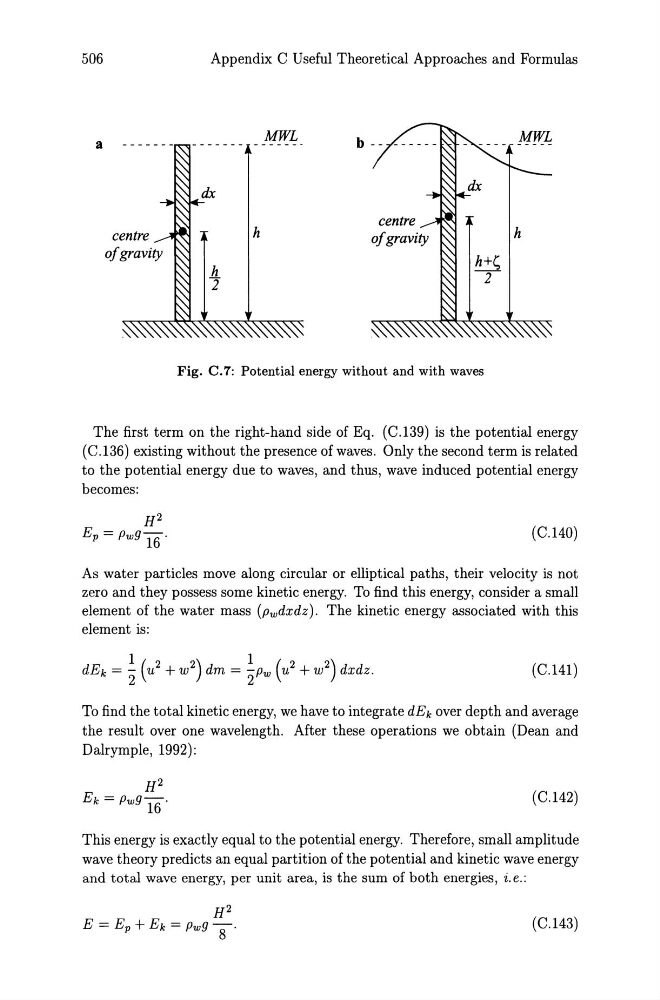
Fig. C.7: Potential energy without and with waves
MWL
h
The first term on the right-hand side of Eq. (C.139) is the potential energy
(C.136) existing without the presence of waves. Only the second term is related
to the potential energy due to waves, and thus, wave induced potential energy
becomes:
(C.140)
As water particles move along circular or elliptical paths, their velocity is not
zero and they possess some kinetic energy. To find this energy, consider a small
element of the water mass (Pwdxdz). The kinetic energy associated with this
element is:
(C.141)
To find the total kinetic energy, we have to integrate dEk over depth and average
the result over one wavelength. After these operations we obtain (Dean and
Dalrymple, 1992):
H2
Ek = P g -
.
w 16'
(C.142)
This energy is exactly equal to the potential energy. Therefore, small amplitude
wave theory predicts an equal partition of the potential and kinetic wave energy
and total wave energy, per unit area, is the sum of both energies, i.e.:
(C.143)
a
Appendix C Useful Theoretical Approaches and Formulas
MWL
h+~
2
Fig. C.7: Potential energy without and with waves
MWL
h
The first term on the right-hand side of Eq. (C.139) is the potential energy
(C.136) existing without the presence of waves. Only the second term is related
to the potential energy due to waves, and thus, wave induced potential energy
becomes:
(C.140)
As water particles move along circular or elliptical paths, their velocity is not
zero and they possess some kinetic energy. To find this energy, consider a small
element of the water mass (Pwdxdz). The kinetic energy associated with this
element is:
(C.141)
To find the total kinetic energy, we have to integrate dEk over depth and average
the result over one wavelength. After these operations we obtain (Dean and
Dalrymple, 1992):
H2
Ek = P g -
.
w 16'
(C.142)
This energy is exactly equal to the potential energy. Therefore, small amplitude
wave theory predicts an equal partition of the potential and kinetic wave energy
and total wave energy, per unit area, is the sum of both energies, i.e.:
(C.143)