

Appendix C Useful Theoretical Approaches and Formulas
505
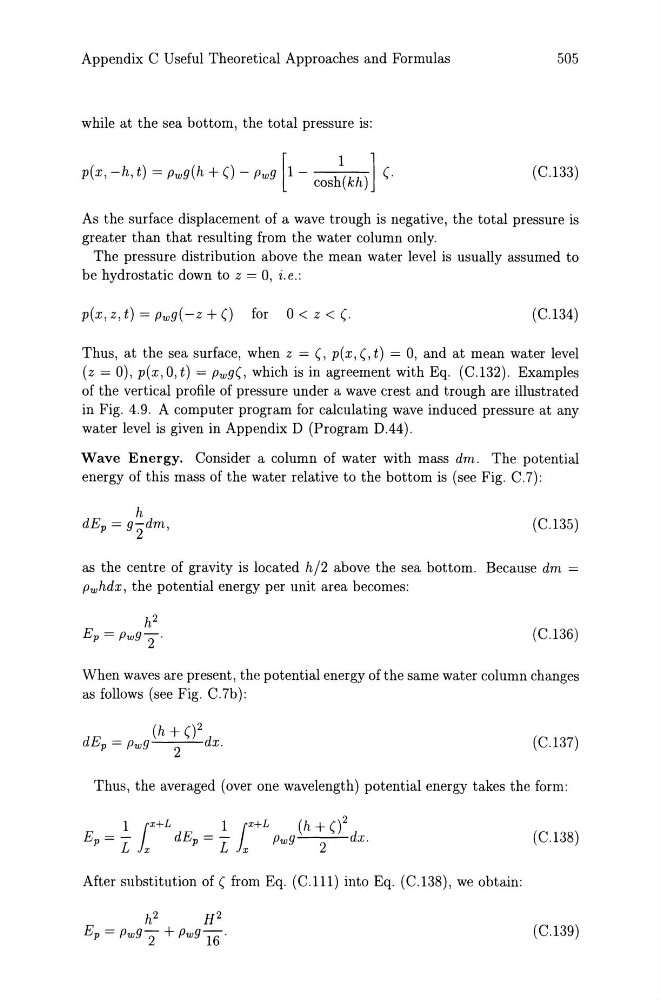
while at the sea bottom, the total pressure is:
(C.133)
As the surface displacement of a wave trough is negative, the total pressure is
greater than that resulting from the water column only.
The pressure distribution above the mean water level is usually assumed to
be hydrostatic down to z = 0, i.e.:
p(x,z,t) = Pwg(-z +() for O
Thus, at the sea surface, when z = (, p(x, (, t) = 0, and at mean water level
(z = 0), p(x, 0, t) = Pwg(, which is in agreement with Eq. (C.132). Examples
of the vertical profile of pressure under a wave crest and trough are illustrated
in Fig. 4.9. A computer program for calculating wave induced pressure at any
water level is given in Appendix D (Program D.44).
Wave Energy. Consider a column of water with mass dm. The potential
energy of this mass of the water relative to the bottom is (see Fig. C.7):
(C.135)
as the centre of gravity is located h/2 above the sea bottom. Because dm =
Pwhdx, the potential energy per unit area becomes:
(C.136)
When waves are present, the potential energy of the same water column changes
as follows (see Fig. C. 7b):
(h + ()2
dEp = Pwg
2
dx.
(C.137)
Thus, the averaged (over one wavelength) potential energy takes the form:
(C.138)
After substitution of ( from Eq. (C.lll) into Eq. (C.138), we obtain:
h 2
H2
Ep = Pwg2" + Pwg 16 ·
(C.139)
505
while at the sea bottom, the total pressure is:
(C.133)
As the surface displacement of a wave trough is negative, the total pressure is
greater than that resulting from the water column only.
The pressure distribution above the mean water level is usually assumed to
be hydrostatic down to z = 0, i.e.:
p(x,z,t) = Pwg(-z +() for O
Thus, at the sea surface, when z = (, p(x, (, t) = 0, and at mean water level
(z = 0), p(x, 0, t) = Pwg(, which is in agreement with Eq. (C.132). Examples
of the vertical profile of pressure under a wave crest and trough are illustrated
in Fig. 4.9. A computer program for calculating wave induced pressure at any
water level is given in Appendix D (Program D.44).
Wave Energy. Consider a column of water with mass dm. The potential
energy of this mass of the water relative to the bottom is (see Fig. C.7):
(C.135)
as the centre of gravity is located h/2 above the sea bottom. Because dm =
Pwhdx, the potential energy per unit area becomes:
(C.136)
When waves are present, the potential energy of the same water column changes
as follows (see Fig. C. 7b):
(h + ()2
dEp = Pwg
2
dx.
(C.137)
Thus, the averaged (over one wavelength) potential energy takes the form:
(C.138)
After substitution of ( from Eq. (C.lll) into Eq. (C.138), we obtain:
h 2
H2
Ep = Pwg2" + Pwg 16 ·
(C.139)