

504
Appendix C Useful Theoretical Approaches and Formulas
the vertical axis Z is directed upwards and the term Pwgz provides positive
pressure. The second term describes the dynamic pressure. To clarify the
nature of the dynamic pressure, we rewrite Eq. (C.125) in the form:
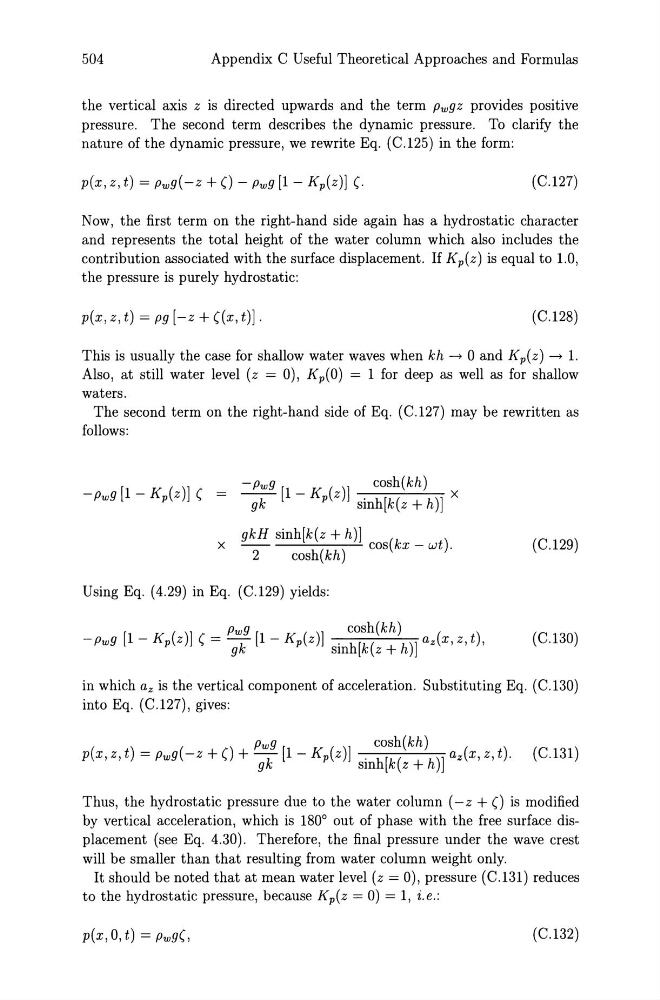
p(x, z, t) = Pwg( -z + () - Pwg [1 - Kp(z)] (.
(C.127)
Now, the first term on the right-hand side again has a hydrostatic character
and represents the total height of the water column which also includes the
contribution associated with the surface displacement. If Kp(z) is equal to 1.0,
the pressure is purely hydrostatic:
p(x, z, t) = pg [-z + ((x, t)].
(C.128)
This is usually the case for shallow water waves when kh -7 0 and Kp(z) -7 1.
Also, at still water level (z = 0), Kp(O) = 1 for deep as well as for shallow
waters.
The second term on the right-hand side of Eq. (C.127) may be rewritten as
follows:
-Pwg [
()]
cosh(kh)
- - l - K z
x
gk
p
sinh[k(z + h)]
gkH sinh[k(z + h)] (
)
x - -
( )
cos kx - wt .
2
cosh kh
(C.129)
Using Eq. (4.29) in Eq. (C.129) yields:
Pwg
cosh(kh)
-Pwg [1 - Kp(z)] ( = - [1 - Kp(z)] . [(
)] az(x, z, t),
gk
smh k z + h
(C.130)
in which az is the vertical component of acceleration. Substituting Eq. (C.130)
into Eq. (C.127), gives:
Pwg
cosh(kh)
p(x, z, t) = Pwg( -z + () + - [1 - Kp(z)] . h[ (
)] az(x, z, t). (C.131)
gk
sm k z + h
Thus, the hydrostatic pressure due to the water column (- z + () is modified
by vertical acceleration, which is 180 0 out of phase with the free surface displacement (see Eq. 4.30). Therefore, the final pressure under the wave crest
will be smaller than that resulting from water column weight only.
It should be noted that at mean water level (z = 0), pressure (C.131) reduces
to the hydrostatic pressure, because Kp(z = 0) = 1, i.e.:
p(x, 0, t) = Pwg(,
(C.132)
Appendix C Useful Theoretical Approaches and Formulas
the vertical axis Z is directed upwards and the term Pwgz provides positive
pressure. The second term describes the dynamic pressure. To clarify the
nature of the dynamic pressure, we rewrite Eq. (C.125) in the form:
p(x, z, t) = Pwg( -z + () - Pwg [1 - Kp(z)] (.
(C.127)
Now, the first term on the right-hand side again has a hydrostatic character
and represents the total height of the water column which also includes the
contribution associated with the surface displacement. If Kp(z) is equal to 1.0,
the pressure is purely hydrostatic:
p(x, z, t) = pg [-z + ((x, t)].
(C.128)
This is usually the case for shallow water waves when kh -7 0 and Kp(z) -7 1.
Also, at still water level (z = 0), Kp(O) = 1 for deep as well as for shallow
waters.
The second term on the right-hand side of Eq. (C.127) may be rewritten as
follows:
-Pwg [
()]
cosh(kh)
- - l - K z
x
gk
p
sinh[k(z + h)]
gkH sinh[k(z + h)] (
)
x - -
( )
cos kx - wt .
2
cosh kh
(C.129)
Using Eq. (4.29) in Eq. (C.129) yields:
Pwg
cosh(kh)
-Pwg [1 - Kp(z)] ( = - [1 - Kp(z)] . [(
)] az(x, z, t),
gk
smh k z + h
(C.130)
in which az is the vertical component of acceleration. Substituting Eq. (C.130)
into Eq. (C.127), gives:
Pwg
cosh(kh)
p(x, z, t) = Pwg( -z + () + - [1 - Kp(z)] . h[ (
)] az(x, z, t). (C.131)
gk
sm k z + h
Thus, the hydrostatic pressure due to the water column (- z + () is modified
by vertical acceleration, which is 180 0 out of phase with the free surface displacement (see Eq. 4.30). Therefore, the final pressure under the wave crest
will be smaller than that resulting from water column weight only.
It should be noted that at mean water level (z = 0), pressure (C.131) reduces
to the hydrostatic pressure, because Kp(z = 0) = 1, i.e.:
p(x, 0, t) = Pwg(,
(C.132)