

Appendix C Useful Theoretical Approaches and Formulas
S03
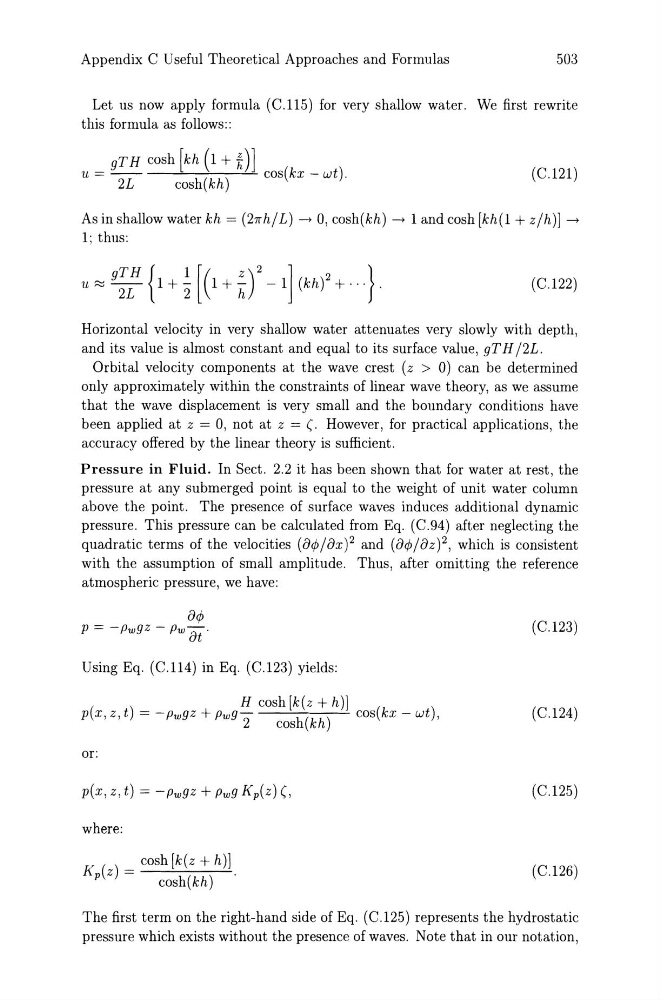
Let us now apply formula (C.IlS) for very shallow water. We first rewrite
this formula as follows::
gTH cosh [kh (1 + *)]
u = - -
cos(kx - wt).
2L
cosh(kh)
(C.121)
As in shallow water kh = (27rh/ L) -> 0, cosh(kh) -> 1 and cosh [kh(l + z/h)] ->
1; thus:
gT H {
1 [(
Z) 2 ] 2
}
u>::; 2L 1 + ' 2 1 + h - 1 (kh) + ....
(C.122)
Horizontal velocity in very shallow water attenuates very slowly with depth,
and its value is almost constant and equal to its surface value, gT H /2L.
Orbital velocity components at the wave crest (z > 0) can be determined
only approximately within the constraints of linear wave theory, as we assume
that the wave displacement is very small and the boundary conditions have
been applied at z = 0, not at z = (. However, for practical applications, the
accuracy offered by the linear theory is sufficient.
Pressure in Fluid. In Sect. 2.2 it has been shown that for water at rest, the
pressure at any submerged point is equal to the weight of unit water column
above the point. The presence of surface waves induces additional dynamic
pressure. This pressure can be calculated from Eq. (C.94) after neglecting the
quadratic terms of the velocities (8¢/8xj2 and (8¢/8zj2, which is consistent
with the assumption of small amplitude. Thus, after omitting the reference
atmospheric pressure, we have:
8¢
P = -Pwgz - Pw7it.
Using Eq. (C.Il4) in Eq. (C.123) yields:
H cosh [k(z + h)]
p(x, z, t) = -Pwgz + Pwg 2 cosh(kh) cos(kx - wt),
or:
where:
K (z) = cosh [k(z + h)].
P
cosh(kh)
(C.123)
(C.124)
(C.l2S)
(C.126)
The first term on the right-hand side of Eq. (C.12S) represents the hydrostatic
pressure which exists without the presence of waves. Note that in our notation,
S03
Let us now apply formula (C.IlS) for very shallow water. We first rewrite
this formula as follows::
gTH cosh [kh (1 + *)]
u = - -
cos(kx - wt).
2L
cosh(kh)
(C.121)
As in shallow water kh = (27rh/ L) -> 0, cosh(kh) -> 1 and cosh [kh(l + z/h)] ->
1; thus:
gT H {
1 [(
Z) 2 ] 2
}
u>::; 2L 1 + ' 2 1 + h - 1 (kh) + ....
(C.122)
Horizontal velocity in very shallow water attenuates very slowly with depth,
and its value is almost constant and equal to its surface value, gT H /2L.
Orbital velocity components at the wave crest (z > 0) can be determined
only approximately within the constraints of linear wave theory, as we assume
that the wave displacement is very small and the boundary conditions have
been applied at z = 0, not at z = (. However, for practical applications, the
accuracy offered by the linear theory is sufficient.
Pressure in Fluid. In Sect. 2.2 it has been shown that for water at rest, the
pressure at any submerged point is equal to the weight of unit water column
above the point. The presence of surface waves induces additional dynamic
pressure. This pressure can be calculated from Eq. (C.94) after neglecting the
quadratic terms of the velocities (8¢/8xj2 and (8¢/8zj2, which is consistent
with the assumption of small amplitude. Thus, after omitting the reference
atmospheric pressure, we have:
8¢
P = -Pwgz - Pw7it.
Using Eq. (C.Il4) in Eq. (C.123) yields:
H cosh [k(z + h)]
p(x, z, t) = -Pwgz + Pwg 2 cosh(kh) cos(kx - wt),
or:
where:
K (z) = cosh [k(z + h)].
P
cosh(kh)
(C.123)
(C.124)
(C.l2S)
(C.126)
The first term on the right-hand side of Eq. (C.12S) represents the hydrostatic
pressure which exists without the presence of waves. Note that in our notation,