

500
Appendix C Useful Theoretical Approaches and Formulas
x, z and time, t. The simplest approach is to represent function i f> as a product
of functions Fl(X), F2(Z) and F3(t), each depending on variable x, z and t,
respectively, i. e.
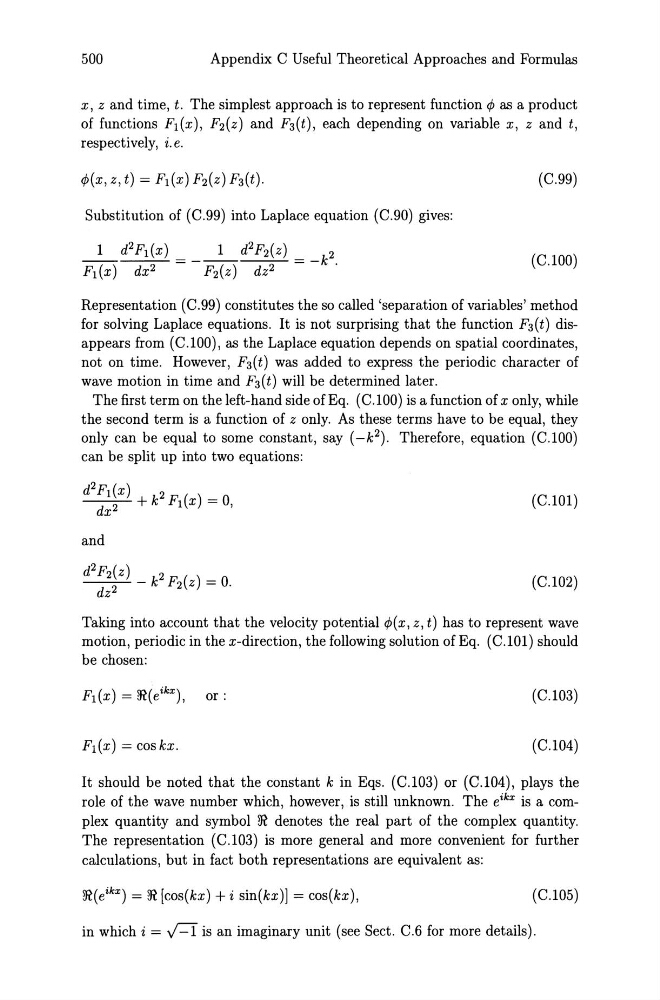
Substitution of (C.99) into Laplace equation (C.90) gives:
1 d 2 Fl(X)
Fl(X) dx 2
(C.99)
(C.100)
Representation (C.99) constitutes the so called 'separation of variables' method
for solving Laplace equations. It is not surprising that the function F3(t) disappears from (C.100), as the Laplace equation depends on spatial coordinates,
not on time. However, F3(t) was added to express the periodic character of
wave motion in time and F3 (t) will be determined later.
The first term on the left-hand side of Eq. (C.100) is a function of x only, while
the second term is a function of z only. As these terms have to be equal, they
only can be equal to some constant, say (_k 2 ). Therefore, equation (C.100)
can be split up into two equations:
(C.101)
and
(C.102)
Taking into account that the velocity potential if>(x, z, t) has to represent wave
motion, periodic in the x-direction, the following solution ofEq. (C.101) should
be chosen:
(C.103)
(C.104)
It should be noted that the constant k in Eqs. (C.103) or (C.104), plays the
role of the wave number which, however, is still unknown. The e ikx is a complex quantity and symbol ~ denotes the real part of the complex quantity.
The representation (C.103) is more general and more convenient for further
calculations, but in fact both representations are equivalent as:
~(eikx) = ~ [cos(kx) + i sin{kx)] = cos(kx),
(C.105)
in which i = R is an imaginary unit (see Sect. C.6 for more details).
Appendix C Useful Theoretical Approaches and Formulas
x, z and time, t. The simplest approach is to represent function i f> as a product
of functions Fl(X), F2(Z) and F3(t), each depending on variable x, z and t,
respectively, i. e.
Substitution of (C.99) into Laplace equation (C.90) gives:
1 d 2 Fl(X)
Fl(X) dx 2
(C.99)
(C.100)
Representation (C.99) constitutes the so called 'separation of variables' method
for solving Laplace equations. It is not surprising that the function F3(t) disappears from (C.100), as the Laplace equation depends on spatial coordinates,
not on time. However, F3(t) was added to express the periodic character of
wave motion in time and F3 (t) will be determined later.
The first term on the left-hand side of Eq. (C.100) is a function of x only, while
the second term is a function of z only. As these terms have to be equal, they
only can be equal to some constant, say (_k 2 ). Therefore, equation (C.100)
can be split up into two equations:
(C.101)
and
(C.102)
Taking into account that the velocity potential if>(x, z, t) has to represent wave
motion, periodic in the x-direction, the following solution ofEq. (C.101) should
be chosen:
(C.103)
(C.104)
It should be noted that the constant k in Eqs. (C.103) or (C.104), plays the
role of the wave number which, however, is still unknown. The e ikx is a complex quantity and symbol ~ denotes the real part of the complex quantity.
The representation (C.103) is more general and more convenient for further
calculations, but in fact both representations are equivalent as:
~(eikx) = ~ [cos(kx) + i sin{kx)] = cos(kx),
(C.105)
in which i = R is an imaginary unit (see Sect. C.6 for more details).