

Appendix C Useful Theoretical Approaches and Formulas
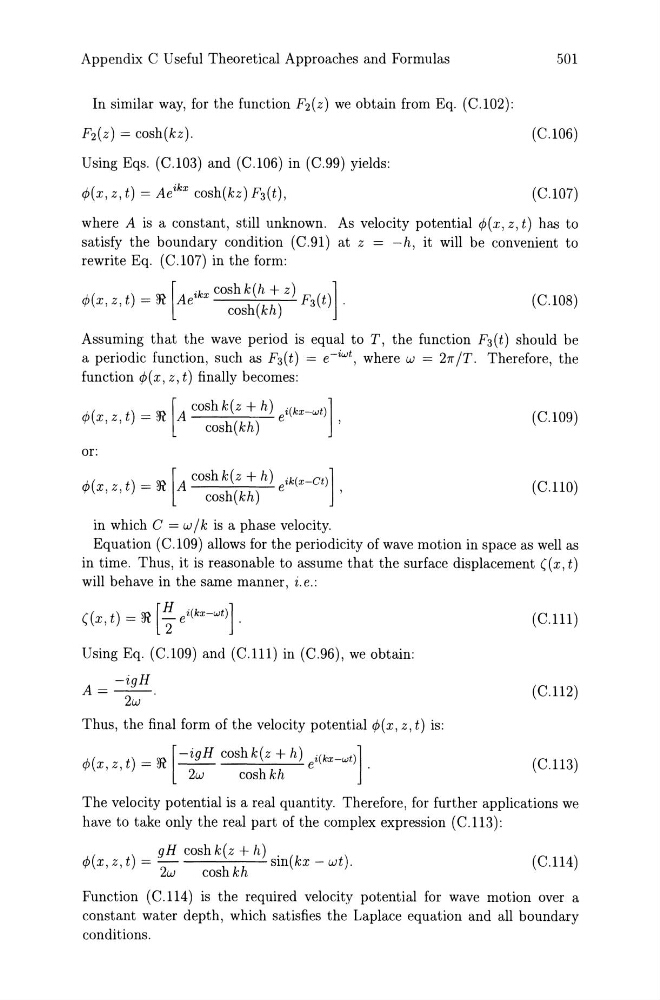
In similar way, for the function F2(Z) we obtain from Eq. (C.I02):
F2(Z) = cosh(kz).
Using Eqs. (C.103) and (C.106) in (C.99) yields:
4>(x, z, t) = Ae ikx cosh(kz) F3(t),
501
(C.106)
(C.107)
where A is a constant, still unknown. As velocity potential 4>(x, z, t) has to
satisfy the boundary condition (C.91) at z = -h, it will be convenient to
rewrite Eq. (C.107) in the form:
[
ikx cosh k (h + z)
]
4>(x, z, t) = R Ae
cosh(kh) F3(t).
(C.108)
Assuming that the wave period is equal to T, the function F3(t) should be
a periodic function, such as F3(t) = e- iwt , where w = 211" IT. Therefore, the
function 4>(x, z, t) finally becomes:
(
) _ [ coshk(z+h) i(kX-wt)]
4> x,z,t - R A cosh(kh) e
,
(C.109)
or:
(
) = R [A coshk(z + h) ik(X-Ct)]
4> x, z, t
cosh(kh) e
,
(C.110)
in which C = wlk is a phase velocity.
Equation (C.109) allows for the periodicity of wave motion in space as well as
in time. Thus, it is reasonable to assume that the surface displacement ((x, t)
will behave in the same manner, i.e.:
((x, t) = R [~ ei(kX-wt)] .
Using Eq. (C.109) and (C.l1l) in (C.96), we obtain:
A = -igH.
2w
Thus, the final form of the velocity potential 4>(x, z, t) is:
4>x,z,t -~
e .
(
)
_
In [-i9H coshk(z + h) i(kX-wt)]
2w
coshkh
(C.I1l)
(C.112)
(C.113)
The velocity potential is a real quantity. Therefore, for further applications we
have to take only the real part of the complex expression (C.113):
9 H cosh k (z + h)
4>(x, z, t) = -
sin(kx - wt).
2w
cosh kh
(C.1l4)
Function (C.114) is the required velocity potential for wave motion over a
constant water depth, which satisfies the Laplace equation and all boundary
conditions.
In similar way, for the function F2(Z) we obtain from Eq. (C.I02):
F2(Z) = cosh(kz).
Using Eqs. (C.103) and (C.106) in (C.99) yields:
4>(x, z, t) = Ae ikx cosh(kz) F3(t),
501
(C.106)
(C.107)
where A is a constant, still unknown. As velocity potential 4>(x, z, t) has to
satisfy the boundary condition (C.91) at z = -h, it will be convenient to
rewrite Eq. (C.107) in the form:
[
ikx cosh k (h + z)
]
4>(x, z, t) = R Ae
cosh(kh) F3(t).
(C.108)
Assuming that the wave period is equal to T, the function F3(t) should be
a periodic function, such as F3(t) = e- iwt , where w = 211" IT. Therefore, the
function 4>(x, z, t) finally becomes:
(
) _ [ coshk(z+h) i(kX-wt)]
4> x,z,t - R A cosh(kh) e
,
(C.109)
or:
(
) = R [A coshk(z + h) ik(X-Ct)]
4> x, z, t
cosh(kh) e
,
(C.110)
in which C = wlk is a phase velocity.
Equation (C.109) allows for the periodicity of wave motion in space as well as
in time. Thus, it is reasonable to assume that the surface displacement ((x, t)
will behave in the same manner, i.e.:
((x, t) = R [~ ei(kX-wt)] .
Using Eq. (C.109) and (C.l1l) in (C.96), we obtain:
A = -igH.
2w
Thus, the final form of the velocity potential 4>(x, z, t) is:
4>x,z,t -~
e .
(
)
_
In [-i9H coshk(z + h) i(kX-wt)]
2w
coshkh
(C.I1l)
(C.112)
(C.113)
The velocity potential is a real quantity. Therefore, for further applications we
have to take only the real part of the complex expression (C.113):
9 H cosh k (z + h)
4>(x, z, t) = -
sin(kx - wt).
2w
cosh kh
(C.1l4)
Function (C.114) is the required velocity potential for wave motion over a
constant water depth, which satisfies the Laplace equation and all boundary
conditions.