

Appendix C Useful Theoretical Approaches and Formulas
499
The existence of the sea surface results also from a dynamic balance between
air and water masses. In particular, air pressure at the point P1 (x, z, t) has to
be equal to the water pressure at this point. This balance is expressed using the
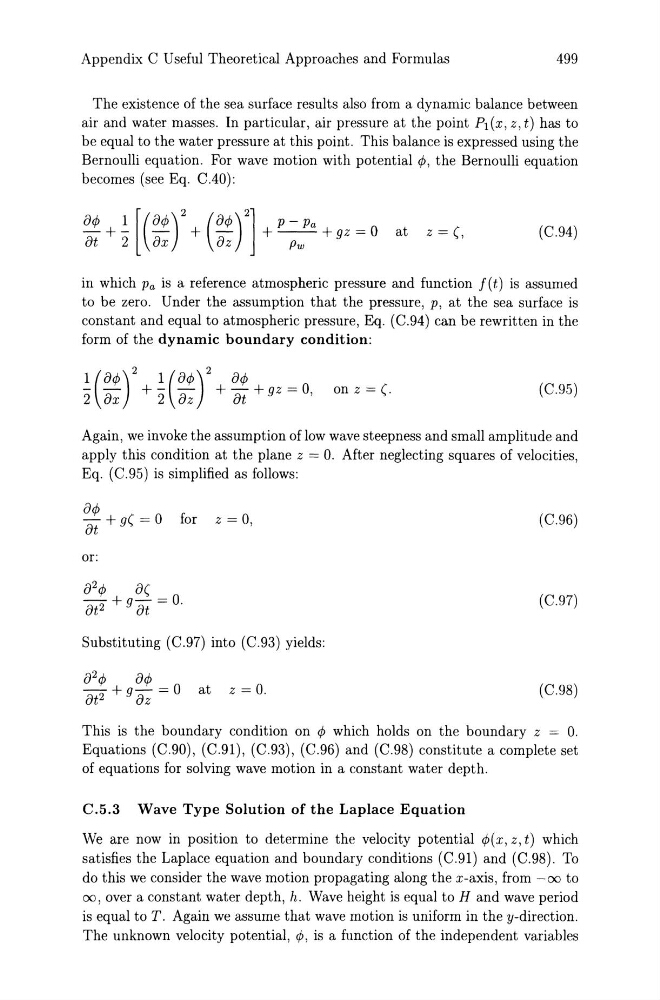
Bernoulli equation. For wave motion with potential ¢, the Bernoulli equation
becomes (see Eq. C.40):
[( ) 2 ( )2]
a¢ 1 a¢
a¢
P - Pa
- + - -
+ -
+ - - + gz = 0
at 2 ax
az
Pw
at z = (,
(C.94)
in which Pa is a reference atmospheric pressure and function f (t) is assumed
to be zero. Under the assumption that the pressure, p, at the sea surface is
constant and equal to atmospheric pressure, Eq. (C.94) can be rewritten in the
form of the dynamic boundary condition:
~(a¢)2 +~(a¢)2 + a¢ +gz=O, onz=(.
2 ax
2 az
at
(C.95)
Again, we invoke the assumption of low wave steepness and small amplitude and
apply this condition at the plane z = O. After neglecting squares of velocities,
Eq. (C.95) is simplified as follows:
for z = 0,
(C.96)
or:
(C.97)
Substituting (C.97) into (C.93) yields:
z = O.
(C.98)
This is the boundary condition on ¢ which holds on the boundary z = O.
Equations (C.90), (C.9l), (C.93), (C.96) and (C.98) constitute a complete set
of equations for solving wave motion in a constant water depth.
C.5.3 Wave Type Solution of the Laplace Equation
We are now in position to determine the velocity potential ¢(x, z, t) which
satisfies the Laplace equation and boundary conditions (C.91) and (C.98). To
do this we consider the wave motion propagating along the x-axis, from -00 to
00, over a constant water depth, h. Wave height is equal to H and wave period
is equal to T. Again we assume that wave motion is uniform in the y-direction.
The unknown velocity potential, ¢, is a function of the independent variables
499
The existence of the sea surface results also from a dynamic balance between
air and water masses. In particular, air pressure at the point P1 (x, z, t) has to
be equal to the water pressure at this point. This balance is expressed using the
Bernoulli equation. For wave motion with potential ¢, the Bernoulli equation
becomes (see Eq. C.40):
[( ) 2 ( )2]
a¢ 1 a¢
a¢
P - Pa
- + - -
+ -
+ - - + gz = 0
at 2 ax
az
Pw
at z = (,
(C.94)
in which Pa is a reference atmospheric pressure and function f (t) is assumed
to be zero. Under the assumption that the pressure, p, at the sea surface is
constant and equal to atmospheric pressure, Eq. (C.94) can be rewritten in the
form of the dynamic boundary condition:
~(a¢)2 +~(a¢)2 + a¢ +gz=O, onz=(.
2 ax
2 az
at
(C.95)
Again, we invoke the assumption of low wave steepness and small amplitude and
apply this condition at the plane z = O. After neglecting squares of velocities,
Eq. (C.95) is simplified as follows:
for z = 0,
(C.96)
or:
(C.97)
Substituting (C.97) into (C.93) yields:
z = O.
(C.98)
This is the boundary condition on ¢ which holds on the boundary z = O.
Equations (C.90), (C.9l), (C.93), (C.96) and (C.98) constitute a complete set
of equations for solving wave motion in a constant water depth.
C.5.3 Wave Type Solution of the Laplace Equation
We are now in position to determine the velocity potential ¢(x, z, t) which
satisfies the Laplace equation and boundary conditions (C.91) and (C.98). To
do this we consider the wave motion propagating along the x-axis, from -00 to
00, over a constant water depth, h. Wave height is equal to H and wave period
is equal to T. Again we assume that wave motion is uniform in the y-direction.
The unknown velocity potential, ¢, is a function of the independent variables