

2.4 Laminar and Turbulent Flow
35
How does the flow behave for Reynolds numbers lower and higher than the
critical Reynolds number associated with transition from laminar to turbulent
flow? In flow with a low Reynolds number, viscosity is sufficiently high to
suppress the small perturbations in the flow. This is not the case for flow
with a very high Reynolds number, where small perturbations, unsuppressed
by viscosity, grow into turbulent eddies. The following approximate ranges of
Reynolds number occur (White, 1994):
o < Re < 1
highly viscous laminar 'creeping' motion
1 < Re < 100
laminar, strong Reynolds number dependence
100 < Re < 10 3
laminar, usually in boundary layer
10 3 < Re < 10 4
transition to turbulence
10 4 < Re < 10 6
turbulent, moderate Reynolds number dependence
10 6 < Re < 00
turbulent, slight Reynolds number dependence.
These representative ranges are approximate only and can vary with flow
geometry, surface roughness and the level of fluctuations in the inlet stream.
As was shown in Chaps. 11 and 12, for marine ecologists who are dealing
with systems that could span an enormous size range, the Reynolds number
is a basic scaling parameter providing common basis for categorizing the flow
induced by these various systems.
The Reynolds number is not only a quantity distinguishing laminar and turbulent flow regimes. It also has a well defined physical meaning which can
briefly be explored as follows. For simplicity, a slow, irrotational flow, with
constant viscosity J.1., is assumed to be one-dimensional along the Ox axis.
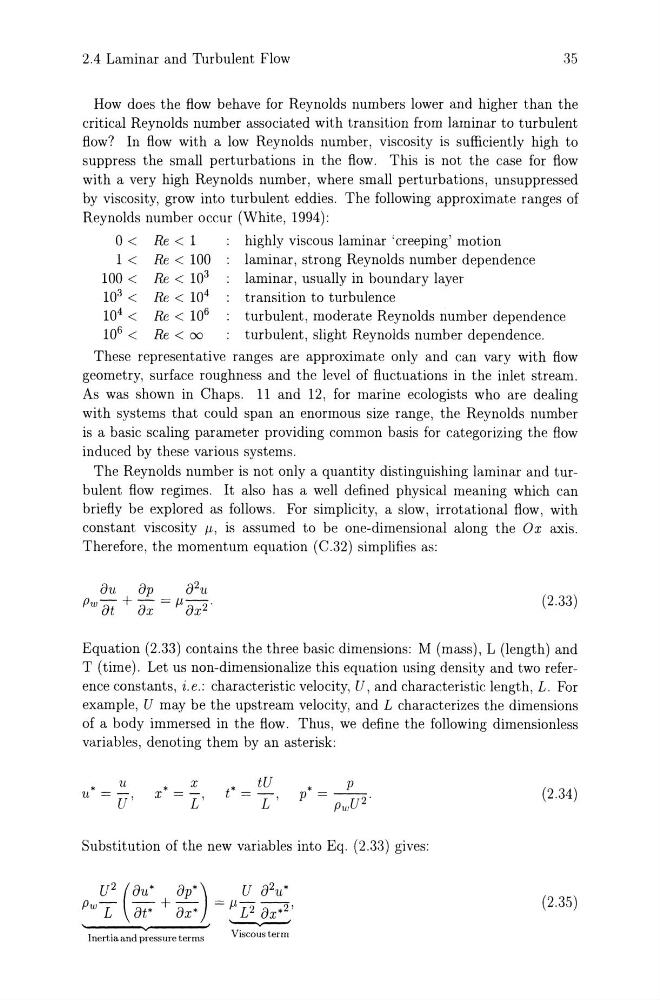
Therefore, the momentum equation (C.32) simplifies as:
(2.33)
Equation (2.33) contains the three basic dimensions: M (mass), L (length) and
T (time). Let us non-dimensionalize this equation using density and two reference constants, i. e.: characteristic velocity, U, and characteristic length, L. For
example, U may be the upstream velocity, and L characterizes the dimensions
of a body immersed in the flow. Thus, we define the following dimensionless
variables, denoting them by an asterisk:
*
u
u
U'
x
x* - L'
t* = tU
p*
L'
Substitution of the new variables into Eq. (2.33) gives:
U 2 (Ou* oP*)
U 02u*
PwT ot* + ox* = J.1. L2 ox*2'
,
,
' - v - ' "
Inertia and p~essure terms
Viscous term
(2.34)
(2.35)
35
How does the flow behave for Reynolds numbers lower and higher than the
critical Reynolds number associated with transition from laminar to turbulent
flow? In flow with a low Reynolds number, viscosity is sufficiently high to
suppress the small perturbations in the flow. This is not the case for flow
with a very high Reynolds number, where small perturbations, unsuppressed
by viscosity, grow into turbulent eddies. The following approximate ranges of
Reynolds number occur (White, 1994):
o < Re < 1
highly viscous laminar 'creeping' motion
1 < Re < 100
laminar, strong Reynolds number dependence
100 < Re < 10 3
laminar, usually in boundary layer
10 3 < Re < 10 4
transition to turbulence
10 4 < Re < 10 6
turbulent, moderate Reynolds number dependence
10 6 < Re < 00
turbulent, slight Reynolds number dependence.
These representative ranges are approximate only and can vary with flow
geometry, surface roughness and the level of fluctuations in the inlet stream.
As was shown in Chaps. 11 and 12, for marine ecologists who are dealing
with systems that could span an enormous size range, the Reynolds number
is a basic scaling parameter providing common basis for categorizing the flow
induced by these various systems.
The Reynolds number is not only a quantity distinguishing laminar and turbulent flow regimes. It also has a well defined physical meaning which can
briefly be explored as follows. For simplicity, a slow, irrotational flow, with
constant viscosity J.1., is assumed to be one-dimensional along the Ox axis.
Therefore, the momentum equation (C.32) simplifies as:
(2.33)
Equation (2.33) contains the three basic dimensions: M (mass), L (length) and
T (time). Let us non-dimensionalize this equation using density and two reference constants, i. e.: characteristic velocity, U, and characteristic length, L. For
example, U may be the upstream velocity, and L characterizes the dimensions
of a body immersed in the flow. Thus, we define the following dimensionless
variables, denoting them by an asterisk:
*
u
u
U'
x
x* - L'
t* = tU
p*
L'
Substitution of the new variables into Eq. (2.33) gives:
U 2 (Ou* oP*)
U 02u*
PwT ot* + ox* = J.1. L2 ox*2'
,
,
' - v - ' "
Inertia and p~essure terms
Viscous term
(2.34)
(2.35)