

34
2 Water at Rest and in Motion
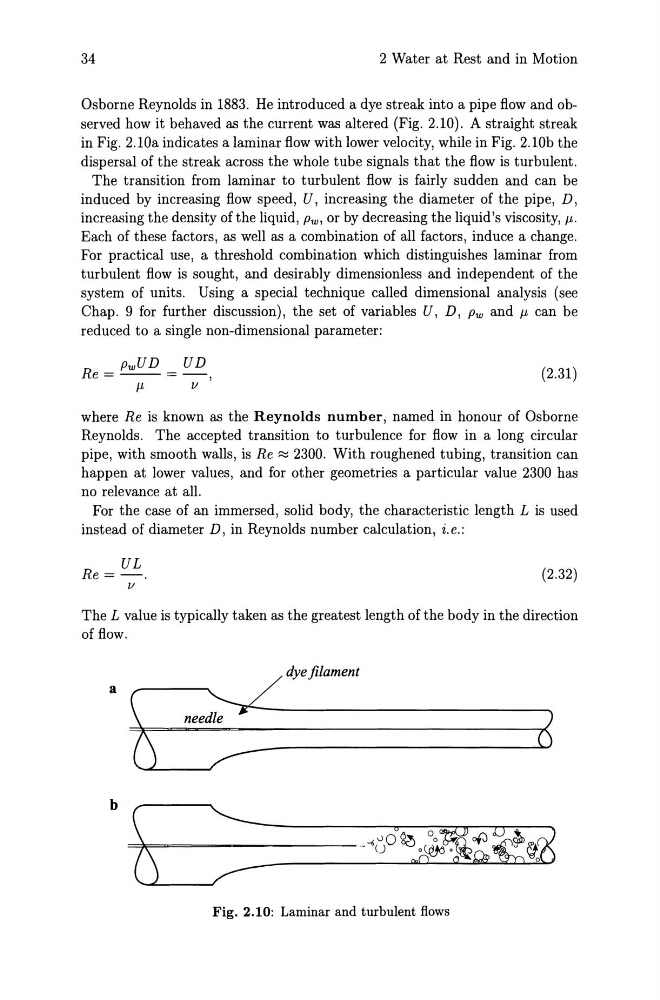
Osborne Reynolds in 1883. He introduced a dye streak into a pipe flow and observed how it behaved as the current was altered (Fig. 2.10). A straight streak
in Fig. 2.lOa indicates a laminar flow with lower velocity, while in Fig. 2.lOb the
dispersal of the streak across the whole tube signals that the flow is turbulent.
The transition from laminar to turbulent flow is fairly sudden and can be
induced by increasing flow speed, U, increasing the diameter of the pipe, D,
increasing the density of the liquid, Pw, or by decreasing the liquid's viscosity, J1.
Each of these factors, as well as a combination of all factors, induce a change.
For practical use, a threshold combination which distinguishes laminar from
turbulent flow is sought, and desirably dimensionless and independent of the
system of units. Using a special technique called dimensional analysis (see
Chap. 9 for further discussion), the set of variables U, D, Pw and J1 can be
reduced to a single non-dimensional parameter:
PwUD
UD
R e = - - = -
J1
1.1 '
(2.31 )
where Re is known as the Reynolds number, named in honour of Osborne
Reynolds. The accepted transition to turbulence for flow in a long circular
pipe, with smooth walls, is Re ~ 2300. With roughened tubing, transition can
happen at lower values, and for other geometries a particular value 2300 has
no relevance at all.
For the case of an immersed, solid body, the characteristic length L is used
instead of diameter D, in Reynolds number calculation, i.e.:
UL
Re=-.
1.1
(2.32)
The L value is typically taken as the greatest length of the body in the direction
of flow.
dye filament
a
Fig. 2.10: Laminar and turbulent flows
2 Water at Rest and in Motion
Osborne Reynolds in 1883. He introduced a dye streak into a pipe flow and observed how it behaved as the current was altered (Fig. 2.10). A straight streak
in Fig. 2.lOa indicates a laminar flow with lower velocity, while in Fig. 2.lOb the
dispersal of the streak across the whole tube signals that the flow is turbulent.
The transition from laminar to turbulent flow is fairly sudden and can be
induced by increasing flow speed, U, increasing the diameter of the pipe, D,
increasing the density of the liquid, Pw, or by decreasing the liquid's viscosity, J1.
Each of these factors, as well as a combination of all factors, induce a change.
For practical use, a threshold combination which distinguishes laminar from
turbulent flow is sought, and desirably dimensionless and independent of the
system of units. Using a special technique called dimensional analysis (see
Chap. 9 for further discussion), the set of variables U, D, Pw and J1 can be
reduced to a single non-dimensional parameter:
PwUD
UD
R e = - - = -
J1
1.1 '
(2.31 )
where Re is known as the Reynolds number, named in honour of Osborne
Reynolds. The accepted transition to turbulence for flow in a long circular
pipe, with smooth walls, is Re ~ 2300. With roughened tubing, transition can
happen at lower values, and for other geometries a particular value 2300 has
no relevance at all.
For the case of an immersed, solid body, the characteristic length L is used
instead of diameter D, in Reynolds number calculation, i.e.:
UL
Re=-.
1.1
(2.32)
The L value is typically taken as the greatest length of the body in the direction
of flow.
dye filament
a
Fig. 2.10: Laminar and turbulent flows