

36
2 Water at Rest and in Motion
and dividing through we obtain:
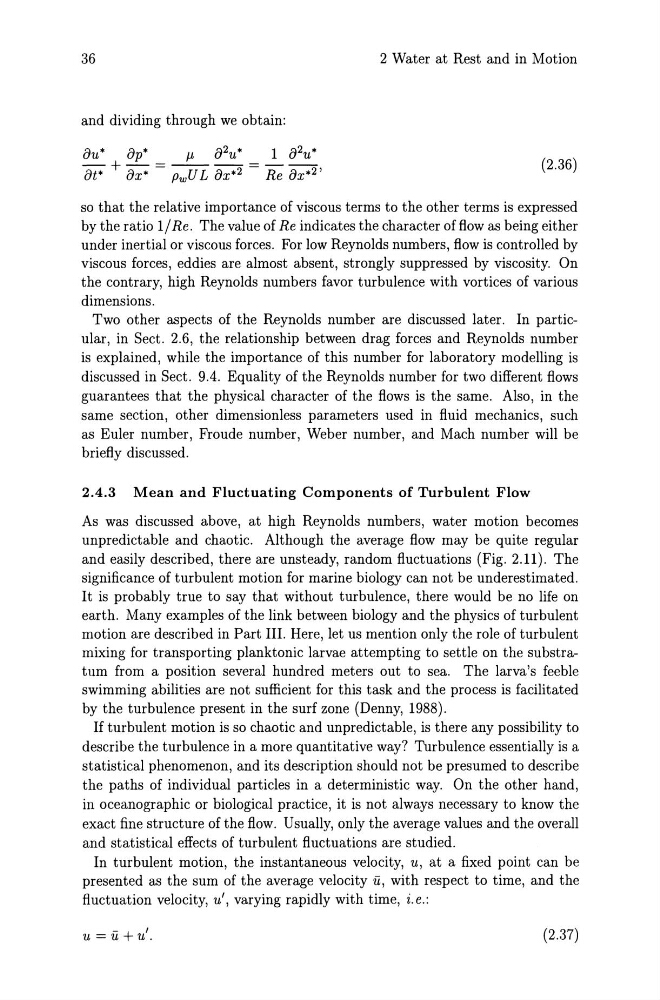
au' op'
/-L
02U'
1 02u'
- + - = - - - - = - - -
at' ax' PwU L ox· 2 Re ox· 2 '
(2.36)
so that the relative importance of viscous terms to the other terms is expressed
by the ratio 1/ Re. The value of Re indicates the character of flow as being either
under inertial or viscous forces. For low Reynolds numbers, flow is controlled by
viscous forces, eddies are almost absent, strongly suppressed by viscosity. On
the contrary, high Reynolds numbers favor turbulence with vortices of various
dimensions.
Two other aspects of the Reynolds number are discussed later. In particular, in Sect. 2.6, the relationship between drag forces and Reynolds number
is explained, while the importance of this number for laboratory modelling is
discussed in Sect. 9.4. Equality of the Reynolds number for two different flows
guarantees that the physical character of the flows is the same. Also, in the
same section, other dimensionless parameters used in fluid mechanics, such
as Euler number, Froude number, Weber number, and Mach number will be
briefly discussed.
2.4.3 Mean and Fluctuating Components of Turbulent Flow
As was discussed above, at high Reynolds numbers, water motion becomes
unpredictable and chaotic. Although the average flow may be quite regular
and easily described, there are unsteady, random fluctuations (Fig. 2.11). The
significance of turbulent motion for marine biology can not be underestimated.
It is probably true to say that without turbulence, there would be no life on
earth. Many examples of the link between biology and the physics of turbulent
motion are described in Part III. Here, let us mention only the role of turbulent
mixing for transporting planktonic larvae attempting to settle on the substratum from a position several hundred meters out to sea. The larva's feeble
swimming abilities are not sufficient for this task and the process is facilitated
by the turbulence present in the surf zone (Denny, 1988).
If turbulent motion is so chaotic and unpredictable, is there any possibility to
describe the turbulence in a more quantitative way? Turbulence essentially is a
statistical phenomenon, and its description should not be presumed to describe
the paths of individual particles in a deterministic way. On the other hand,
in oceanographic or biological practice, it is not always necessary to know the
exact fine structure of the flow. Usually, only the average values and the overall
and statistical effects of turbulent fluctuations are studied.
In turbulent motion, the instantaneous velocity, u, at a fixed point can be
presented as the sum of the average velocity ii, with respect to time, and the
fluctuation velocity, u', varying rapidly with time, i. e.:
U = ii +u'.
(2.37)
2 Water at Rest and in Motion
and dividing through we obtain:
au' op'
/-L
02U'
1 02u'
- + - = - - - - = - - -
at' ax' PwU L ox· 2 Re ox· 2 '
(2.36)
so that the relative importance of viscous terms to the other terms is expressed
by the ratio 1/ Re. The value of Re indicates the character of flow as being either
under inertial or viscous forces. For low Reynolds numbers, flow is controlled by
viscous forces, eddies are almost absent, strongly suppressed by viscosity. On
the contrary, high Reynolds numbers favor turbulence with vortices of various
dimensions.
Two other aspects of the Reynolds number are discussed later. In particular, in Sect. 2.6, the relationship between drag forces and Reynolds number
is explained, while the importance of this number for laboratory modelling is
discussed in Sect. 9.4. Equality of the Reynolds number for two different flows
guarantees that the physical character of the flows is the same. Also, in the
same section, other dimensionless parameters used in fluid mechanics, such
as Euler number, Froude number, Weber number, and Mach number will be
briefly discussed.
2.4.3 Mean and Fluctuating Components of Turbulent Flow
As was discussed above, at high Reynolds numbers, water motion becomes
unpredictable and chaotic. Although the average flow may be quite regular
and easily described, there are unsteady, random fluctuations (Fig. 2.11). The
significance of turbulent motion for marine biology can not be underestimated.
It is probably true to say that without turbulence, there would be no life on
earth. Many examples of the link between biology and the physics of turbulent
motion are described in Part III. Here, let us mention only the role of turbulent
mixing for transporting planktonic larvae attempting to settle on the substratum from a position several hundred meters out to sea. The larva's feeble
swimming abilities are not sufficient for this task and the process is facilitated
by the turbulence present in the surf zone (Denny, 1988).
If turbulent motion is so chaotic and unpredictable, is there any possibility to
describe the turbulence in a more quantitative way? Turbulence essentially is a
statistical phenomenon, and its description should not be presumed to describe
the paths of individual particles in a deterministic way. On the other hand,
in oceanographic or biological practice, it is not always necessary to know the
exact fine structure of the flow. Usually, only the average values and the overall
and statistical effects of turbulent fluctuations are studied.
In turbulent motion, the instantaneous velocity, u, at a fixed point can be
presented as the sum of the average velocity ii, with respect to time, and the
fluctuation velocity, u', varying rapidly with time, i. e.:
U = ii +u'.
(2.37)