

Appendix C Useful Theoretical Approaches and Formulas
483
C.2 Derivation of Mass Conservation Equation
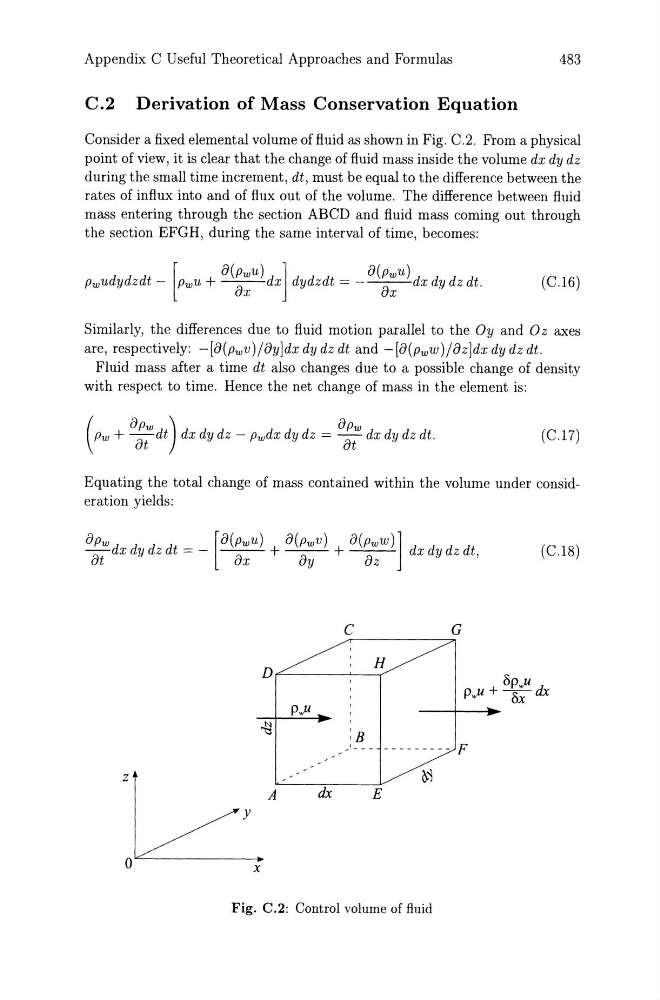
Consider a fixed elemental volume of fluid as shown in Fig. C.2. From a physical
point of view, it is clear that the change of fluid mass inside the volume dx dy dz
during the small time increment, dt, must be equal to the difference between the
rates of influx into and of flux out of the volume. The difference between fluid
mass entering through the section ABCD and fluid mass coming out through
the section EFGH, during the same interval of time, becomes:
[
O(PWU)]
o(Pwu)
Pwudydzdt - PwU + ---dx dydzdt = ----dx dy dz dt.
ax
ax
(C.16)
Similarly, the differences due to fluid motion parallel to the Oy and 0 z axes
are, respectively: -[o(pwv )/oyldx dy dz dt and -[o(Pww )/ozldx dy dz dt.
Fluid mass after a time dt also changes due to a possible change of density
with respect to time. Hence the net change of mass in the element is:
Pw + - d t dx dy dz - Pwdx dy dz = - dx dy dz dt.
(
opw)
opw
at
at
(C.17)
Equating the total change of mass contained within the volume under consideration yields:
oPw dx dy dz dt = _ [O(pw u ) + o(Pw v ) + O(pww)] dx dy dz dt,
at
ax
oy
oz
(C.18)
c
G
H
D r"'-----'------T'
--------- F
z
o.~
A
dx
E
y
o
x
Fig. C.2: Control volume of fluid
483
C.2 Derivation of Mass Conservation Equation
Consider a fixed elemental volume of fluid as shown in Fig. C.2. From a physical
point of view, it is clear that the change of fluid mass inside the volume dx dy dz
during the small time increment, dt, must be equal to the difference between the
rates of influx into and of flux out of the volume. The difference between fluid
mass entering through the section ABCD and fluid mass coming out through
the section EFGH, during the same interval of time, becomes:
[
O(PWU)]
o(Pwu)
Pwudydzdt - PwU + ---dx dydzdt = ----dx dy dz dt.
ax
ax
(C.16)
Similarly, the differences due to fluid motion parallel to the Oy and 0 z axes
are, respectively: -[o(pwv )/oyldx dy dz dt and -[o(Pww )/ozldx dy dz dt.
Fluid mass after a time dt also changes due to a possible change of density
with respect to time. Hence the net change of mass in the element is:
Pw + - d t dx dy dz - Pwdx dy dz = - dx dy dz dt.
(
opw)
opw
at
at
(C.17)
Equating the total change of mass contained within the volume under consideration yields:
oPw dx dy dz dt = _ [O(pw u ) + o(Pw v ) + O(pww)] dx dy dz dt,
at
ax
oy
oz
(C.18)
c
G
H
D r"'-----'------T'
--------- F
z
o.~
A
dx
E
y
o
x
Fig. C.2: Control volume of fluid