

484
Appendix C Useful Theoretical Approaches and Formulas
and:
(C.19)
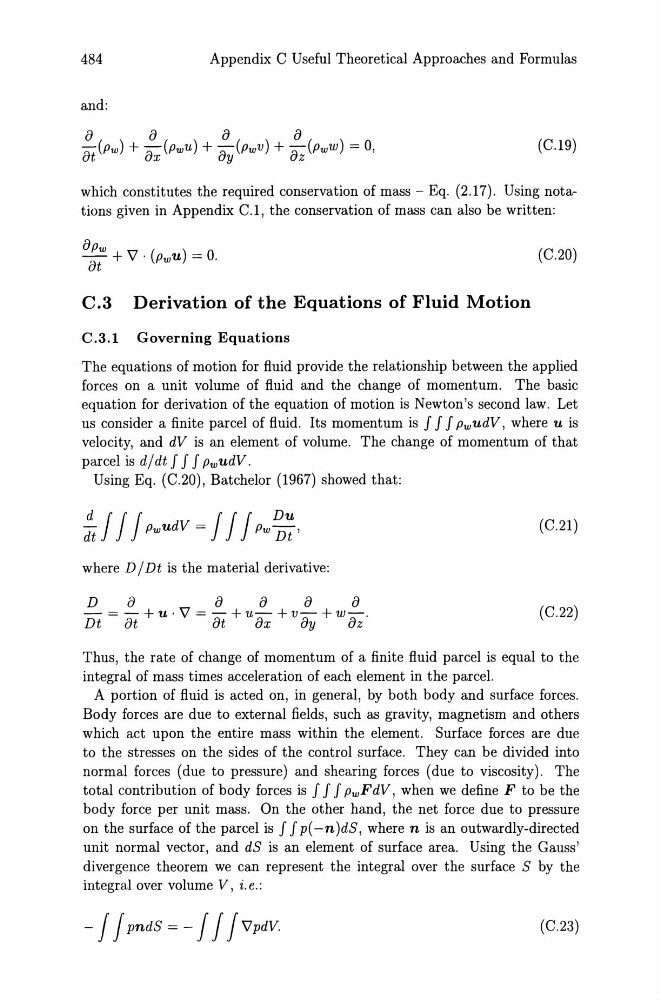
which constitutes the required conservation of mass - Eq. (2.17). Using notations given in Appendix C.1, the conservation of mass can also be written:
(C.20)
C.3 Derivation of the Equations of Fluid Motion
C.3.1 Governing Equations
The equations of motion for fluid provide the relationship between the applied
forces on a unit volume of fluid and the change of momentum. The basic
equation for derivation of the equation of motion is Newton's second law. Let
us consider a finite parcel of fluid. Its momentum is J J J PwudV, where u is
velocity, and dV is an element of volume. The change of momentum of that
parcel is d/ dt J J J PwudV .
Using Eq. (C.20), Batchelor (1967) showed that:
:t J J J Pw udV = J J J Pw ~~,
(C.21)
where D / Dt is the material derivative:
D a
a a a
a
- = -+u·\7 = -+u-+v-+w-.
Dt at
at ax ay az
(C.22)
Thus, the rate of change of momentum of a finite fluid parcel is equal to the
integral of mass times acceleration of each element in the parcel.
A portion of fluid is acted on, in general, by both body and surface forces.
Body forces are due to external fields, such as gravity, magnetism and others
which act upon the entire mass within the element. Surface forces are due
to the stresses on the sides of the control surface. They can be divided into
normal forces (due to pressure) and shearing forces (due to viscosity). The
total contribution of body forces is J J J PwFdV, when we define F to be the
body force per unit mass. On the other hand, the net force due to pressure
on the surface of the parcel is J J p( -n )dS, where n is an outwardly-directed
unit normal vector, and dS is an element of surface area. Using the Gauss'
divergence theorem we can represent the integral over the surface S by the
integral over volume V, i. e.:
-J J pndS = - J J J \7 pdV.
(C.23)
Appendix C Useful Theoretical Approaches and Formulas
and:
(C.19)
which constitutes the required conservation of mass - Eq. (2.17). Using notations given in Appendix C.1, the conservation of mass can also be written:
(C.20)
C.3 Derivation of the Equations of Fluid Motion
C.3.1 Governing Equations
The equations of motion for fluid provide the relationship between the applied
forces on a unit volume of fluid and the change of momentum. The basic
equation for derivation of the equation of motion is Newton's second law. Let
us consider a finite parcel of fluid. Its momentum is J J J PwudV, where u is
velocity, and dV is an element of volume. The change of momentum of that
parcel is d/ dt J J J PwudV .
Using Eq. (C.20), Batchelor (1967) showed that:
:t J J J Pw udV = J J J Pw ~~,
(C.21)
where D / Dt is the material derivative:
D a
a a a
a
- = -+u·\7 = -+u-+v-+w-.
Dt at
at ax ay az
(C.22)
Thus, the rate of change of momentum of a finite fluid parcel is equal to the
integral of mass times acceleration of each element in the parcel.
A portion of fluid is acted on, in general, by both body and surface forces.
Body forces are due to external fields, such as gravity, magnetism and others
which act upon the entire mass within the element. Surface forces are due
to the stresses on the sides of the control surface. They can be divided into
normal forces (due to pressure) and shearing forces (due to viscosity). The
total contribution of body forces is J J J PwFdV, when we define F to be the
body force per unit mass. On the other hand, the net force due to pressure
on the surface of the parcel is J J p( -n )dS, where n is an outwardly-directed
unit normal vector, and dS is an element of surface area. Using the Gauss'
divergence theorem we can represent the integral over the surface S by the
integral over volume V, i. e.:
-J J pndS = - J J J \7 pdV.
(C.23)