

482
Appendix C Useful Theoretical Approaches and Formulas
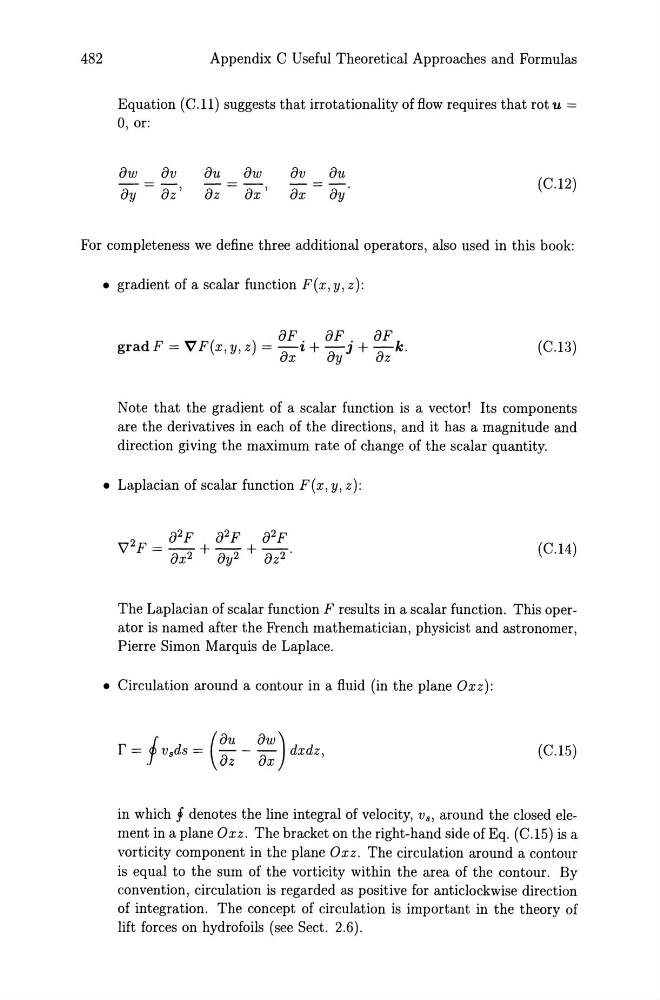
Equation (C.lI) suggests that irrotationality of flow requires that rot u =
0, or:
ow av au ow
ay
az'
az
ax'
av
au
ax
ay
(C.l2)
For completeness we define three additional operators, also used in this book:
• gradient of a scalar function F (x, y, z):
of. of. of
gradF = VF(x,y,z) = ax 1,+ ayJ + a;k.
(C.13)
Note that the gradient of a scalar function is a vector! Its components
are the derivatives in each of the directions, and it has a magnitude and
direction giving the maximum rate of change of the scalar quantity.
• Laplacian of scalar function F (x, y, z):
(C.14)
The Laplacian of scalar function F results in a scalar function. This operator is named after the French mathematician, physicist and astronomer,
Pierre Simon Marquis de Laplace.
• Circulation around a contour in a fluid (in the plane Oxz):
r = v ds = - - - dxdz
f ( aU ow)
S
az
ax
'
(C.15)
in which f denotes the line integral of velocity, V s , around the closed element in a plane 0 x z. The bracket on the right-hand side of Eq. (C .15) is a
vorticity component in the plane Oxz. The circulation around a contour
is equal to the sum of the vorticity within the area of the contour. By
convention, circulation is regarded as positive for anticlockwise direction
of integration. The concept of circulation is important in the theory of
lift forces on hydrofoils (see Sect. 2.6).
Appendix C Useful Theoretical Approaches and Formulas
Equation (C.lI) suggests that irrotationality of flow requires that rot u =
0, or:
ow av au ow
ay
az'
az
ax'
av
au
ax
ay
(C.l2)
For completeness we define three additional operators, also used in this book:
• gradient of a scalar function F (x, y, z):
of. of. of
gradF = VF(x,y,z) = ax 1,+ ayJ + a;k.
(C.13)
Note that the gradient of a scalar function is a vector! Its components
are the derivatives in each of the directions, and it has a magnitude and
direction giving the maximum rate of change of the scalar quantity.
• Laplacian of scalar function F (x, y, z):
(C.14)
The Laplacian of scalar function F results in a scalar function. This operator is named after the French mathematician, physicist and astronomer,
Pierre Simon Marquis de Laplace.
• Circulation around a contour in a fluid (in the plane Oxz):
r = v ds = - - - dxdz
f ( aU ow)
S
az
ax
'
(C.15)
in which f denotes the line integral of velocity, V s , around the closed element in a plane 0 x z. The bracket on the right-hand side of Eq. (C .15) is a
vorticity component in the plane Oxz. The circulation around a contour
is equal to the sum of the vorticity within the area of the contour. By
convention, circulation is regarded as positive for anticlockwise direction
of integration. The concept of circulation is important in the theory of
lift forces on hydrofoils (see Sect. 2.6).