

Appendix C Useful Theoretical Approaches and Formulas
481
In fluid mechanics, a vector and its components usually are functions of position
and time. This means that:
u(x, y, z, t) = u(x, y, z, t) i + v(x, y, z, t) j + w(x, y, z, t) k.
(C.8)
Using Eq. (C.8), two other important operations on vector u can be defined as
follows:
• the divergence of a vector, u, is a scalar function of vector components:
AU avow
divu = -+-+- AX oy oz'
(C.g)
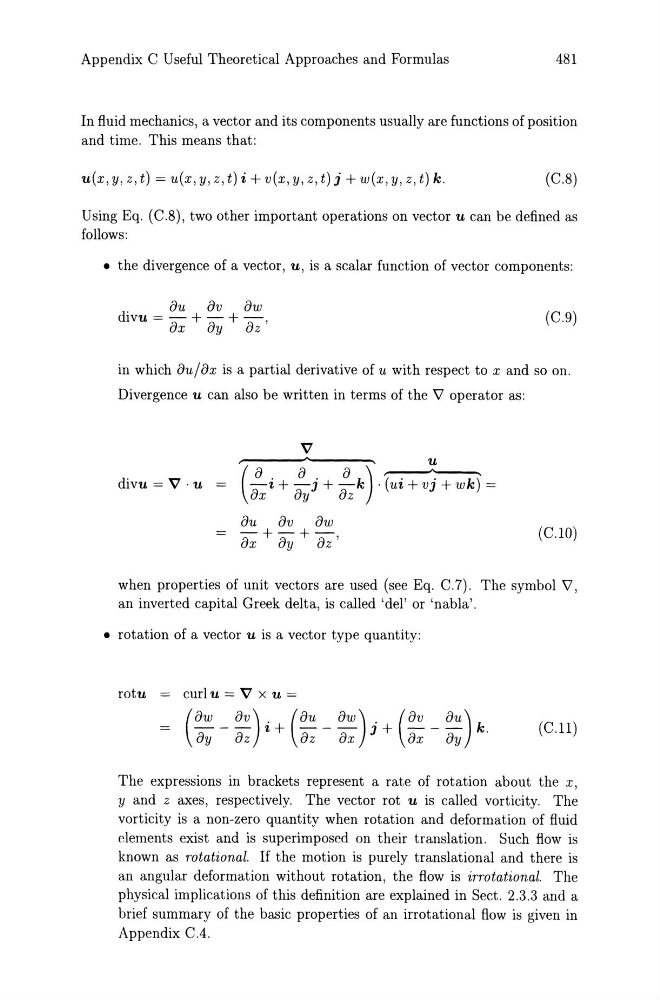
in which au/ax is a partial derivative of u with respect to x and so on.
Divergence u can also be written in terms of the '\7 operator as:
v
divu = V· u
'( a
a"
a )"
'If
,
-i+-j+-k ·(ui+vj+wk)=
ax
oy
oz
au avow
ax + oy + 7);'
(C.lO)
when properties of unit vectors are used (see Eq. C.7). The symbol '\7,
an inverted capital Greek delta, is called 'del' or 'nabla' .
• rotation of a vector u is a vector type quantity:
rotu
curl u = V x u =
( OW _ ov) i + (au _ ow) j + (ov _ au) k.
oy oz
oz ax
ax oy
(C.l1)
The expressions in brackets represent a rate of rotation about the x,
y and z axes, respectively. The vector rot u is called vorticity. The
vorticity is a non-zero quantity when rotation and deformation of fluid
elements exist and is superimposed on their translation. Such flow is
known as rotational. If the motion is purely translational and there is
an angular deformation without rotation, the flow is irrotational. The
physical implications of this definition are explained in Sect. 2.3.3 and a
brief summary of the basic properties of an irrotational flow is given in
Appendix C.4.
481
In fluid mechanics, a vector and its components usually are functions of position
and time. This means that:
u(x, y, z, t) = u(x, y, z, t) i + v(x, y, z, t) j + w(x, y, z, t) k.
(C.8)
Using Eq. (C.8), two other important operations on vector u can be defined as
follows:
• the divergence of a vector, u, is a scalar function of vector components:
AU avow
divu = -+-+- AX oy oz'
(C.g)
in which au/ax is a partial derivative of u with respect to x and so on.
Divergence u can also be written in terms of the '\7 operator as:
v
divu = V· u
'( a
a"
a )"
'If
,
-i+-j+-k ·(ui+vj+wk)=
ax
oy
oz
au avow
ax + oy + 7);'
(C.lO)
when properties of unit vectors are used (see Eq. C.7). The symbol '\7,
an inverted capital Greek delta, is called 'del' or 'nabla' .
• rotation of a vector u is a vector type quantity:
rotu
curl u = V x u =
( OW _ ov) i + (au _ ow) j + (ov _ au) k.
oy oz
oz ax
ax oy
(C.l1)
The expressions in brackets represent a rate of rotation about the x,
y and z axes, respectively. The vector rot u is called vorticity. The
vorticity is a non-zero quantity when rotation and deformation of fluid
elements exist and is superimposed on their translation. Such flow is
known as rotational. If the motion is purely translational and there is
an angular deformation without rotation, the flow is irrotational. The
physical implications of this definition are explained in Sect. 2.3.3 and a
brief summary of the basic properties of an irrotational flow is given in
Appendix C.4.