

480
Appendix C Useful Theoretical Approaches and Formulas
z
x
-3i
o
9i
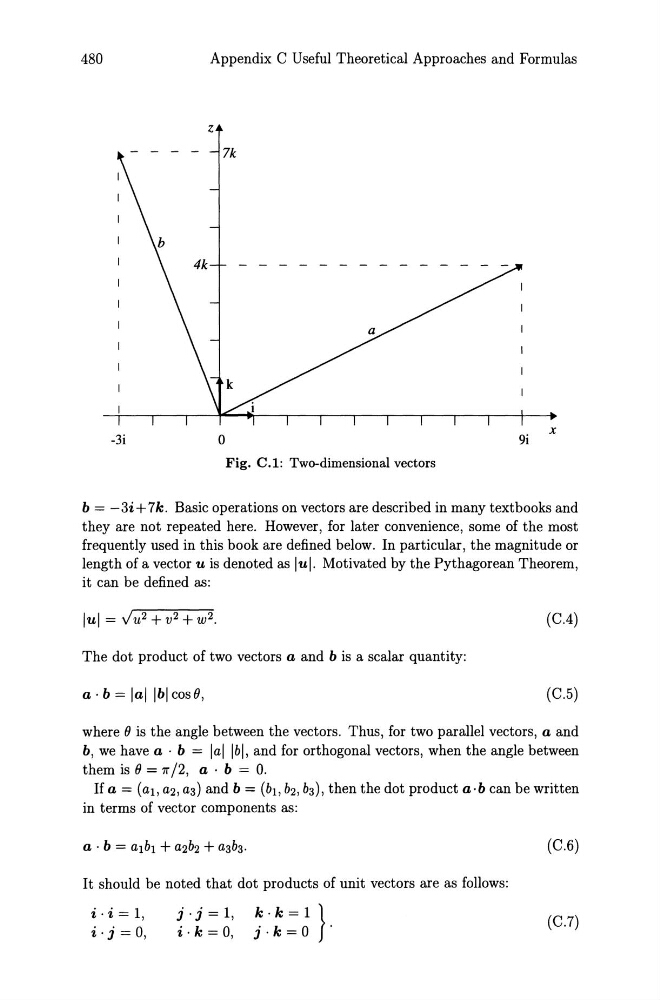
Fig. C.I: Two-dimensional vectors
b = -3i+ 7k. Basic operations on vectors are described in many textbooks and
they are not repeated here. However, for later convenience, some of the most
frequently used in this book are defined below. In particular, the magnitude or
length of a vector u is denoted as lui. Motivated by the Pythagorean Theorem,
it can be defined as:
(C.4)
The dot product of two vectors a and b is a scalar quantity:
a . b = lal Ibl cos 9,
(C.S)
where 9 is the angle between the vectors. Thus, for two parallel vectors, a and
b, we have a . b = lallbl, and for orthogonal vectors, when the angle between
them is 9 = 7r /2, a· b = O.
If a = (a!, a2, a3) and b = (bI, b2, b3), then the dot product a·b can be written
in terms of vector components as:
It should be noted that dot products of unit vectors are as follows:
i· i = 1,
i· j = 0,
j. j = 1,
i· k = 0,
k·k=1 }
j·k = 0 .
(C.6)
(C.7)
Appendix C Useful Theoretical Approaches and Formulas
z
x
-3i
o
9i
Fig. C.I: Two-dimensional vectors
b = -3i+ 7k. Basic operations on vectors are described in many textbooks and
they are not repeated here. However, for later convenience, some of the most
frequently used in this book are defined below. In particular, the magnitude or
length of a vector u is denoted as lui. Motivated by the Pythagorean Theorem,
it can be defined as:
(C.4)
The dot product of two vectors a and b is a scalar quantity:
a . b = lal Ibl cos 9,
(C.S)
where 9 is the angle between the vectors. Thus, for two parallel vectors, a and
b, we have a . b = lallbl, and for orthogonal vectors, when the angle between
them is 9 = 7r /2, a· b = O.
If a = (a!, a2, a3) and b = (bI, b2, b3), then the dot product a·b can be written
in terms of vector components as:
It should be noted that dot products of unit vectors are as follows:
i· i = 1,
i· j = 0,
j. j = 1,
i· k = 0,
k·k=1 }
j·k = 0 .
(C.6)
(C.7)