

15.6 Tidal Mixing and Phytoplankton Production
465
A change in water temperature depends on a change of heat, b.Q, added to the
water. In particular, the absorption of short-wave radiation by water in the
upper layer results in an increase of temperature as follows:
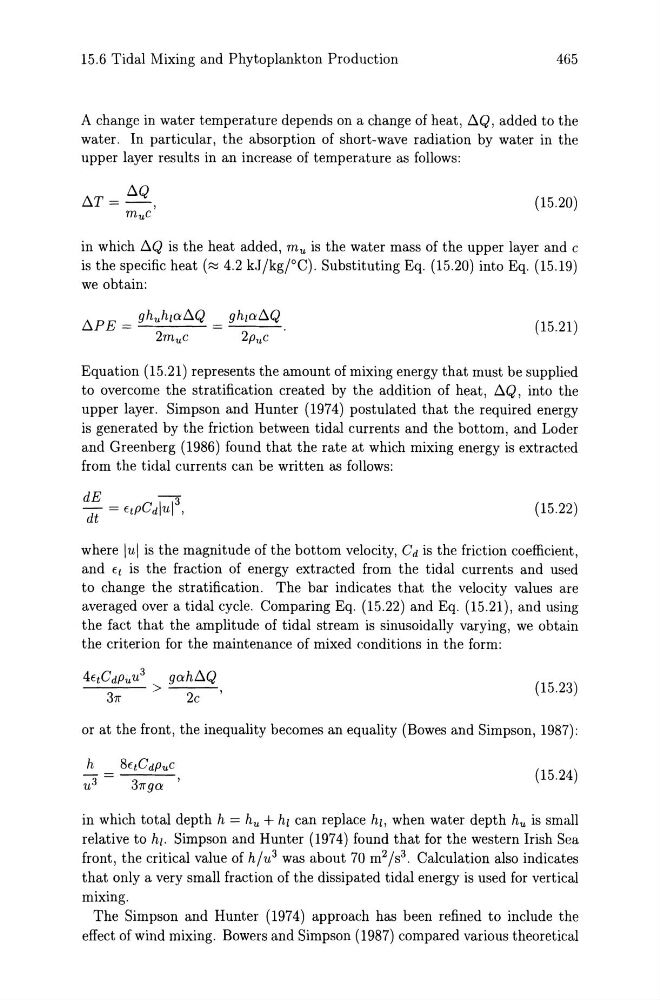
(15.20)
in which b.Q is the heat added, mu is the water mass of the upper layer and c
is the specific heat (~ 4.2 kJ/kg;oC). Substituting Eq. (15.20) into Eq. (15.19)
we obtain:
(15.21)
Equation (15.21) represents the amount of mixing energy that must be supplied
to overcome the stratification created by the addition of heat, b.Q, into the
upper layer. Simpson and Hunter (1974) postulated that the required energy
is generated by the friction between tidal currents and the bottom, and Loder
and Greenberg (1986) found that the rate at which mixing energy is extracted
from the tidal currents can be written as follows:
(15.22)
where lui is the magnitude of the bottom velocity, Cd is the friction coefficient,
and Et is the fraction of energy extracted from the tidal currents and used
to change the stratification. The bar indicates that the velocity values are
averaged over a tidal cycle. Comparing Eq. (15.22) and Eq. (15.21), and using
the fact that the amplitude of tidal stream is sinusoidally varying, we obtain
the criterion for the maintenance of mixed conditions in the form:
(15.23)
or at the front, the inequality becomes an equality (Bowes and Simpson, 1987):
h
8EtCdPuc
u 3
37rga'
(15.24)
in which total depth h = hu + hz can replace hz, when water depth hu is small
relative to hz. Simpson and Hunter (1974) found that for the western Irish Sea
front, the critical value of h/u 3 was about 70 m 2 /s 3 . Calculation also indicates
that only a very small fraction of the dissipated tidal energy is used for vertical
mixing.
The Simpson and Hunter (1974) approach has been refined to include the
effect of wind mixing. Bowers and Simpson (1987) compared various theoretical
465
A change in water temperature depends on a change of heat, b.Q, added to the
water. In particular, the absorption of short-wave radiation by water in the
upper layer results in an increase of temperature as follows:
(15.20)
in which b.Q is the heat added, mu is the water mass of the upper layer and c
is the specific heat (~ 4.2 kJ/kg;oC). Substituting Eq. (15.20) into Eq. (15.19)
we obtain:
(15.21)
Equation (15.21) represents the amount of mixing energy that must be supplied
to overcome the stratification created by the addition of heat, b.Q, into the
upper layer. Simpson and Hunter (1974) postulated that the required energy
is generated by the friction between tidal currents and the bottom, and Loder
and Greenberg (1986) found that the rate at which mixing energy is extracted
from the tidal currents can be written as follows:
(15.22)
where lui is the magnitude of the bottom velocity, Cd is the friction coefficient,
and Et is the fraction of energy extracted from the tidal currents and used
to change the stratification. The bar indicates that the velocity values are
averaged over a tidal cycle. Comparing Eq. (15.22) and Eq. (15.21), and using
the fact that the amplitude of tidal stream is sinusoidally varying, we obtain
the criterion for the maintenance of mixed conditions in the form:
(15.23)
or at the front, the inequality becomes an equality (Bowes and Simpson, 1987):
h
8EtCdPuc
u 3
37rga'
(15.24)
in which total depth h = hu + hz can replace hz, when water depth hu is small
relative to hz. Simpson and Hunter (1974) found that for the western Irish Sea
front, the critical value of h/u 3 was about 70 m 2 /s 3 . Calculation also indicates
that only a very small fraction of the dissipated tidal energy is used for vertical
mixing.
The Simpson and Hunter (1974) approach has been refined to include the
effect of wind mixing. Bowers and Simpson (1987) compared various theoretical