

466
15 Vertical Structure of Ocean Waters and Biological Productivity
approaches with observed positions of tidal fronts on the European shelf seas
and found that the models incorporating wind mixing are most accurate. The
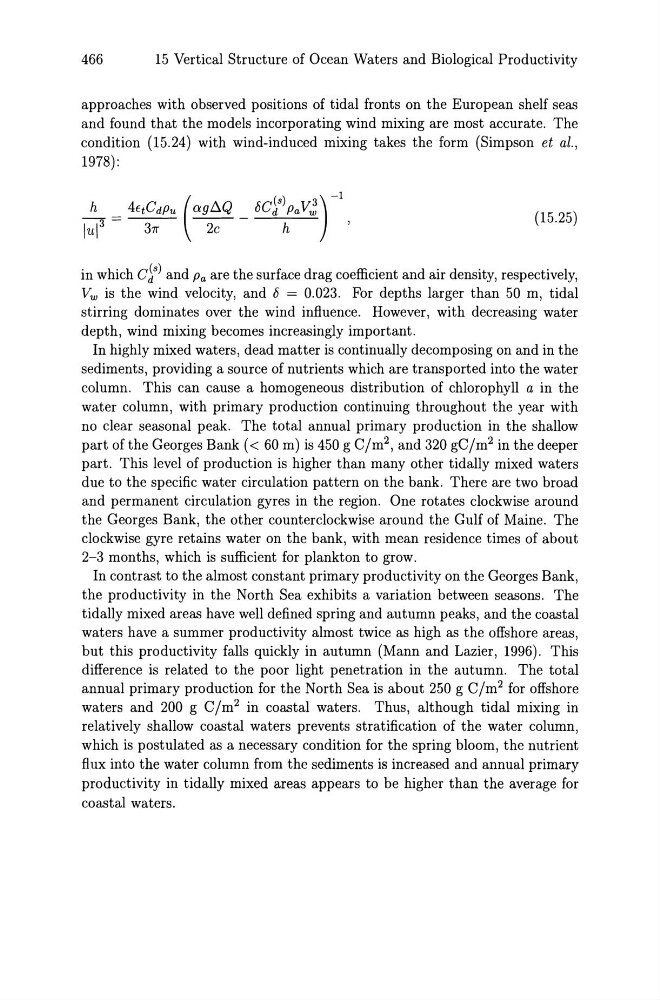
condition (15.24) with wind-induced mixing takes the form (Simpson et at.,
1978) :
(15.25)
in which Cds) and Pa are the surface drag coefficient and air density, respectively,
Vw is the wind velocity, and {j = 0.023. For depths larger than 50 m, tidal
stirring dominates over the wind influence. However, with decreasing water
depth, wind mixing becomes increasingly important.
In highly mixed waters, dead matter is continually decomposing on and in the
sediments, providing a source of nutrients which are transported into the water
column. This can cause a homogeneous distribution of chlorophyll a in the
water column, with primary production continuing throughout the year with
no clear seasonal peak. The total annual primary production in the shallow
part ofthe Georges Bank « 60 m) is 450 g C/m 2 , and 320 gC/m 2 in the deeper
part. This level of production is higher than many other tidally mixed waters
due to the specific water circulation pattern on the bank. There are two broad
and permanent circulation gyres in the region. One rotates clockwise around
the Georges Bank, the other counterclockwise around the Gulf of Maine. The
clockwise gyre retains water on the bank, with mean residence times of about
2-3 months, which is sufficient for plankton to grow.
In contrast to the almost constant primary productivity on the Georges Bank,
the productivity in the North Sea exhibits a variation between seasons. The
tidally mixed areas have well defined spring and autumn peaks, and the coastal
waters have a summer productivity almost twice as high as the offshore areas,
but this productivity falls quickly in autumn (Mann and Lazier, 1996). This
difference is related to the poor light penetration in the autumn. The total
annual primary production for the North Sea is about 250 g C/m 2 for offshore
waters and 200 g C/m 2 in coastal waters. Thus, although tidal mixing in
relatively shallow coastal waters prevents stratification of the water column,
which is postulated as a necessary condition for the spring bloom, the nutrient
flux into the water column from the sediments is increased and annual primary
productivity in tidally mixed areas appears to be higher than the average for
coastal waters.
15 Vertical Structure of Ocean Waters and Biological Productivity
approaches with observed positions of tidal fronts on the European shelf seas
and found that the models incorporating wind mixing are most accurate. The
condition (15.24) with wind-induced mixing takes the form (Simpson et at.,
1978) :
(15.25)
in which Cds) and Pa are the surface drag coefficient and air density, respectively,
Vw is the wind velocity, and {j = 0.023. For depths larger than 50 m, tidal
stirring dominates over the wind influence. However, with decreasing water
depth, wind mixing becomes increasingly important.
In highly mixed waters, dead matter is continually decomposing on and in the
sediments, providing a source of nutrients which are transported into the water
column. This can cause a homogeneous distribution of chlorophyll a in the
water column, with primary production continuing throughout the year with
no clear seasonal peak. The total annual primary production in the shallow
part ofthe Georges Bank « 60 m) is 450 g C/m 2 , and 320 gC/m 2 in the deeper
part. This level of production is higher than many other tidally mixed waters
due to the specific water circulation pattern on the bank. There are two broad
and permanent circulation gyres in the region. One rotates clockwise around
the Georges Bank, the other counterclockwise around the Gulf of Maine. The
clockwise gyre retains water on the bank, with mean residence times of about
2-3 months, which is sufficient for plankton to grow.
In contrast to the almost constant primary productivity on the Georges Bank,
the productivity in the North Sea exhibits a variation between seasons. The
tidally mixed areas have well defined spring and autumn peaks, and the coastal
waters have a summer productivity almost twice as high as the offshore areas,
but this productivity falls quickly in autumn (Mann and Lazier, 1996). This
difference is related to the poor light penetration in the autumn. The total
annual primary production for the North Sea is about 250 g C/m 2 for offshore
waters and 200 g C/m 2 in coastal waters. Thus, although tidal mixing in
relatively shallow coastal waters prevents stratification of the water column,
which is postulated as a necessary condition for the spring bloom, the nutrient
flux into the water column from the sediments is increased and annual primary
productivity in tidally mixed areas appears to be higher than the average for
coastal waters.