

464
15 Vertical Structure of Ocean Waters and Biological Productivity
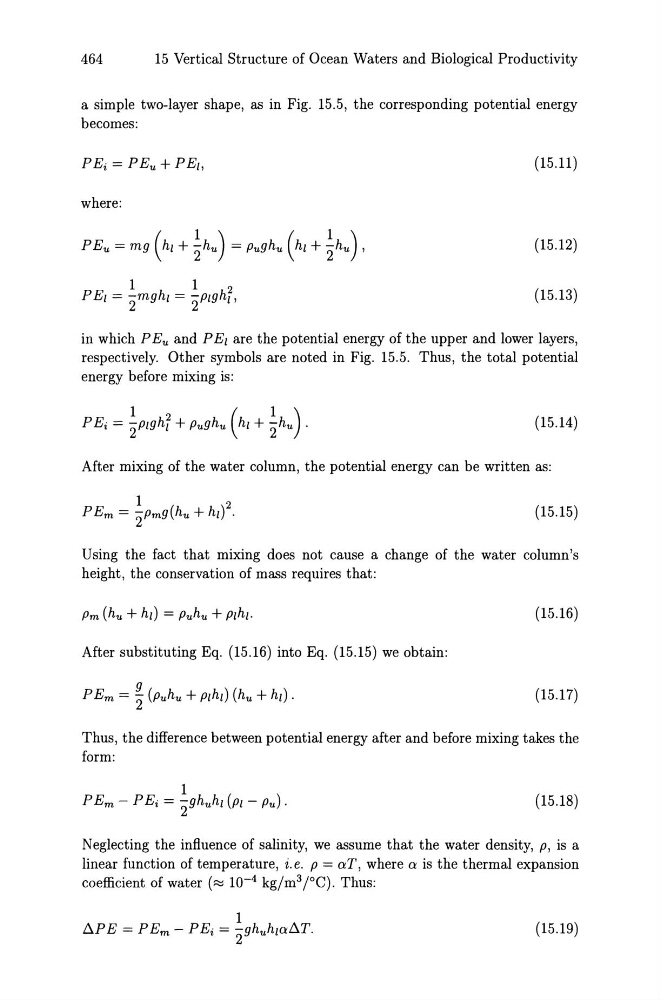
a simple two-layer shape, as in Fig. 15.5, the corresponding potential energy
becomes:
(15.11)
where:
P Eu = mg (hi + ~hu) = Pughu (hi + ~hu) ,
(15.12)
1
1
2
PEl = 2mghl = 2P19hl'
(15.13)
in which P Eu and PEl are the potential energy of the upper and lower layers,
respectively. Other symbols are noted in Fig. 15.5. Thus, the total potential
energy before mixing is:
(15.14)
After mixing of the water column, the potential energy can be written as:
(15.15)
Using the fact that mixing does not cause a change of the water column's
height, the conservation of mass requires that:
(15.16)
After substituting Eq. (15.16) into Eq. (15.15) we obtain:
(15.17)
Thus, the difference between potential energy after and before mixing takes the
form:
(15.18)
Neglecting the influence of salinity, we assume that the water density, p, is a
linear function of temperature, i. e. P = aT, where a is the thermal expansion
coefficient of water (;::::, 10- 4 kg/m 3 rC). Thus:
(15.19)
15 Vertical Structure of Ocean Waters and Biological Productivity
a simple two-layer shape, as in Fig. 15.5, the corresponding potential energy
becomes:
(15.11)
where:
P Eu = mg (hi + ~hu) = Pughu (hi + ~hu) ,
(15.12)
1
1
2
PEl = 2mghl = 2P19hl'
(15.13)
in which P Eu and PEl are the potential energy of the upper and lower layers,
respectively. Other symbols are noted in Fig. 15.5. Thus, the total potential
energy before mixing is:
(15.14)
After mixing of the water column, the potential energy can be written as:
(15.15)
Using the fact that mixing does not cause a change of the water column's
height, the conservation of mass requires that:
(15.16)
After substituting Eq. (15.16) into Eq. (15.15) we obtain:
(15.17)
Thus, the difference between potential energy after and before mixing takes the
form:
(15.18)
Neglecting the influence of salinity, we assume that the water density, p, is a
linear function of temperature, i. e. P = aT, where a is the thermal expansion
coefficient of water (;::::, 10- 4 kg/m 3 rC). Thus:
(15.19)