

448
14 Tides and Waves on Vegetated Coasts
to 3 m long. The presence of considerable number of 'decapitated' stipes suggests that they were damaged by strong currents in the strait. Mechanical test
showed that large kelp (6-7 year old) break at or very near to the stipe-lamina
junction under the force of 255 N. The junction is usually the narrowest part
of the Laminaria plant and is composed of young meristematic tissue (Drew
et at., 1982). A drag formula (2.63) suggests that the force of about 255 N is
exceeded at current velocity of about 2.9 m/s. Seasonal variation of currents
in the strait show that the highest value is about 3.07 m/s.
The situation is more complicated when the flexible organisms, such as kelps,
have to withstand forces in the wave-swept environment when the velocities and
accelerations may be large. Waves passing over the plants induce drag forces
on the lamina, causing lateral swaying of both the stipe and lamina. There
are a few mathematical models recently proposed to describe the dynamics of
the kelp stipe/lamina system (Denny, 1988; Dubi and Torum, 1994; Denny
et at., 1998). All models are based on the theory of vibrations of mechanical
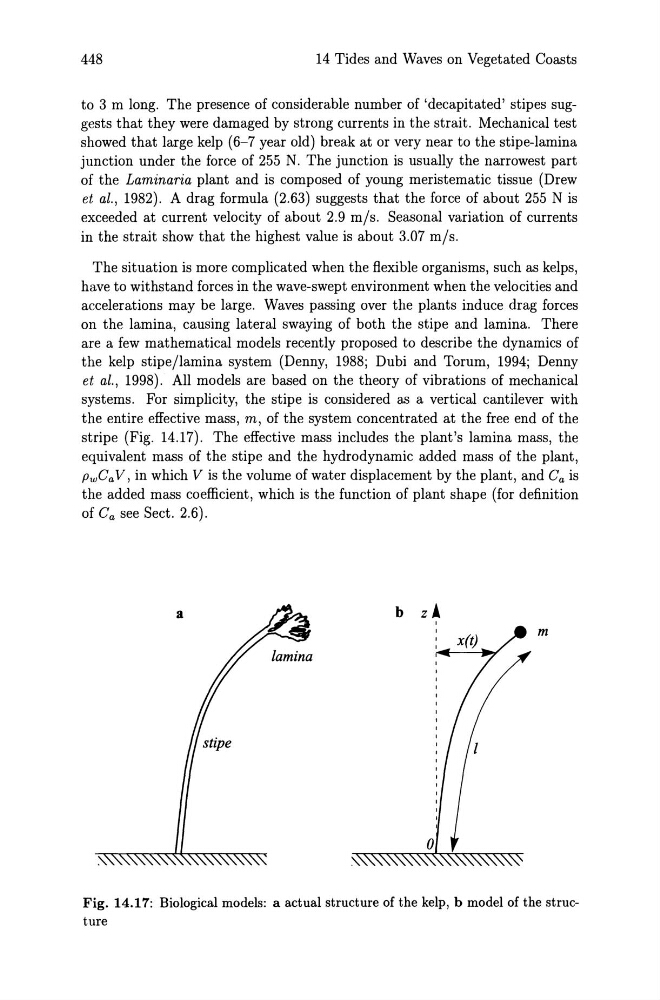
systems. For simplicity, the stipe is considered as a vertical cantilever with
the entire effective mass, m, of the system concentrated at the free end of the
stripe (Fig. 14.17). The effective mass includes the plant's lamina mass, the
equivalent mass of the stipe and the hydrodynamic added mass of the plant,
PwCa V, in which V is the volume of water displacement by the plant, and Ca is
the added mass coefficient, which is the function of plant shape (for definition
of Ca see Sect. 2.6).
a
b z A ,
m
Fig. 14.17: Biological models: a actual structure of the kelp, b model of the structure
14 Tides and Waves on Vegetated Coasts
to 3 m long. The presence of considerable number of 'decapitated' stipes suggests that they were damaged by strong currents in the strait. Mechanical test
showed that large kelp (6-7 year old) break at or very near to the stipe-lamina
junction under the force of 255 N. The junction is usually the narrowest part
of the Laminaria plant and is composed of young meristematic tissue (Drew
et at., 1982). A drag formula (2.63) suggests that the force of about 255 N is
exceeded at current velocity of about 2.9 m/s. Seasonal variation of currents
in the strait show that the highest value is about 3.07 m/s.
The situation is more complicated when the flexible organisms, such as kelps,
have to withstand forces in the wave-swept environment when the velocities and
accelerations may be large. Waves passing over the plants induce drag forces
on the lamina, causing lateral swaying of both the stipe and lamina. There
are a few mathematical models recently proposed to describe the dynamics of
the kelp stipe/lamina system (Denny, 1988; Dubi and Torum, 1994; Denny
et at., 1998). All models are based on the theory of vibrations of mechanical
systems. For simplicity, the stipe is considered as a vertical cantilever with
the entire effective mass, m, of the system concentrated at the free end of the
stripe (Fig. 14.17). The effective mass includes the plant's lamina mass, the
equivalent mass of the stipe and the hydrodynamic added mass of the plant,
PwCa V, in which V is the volume of water displacement by the plant, and Ca is
the added mass coefficient, which is the function of plant shape (for definition
of Ca see Sect. 2.6).
a
b z A ,
m
Fig. 14.17: Biological models: a actual structure of the kelp, b model of the structure