

14.4 Seaweeds and Seagrasses
447
total kelp biomass along the Norwegian coast has been estimated at some 10
million tones and about 160,000 tones of kelp is harvested annually for chemical
production. The harvesting of seaweeds has been a controversial issue, as there
exists a public perception that kelp can somehow detrimentally or beneficially
affect beach widths. It is reasonable to assume that a kelp bed must alter the
incoming wave to have any effect on beaches, and seaweeds are known to reduce
wave energy when waves propagate through them.
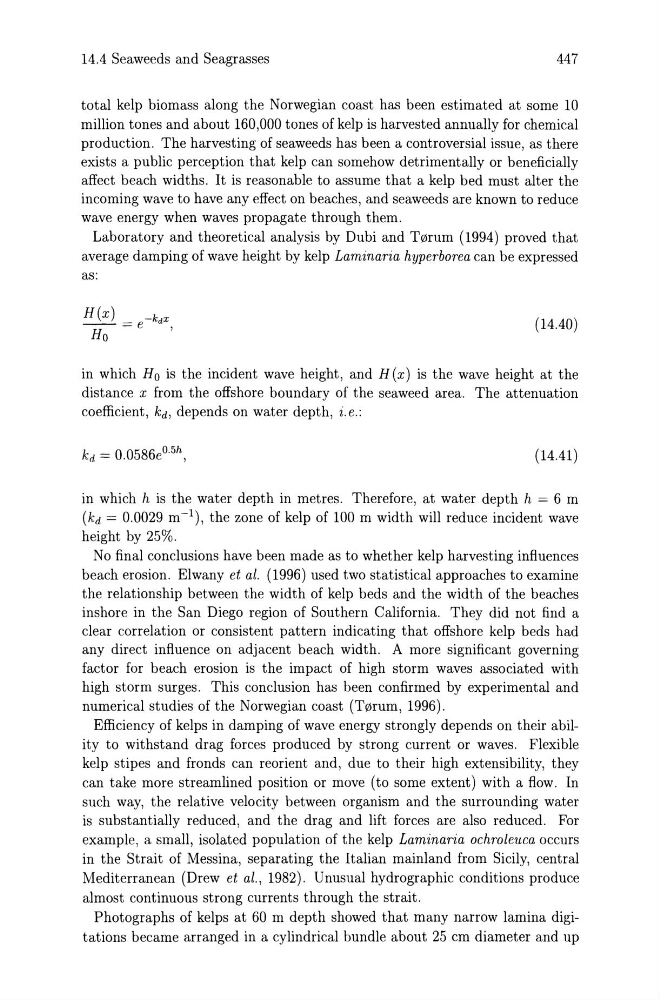
Laboratory and theoretical analysis by Dubi and T0rum (1994) proved that
average damping of wave height by kelp Laminaria hyperborea can be expressed
as:
H(x)
-k x
- - = e d
Ho
'
(14.40)
in which Ho is the incident wave height, and H(x) is the wave height at the
distance x from the offshore boundary of the seaweed area. The attenuation
coefficient, kd, depends on water depth, i. e.:
(14.41)
in which h is the water depth in metres. Therefore, at water depth h = 6 m
(kd = 0.0029 m- I ), the zone of kelp of 100 m width will reduce incident wave
height by 25%.
No final conclusions have been made as to whether kelp harvesting influences
beach erosion. Elwany et al. (1996) used two statistical approaches to examine
the relationship between the width of kelp beds and the width of the beaches
inshore in the San Diego region of Southern California. They did not find a
clear correlation or consistent pattern indicating that offshore kelp beds had
any direct influence on adjacent beach width. A more significant governing
factor for beach erosion is the impact of high storm waves associated with
high storm surges. This conclusion has been confirmed by experimental and
numerical studies of the Norwegian coast (T0rum, 1996).
Efficiency of kelps in damping of wave energy strongly depends on their ability to withstand drag forces produced by strong current or waves. Flexible
kelp stipes and fronds can reorient and, due to their high extensibility, they
can take more streamlined position or move (to some extent) with a flow. In
such way, the relative velocity between organism and the surrounding water
is substantially reduced, and the drag and lift forces are also reduced. For
example, a small, isolated population of the kelp Laminaria ochroleuca occurs
in the Strait of Messina, separating the Italian mainland from Sicily, central
Mediterranean (Drew et ai., 1982). Unusual hydrographic conditions produce
almost continuous strong currents through the strait.
Photographs of kelps at 60 m depth showed that many narrow lamina digitations became arranged in a cylindrical bundle about 25 cm diameter and up
447
total kelp biomass along the Norwegian coast has been estimated at some 10
million tones and about 160,000 tones of kelp is harvested annually for chemical
production. The harvesting of seaweeds has been a controversial issue, as there
exists a public perception that kelp can somehow detrimentally or beneficially
affect beach widths. It is reasonable to assume that a kelp bed must alter the
incoming wave to have any effect on beaches, and seaweeds are known to reduce
wave energy when waves propagate through them.
Laboratory and theoretical analysis by Dubi and T0rum (1994) proved that
average damping of wave height by kelp Laminaria hyperborea can be expressed
as:
H(x)
-k x
- - = e d
Ho
'
(14.40)
in which Ho is the incident wave height, and H(x) is the wave height at the
distance x from the offshore boundary of the seaweed area. The attenuation
coefficient, kd, depends on water depth, i. e.:
(14.41)
in which h is the water depth in metres. Therefore, at water depth h = 6 m
(kd = 0.0029 m- I ), the zone of kelp of 100 m width will reduce incident wave
height by 25%.
No final conclusions have been made as to whether kelp harvesting influences
beach erosion. Elwany et al. (1996) used two statistical approaches to examine
the relationship between the width of kelp beds and the width of the beaches
inshore in the San Diego region of Southern California. They did not find a
clear correlation or consistent pattern indicating that offshore kelp beds had
any direct influence on adjacent beach width. A more significant governing
factor for beach erosion is the impact of high storm waves associated with
high storm surges. This conclusion has been confirmed by experimental and
numerical studies of the Norwegian coast (T0rum, 1996).
Efficiency of kelps in damping of wave energy strongly depends on their ability to withstand drag forces produced by strong current or waves. Flexible
kelp stipes and fronds can reorient and, due to their high extensibility, they
can take more streamlined position or move (to some extent) with a flow. In
such way, the relative velocity between organism and the surrounding water
is substantially reduced, and the drag and lift forces are also reduced. For
example, a small, isolated population of the kelp Laminaria ochroleuca occurs
in the Strait of Messina, separating the Italian mainland from Sicily, central
Mediterranean (Drew et ai., 1982). Unusual hydrographic conditions produce
almost continuous strong currents through the strait.
Photographs of kelps at 60 m depth showed that many narrow lamina digitations became arranged in a cylindrical bundle about 25 cm diameter and up