

14.4 Seaweeds and Seagrasses
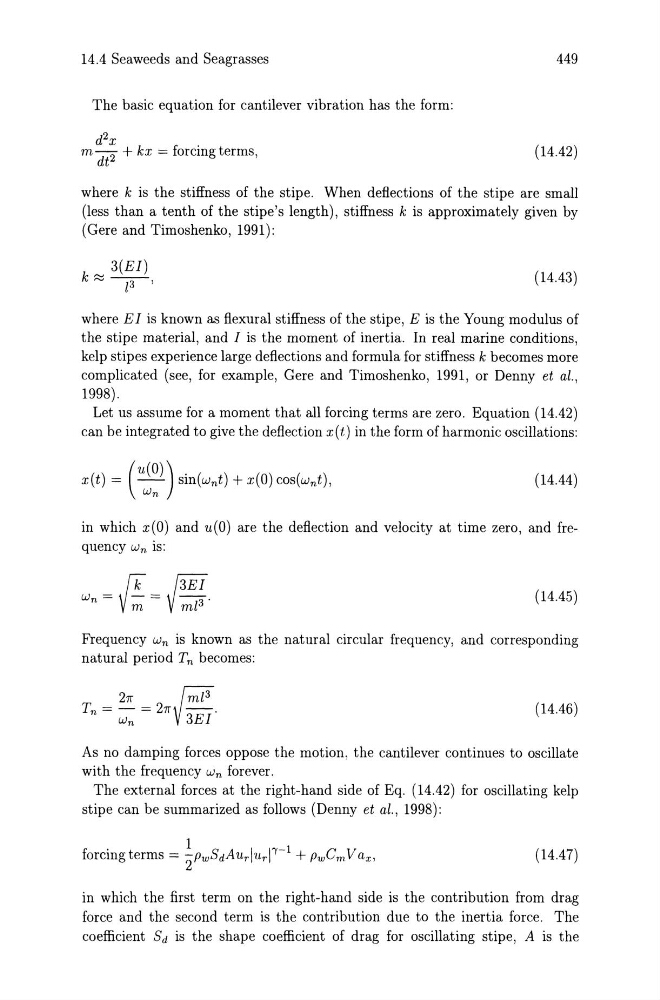
The basic equation for cantilever vibration has the form:
d 2 x
m - 2 + kx = forcing terms,
dt
449
(14.42)
where k is the stiffness of the stipe. When deflections of the stipe are small
(less than a tenth of the stipe's length), stiffness k is approximately given by
(Gere and Timoshenko, 1991):
3(EI)
k>:::; -1- 3 - '
(14.43)
where EI is known as flexural stiffness of the stipe, E is the Young modulus of
the stipe material, and I is the moment of inertia. In real marine conditions,
kelp stipes experience large deflections and formula for stiffness k becomes more
complicated (see, for example, Gere and Timoshenko, 1991, or Denny et al.,
1998) .
Let us assume for a moment that all forcing terms are zero. Equation (14.42)
can be integrated to give the deflection x (t) in the form of harmonic oscillations:
( U(O)) .
x(t) = Wn sm(wnt) + x(O) cos(Wnt) ,
(14.44)
in which x(O) and u(O) are the deflection and velocity at time zero, and frequency w'" is:
(14.45)
Frequency Wn is known as the natural circular frequency, and corresponding
natural period Tn becomes:
(14.46)
As no damping forces oppose the motion, the cantilever continues to oscillate
with the frequency w'" forever.
The external forces at the right-hand side of Eq. (14.42) for oscillating kelp
stipe can be summarized as follows (Denny et al., 1998):
(14.47)
in which the first term on the right-hand side is the contribution from drag
force and the second term is the contribution due to the inertia force. The
coefficient Sd is the shape coefficient of drag for oscillating stipe, A is the
The basic equation for cantilever vibration has the form:
d 2 x
m - 2 + kx = forcing terms,
dt
449
(14.42)
where k is the stiffness of the stipe. When deflections of the stipe are small
(less than a tenth of the stipe's length), stiffness k is approximately given by
(Gere and Timoshenko, 1991):
3(EI)
k>:::; -1- 3 - '
(14.43)
where EI is known as flexural stiffness of the stipe, E is the Young modulus of
the stipe material, and I is the moment of inertia. In real marine conditions,
kelp stipes experience large deflections and formula for stiffness k becomes more
complicated (see, for example, Gere and Timoshenko, 1991, or Denny et al.,
1998) .
Let us assume for a moment that all forcing terms are zero. Equation (14.42)
can be integrated to give the deflection x (t) in the form of harmonic oscillations:
( U(O)) .
x(t) = Wn sm(wnt) + x(O) cos(Wnt) ,
(14.44)
in which x(O) and u(O) are the deflection and velocity at time zero, and frequency w'" is:
(14.45)
Frequency Wn is known as the natural circular frequency, and corresponding
natural period Tn becomes:
(14.46)
As no damping forces oppose the motion, the cantilever continues to oscillate
with the frequency w'" forever.
The external forces at the right-hand side of Eq. (14.42) for oscillating kelp
stipe can be summarized as follows (Denny et al., 1998):
(14.47)
in which the first term on the right-hand side is the contribution from drag
force and the second term is the contribution due to the inertia force. The
coefficient Sd is the shape coefficient of drag for oscillating stipe, A is the