

14.4 Waves at Coral Reefs
443
""' 5
S
12 m
'-"
....
..c bI)
.i)
4
..c
~
9m
;>
~
~
3
6m
2
3m
o
0.0
0.5
1.0
1.5
2.0
2.5
Coral diameter (m)
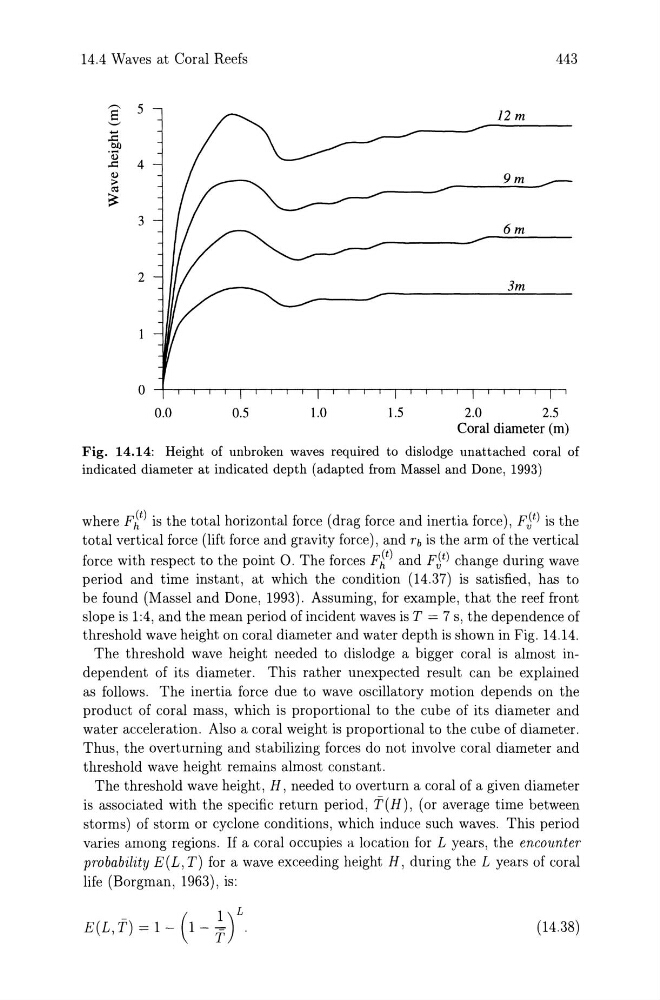
Fig. 14.14: Height of unbroken waves required to dislodge unattached coral of
indicated diameter at indicated depth (adapted from Massel and Done, 1993)
where F~t) is the total horizontal force (drag force and inertia force), FS t ) is the
total vertical force (lift force and gravity force), and fb is the arm of the vertical
force with respect to the point O. The forces F~t) and FS t ) change during wave
period and time instant, at which the condition (14.37) is satisfied, has to
be found (Massel and Done, 1993). Assuming, for example, that the reef front
slope is 1:4, and the mean period of incident waves is T = 7 s, the dependence of
threshold wave height on coral diameter and water depth is shown in Fig. 14.14.
The threshold wave height needed to dislodge a bigger coral is almost independent of its diameter. This rather unexpected result can be explained
as follows. The inertia force due to wave oscillatory motion depends on the
product of coral mass, which is proportional to the cube of its diameter and
water acceleration. Also a coral weight is proportional to the cube of diameter.
Thus, the overturning and stabilizing forces do not involve coral diameter and
threshold wave height remains almost constant.
The threshold wave height, H, needed to overturn a coral of a given diameter
is associated with the specific return period, t(H), (or average time between
storms) of storm or cyclone conditions, which induce such waves. This period
varies among regions. If a coral occupies a location for L years, the encounter
probability E (L, T) for a wave exceeding height H, during the L years of coral
life (Borgman, 1963), is:
(14.38)
443
""' 5
S
12 m
'-"
....
..c bI)
.i)
4
..c
~
9m
;>
~
~
3
6m
2
3m
o
0.0
0.5
1.0
1.5
2.0
2.5
Coral diameter (m)
Fig. 14.14: Height of unbroken waves required to dislodge unattached coral of
indicated diameter at indicated depth (adapted from Massel and Done, 1993)
where F~t) is the total horizontal force (drag force and inertia force), FS t ) is the
total vertical force (lift force and gravity force), and fb is the arm of the vertical
force with respect to the point O. The forces F~t) and FS t ) change during wave
period and time instant, at which the condition (14.37) is satisfied, has to
be found (Massel and Done, 1993). Assuming, for example, that the reef front
slope is 1:4, and the mean period of incident waves is T = 7 s, the dependence of
threshold wave height on coral diameter and water depth is shown in Fig. 14.14.
The threshold wave height needed to dislodge a bigger coral is almost independent of its diameter. This rather unexpected result can be explained
as follows. The inertia force due to wave oscillatory motion depends on the
product of coral mass, which is proportional to the cube of its diameter and
water acceleration. Also a coral weight is proportional to the cube of diameter.
Thus, the overturning and stabilizing forces do not involve coral diameter and
threshold wave height remains almost constant.
The threshold wave height, H, needed to overturn a coral of a given diameter
is associated with the specific return period, t(H), (or average time between
storms) of storm or cyclone conditions, which induce such waves. This period
varies among regions. If a coral occupies a location for L years, the encounter
probability E (L, T) for a wave exceeding height H, during the L years of coral
life (Borgman, 1963), is:
(14.38)