

442
14 Tides and Waves on Vegetated Coasts
Using the meteorological record, hydrodynamic formulations and risk analysis, some demographic consequences of tropical cyclones for massive corals
growing in different regions of the (GBR), Australia, have been predicted (Massel and Done, 1993). Analysis of shear, compression and tension forces generated by waves indicate that corals firmly attached to a solid substratum, even
if only over a small proportion of their base, can resist all waves, regardless
of colony size shape, cyclone intensity or region. Waves are thus directly important as controls on colony size and frequency distributions only for weakly
attached or unattached colonies. For example, the relationships suggest that
massive corals of any size with only a small attachment to a consolidated substratum are invulnerable to even the most powerful wave, either unbroken
or broken, generated by the most severe tropical cyclone in GBR waters. It
appears that adhesion can resist the most powerful drag and the overturning moments which impose compression and tension forces on the basal plate.
Corals on the GBR which are dislodged in storms must, therefore, be either
unattached, or strongly attached to substrata which are themselves, weak, or
of small mass.
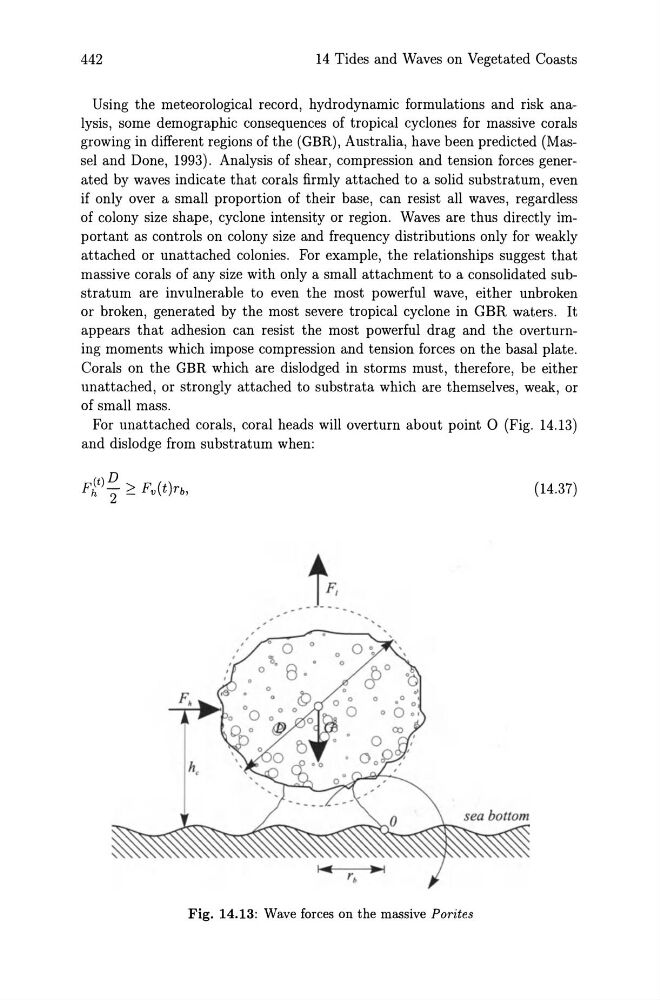
For unattached corals, coral heads will overturn about point 0 (Fig. 14.13)
and dislodge from substratum when:
(14.37)
Fig. 14.13: Wave forces on the massive Porites
14 Tides and Waves on Vegetated Coasts
Using the meteorological record, hydrodynamic formulations and risk analysis, some demographic consequences of tropical cyclones for massive corals
growing in different regions of the (GBR), Australia, have been predicted (Massel and Done, 1993). Analysis of shear, compression and tension forces generated by waves indicate that corals firmly attached to a solid substratum, even
if only over a small proportion of their base, can resist all waves, regardless
of colony size shape, cyclone intensity or region. Waves are thus directly important as controls on colony size and frequency distributions only for weakly
attached or unattached colonies. For example, the relationships suggest that
massive corals of any size with only a small attachment to a consolidated substratum are invulnerable to even the most powerful wave, either unbroken
or broken, generated by the most severe tropical cyclone in GBR waters. It
appears that adhesion can resist the most powerful drag and the overturning moments which impose compression and tension forces on the basal plate.
Corals on the GBR which are dislodged in storms must, therefore, be either
unattached, or strongly attached to substrata which are themselves, weak, or
of small mass.
For unattached corals, coral heads will overturn about point 0 (Fig. 14.13)
and dislodge from substratum when:
(14.37)
Fig. 14.13: Wave forces on the massive Porites