

14.4 Waves at Coral Reefs
441
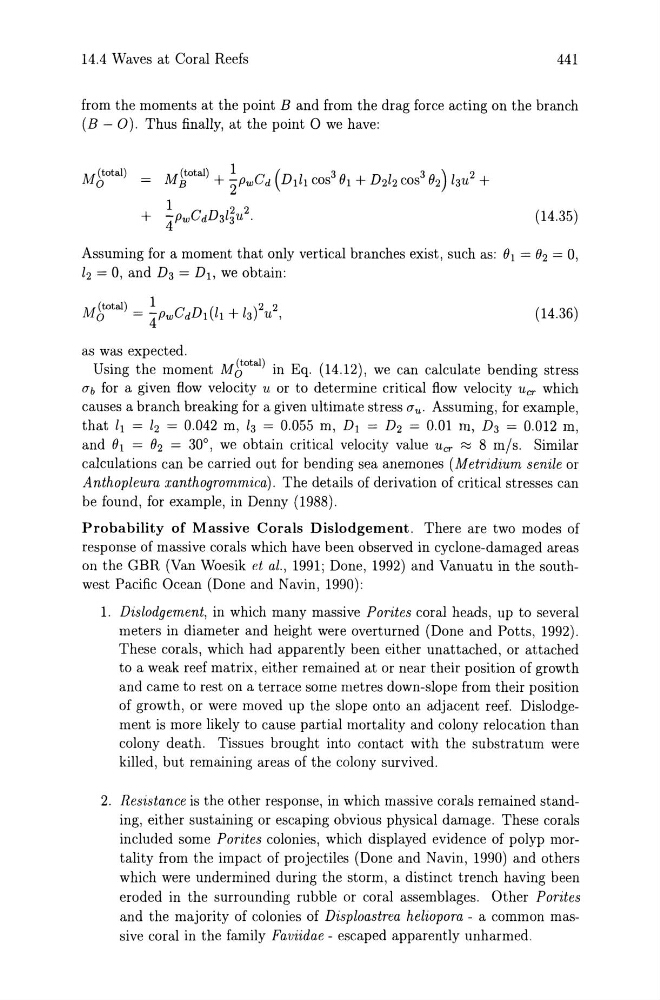
from the moments at the point B and from the drag force acting on the branch
(B - 0). Thus finally, at the point 0 we have:
(14.35)
Assuming for a moment that only vertical branches exist, such as: 01 = O2 = 0,
12 = 0, and D3 = D1, we obtain:
M (total) _ ~ C D (I + I )2 2
o
- 4 Pw d 1 1 3 U,
(14.36)
as was expected.
Using the moment Mg ota1 ) in Eq. (14.12), we can calculate bending stress
O"b for a given flow velocity u or to determine critical flow velocity Ucr which
causes a branch breaking for a given ultimate stress O"u. Assuming, for example,
that 11 = 12 = 0.042 m, 13 = 0.055 m, Dl = D2 = 0.01 m, D3 = 0.012 m,
and 01 = O2 = 30°, we obtain critical velocity value U cr ;:::; 8 m/s. Similar
calculations can be carried out for bending sea anemones (Metridium senile or
Anthopleum xanthogrommica). The details of derivation of critical stresses can
be found, for example, in Denny (1988).
Probability of Massive Corals Dislodgement. There are two modes of
response of massive corals which have been observed in cyclone-damaged areas
on the GBR (Van Woesik et al., 1991; Done, 1992) and Vanuatu in the southwest Pacific Ocean (Done and Navin, 1990):
1. Dislodgement, in which many massive Porites coral heads, up to several
meters in diameter and height were overturned (Done and Potts, 1992).
These corals, which had apparently been either unattached, or attached
to a weak reef matrix, either remained at or near their position of growth
and came to rest on a terrace some metres down-slope from their position
of growth, or were moved up the slope onto an adjacent reef. Dislodgement is more likely to cause partial mortality and colony relocation than
colony death. Tissues brought into contact with the substratum were
killed, but remaining areas of the colony survived.
2. Resistance is the other response, in which massive corals remained standing, either sustaining or escaping obvious physical damage. These corals
included some Porites colonies, which displayed evidence of polyp mortality from the impact of projectiles (Done and Navin, 1990) and others
which were undermined during the storm, a distinct trench having been
eroded in the surrounding rubble or coral assemblages. Other Porites
and the majority of colonies of Disploastrea heliopom - a common massive coral in the family Faviidae - escaped apparently unharmed.
441
from the moments at the point B and from the drag force acting on the branch
(B - 0). Thus finally, at the point 0 we have:
(14.35)
Assuming for a moment that only vertical branches exist, such as: 01 = O2 = 0,
12 = 0, and D3 = D1, we obtain:
M (total) _ ~ C D (I + I )2 2
o
- 4 Pw d 1 1 3 U,
(14.36)
as was expected.
Using the moment Mg ota1 ) in Eq. (14.12), we can calculate bending stress
O"b for a given flow velocity u or to determine critical flow velocity Ucr which
causes a branch breaking for a given ultimate stress O"u. Assuming, for example,
that 11 = 12 = 0.042 m, 13 = 0.055 m, Dl = D2 = 0.01 m, D3 = 0.012 m,
and 01 = O2 = 30°, we obtain critical velocity value U cr ;:::; 8 m/s. Similar
calculations can be carried out for bending sea anemones (Metridium senile or
Anthopleum xanthogrommica). The details of derivation of critical stresses can
be found, for example, in Denny (1988).
Probability of Massive Corals Dislodgement. There are two modes of
response of massive corals which have been observed in cyclone-damaged areas
on the GBR (Van Woesik et al., 1991; Done, 1992) and Vanuatu in the southwest Pacific Ocean (Done and Navin, 1990):
1. Dislodgement, in which many massive Porites coral heads, up to several
meters in diameter and height were overturned (Done and Potts, 1992).
These corals, which had apparently been either unattached, or attached
to a weak reef matrix, either remained at or near their position of growth
and came to rest on a terrace some metres down-slope from their position
of growth, or were moved up the slope onto an adjacent reef. Dislodgement is more likely to cause partial mortality and colony relocation than
colony death. Tissues brought into contact with the substratum were
killed, but remaining areas of the colony survived.
2. Resistance is the other response, in which massive corals remained standing, either sustaining or escaping obvious physical damage. These corals
included some Porites colonies, which displayed evidence of polyp mortality from the impact of projectiles (Done and Navin, 1990) and others
which were undermined during the storm, a distinct trench having been
eroded in the surrounding rubble or coral assemblages. Other Porites
and the majority of colonies of Disploastrea heliopom - a common massive coral in the family Faviidae - escaped apparently unharmed.