

444
14 Tides and Waves on Vegetated Coasts
"""'
.~
100
'-'
p...
90
80
70
60
50
40
30
20
10
0
0
20
40
60
80
100
120
Age (years)
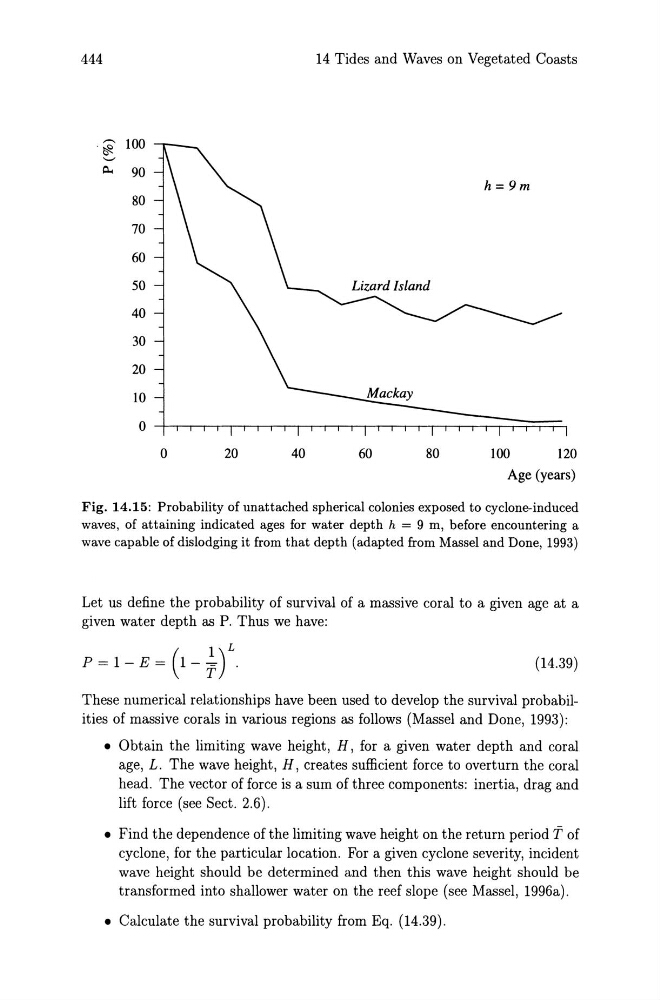
Fig. 14.15: Probability of unattached spherical colonies exposed to cyclone-induced
waves, of attaining indicated ages for water depth h = 9 m, before encountering a
wave capable of dislodging it from that depth (adapted from Massel and Done, 1993)
Let us define the probability of survival of a massive coral to a given age at a
given water depth as P. Thus we have:
(14.39)
These numerical relationships have been used to develop the survival probabilities of massive corals in various regions as follows (Massel and Done, 1993):
• Obtain the limiting wave height, H, for a given water depth and coral
age, L. The wave height, H, creates sufficient force to overturn the coral
head. The vector of force is a sum of three components: inertia, drag and
lift force (see Sect. 2.6).
• Find the dependence of the limiting wave height on the return period t of
cyclone, for the particular location. For a given cyclone severity, incident
wave height should be determined and then this wave height should be
transformed into shallower water on the reef slope (see Massel, 1996a).
• Calculate the survival probability from Eq. (14.39).
14 Tides and Waves on Vegetated Coasts
"""'
.~
100
'-'
p...
90
80
70
60
50
40
30
20
10
0
0
20
40
60
80
100
120
Age (years)
Fig. 14.15: Probability of unattached spherical colonies exposed to cyclone-induced
waves, of attaining indicated ages for water depth h = 9 m, before encountering a
wave capable of dislodging it from that depth (adapted from Massel and Done, 1993)
Let us define the probability of survival of a massive coral to a given age at a
given water depth as P. Thus we have:
(14.39)
These numerical relationships have been used to develop the survival probabilities of massive corals in various regions as follows (Massel and Done, 1993):
• Obtain the limiting wave height, H, for a given water depth and coral
age, L. The wave height, H, creates sufficient force to overturn the coral
head. The vector of force is a sum of three components: inertia, drag and
lift force (see Sect. 2.6).
• Find the dependence of the limiting wave height on the return period t of
cyclone, for the particular location. For a given cyclone severity, incident
wave height should be determined and then this wave height should be
transformed into shallower water on the reef slope (see Massel, 1996a).
• Calculate the survival probability from Eq. (14.39).