

2.3 Water in Motion: Hydrodynamics
29
simplification arrives when we assume that water is homogeneous (Pw = Const).
Then Eq. (2.17) becomes:
(2.18)
It should be noted that any homogeneous, incompressible fluid with a negligible
coefficient of kinematic viscosity (v ~ 0) is called an inviscid, incompressible
fluid or perfect fluid. For uniform, one-dimensional flow, Eq. (2.18) simplifies
further as:
au = 0
or u = Const.
ax '
(2.19)
In professional literature, Eq. (2.18) is sometimes written in the more compact
form:
AU avow .
- + - + - = dlVu = 0,
ax oy a z
(2.20)
where div denotes the divergence of a velocity vector U = (u, v, w) = u i +
v j + w k. For a detailed explanation of the notation used in Eq. (2.20), see
Appendix C.1.
2.3.5 The Momentum Principle and Bernoulli Equation
If the surroundings exert a net force, F, on a unit volume of fluid, Newton's
second law states that the mass begins to accelerate. In fluid mechanics Newton's law is called the conservation of momentum, which includes the fact that
a fluid particle may be deformed. For steady, irrotational motion of a perfect
fluid, conservation of momentum is identical to conservation of energy of an elementary particle of fluid, where the sum of kinetic and potential energy should
be conserved. The momentum principle is obtained by equating the applied
forces to the so called 'inertia force' which characterizes the natural resistance
of matter to any change in its state of motion. The resulting equation for a
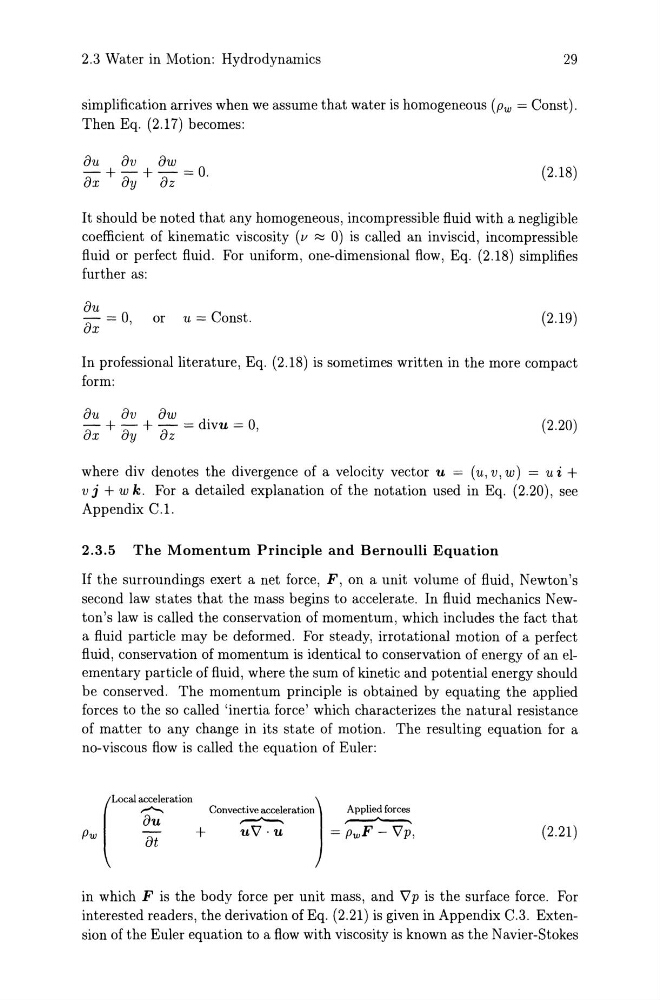
no-viscous flow is called the equation of Euler:
(
Local acceleration
)
~
Convective acceleration
aU
,-A-,.
P
-
+
UV'·U
w
at
Applied forces
~
= PwF - V'p,
(2.21 )
in which F is the body force per unit mass, and V' p is the surface force. For
interested readers, the derivation of Eq. (2.21) is given in Appendix C.3. Extension of the Euler equation to a flow with viscosity is known as the Navier-Stokes
29
simplification arrives when we assume that water is homogeneous (Pw = Const).
Then Eq. (2.17) becomes:
(2.18)
It should be noted that any homogeneous, incompressible fluid with a negligible
coefficient of kinematic viscosity (v ~ 0) is called an inviscid, incompressible
fluid or perfect fluid. For uniform, one-dimensional flow, Eq. (2.18) simplifies
further as:
au = 0
or u = Const.
ax '
(2.19)
In professional literature, Eq. (2.18) is sometimes written in the more compact
form:
AU avow .
- + - + - = dlVu = 0,
ax oy a z
(2.20)
where div denotes the divergence of a velocity vector U = (u, v, w) = u i +
v j + w k. For a detailed explanation of the notation used in Eq. (2.20), see
Appendix C.1.
2.3.5 The Momentum Principle and Bernoulli Equation
If the surroundings exert a net force, F, on a unit volume of fluid, Newton's
second law states that the mass begins to accelerate. In fluid mechanics Newton's law is called the conservation of momentum, which includes the fact that
a fluid particle may be deformed. For steady, irrotational motion of a perfect
fluid, conservation of momentum is identical to conservation of energy of an elementary particle of fluid, where the sum of kinetic and potential energy should
be conserved. The momentum principle is obtained by equating the applied
forces to the so called 'inertia force' which characterizes the natural resistance
of matter to any change in its state of motion. The resulting equation for a
no-viscous flow is called the equation of Euler:
(
Local acceleration
)
~
Convective acceleration
aU
,-A-,.
P
-
+
UV'·U
w
at
Applied forces
~
= PwF - V'p,
(2.21 )
in which F is the body force per unit mass, and V' p is the surface force. For
interested readers, the derivation of Eq. (2.21) is given in Appendix C.3. Extension of the Euler equation to a flow with viscosity is known as the Navier-Stokes