

28
2. Water at Rest and in Motion
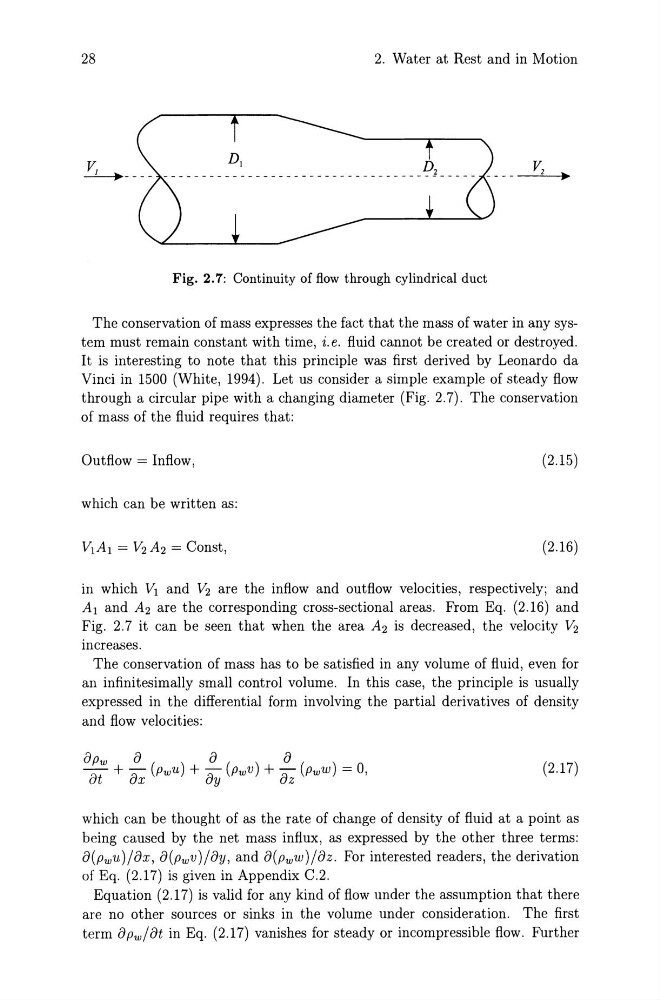
Fig. 2.7: Continuity of flow through cylindrical duct
The conservation of mass expresses the fact that the mass of water in any system must remain constant with time, i. e. fluid cannot be created or destroyed.
It is interesting to note that this principle was first derived by Leonardo da
Vinci in 1500 (White, 1994). Let us consider a simple example of steady flow
through a circular pipe with a changing diameter (Fig. 2.7). The conservation
of mass of the fluid requires that:
Outflow = Inflow,
(2.15)
which can be written as:
(2.16)
in which V1 and V2 are the inflow and outflow velocities, respectively; and
Al and A2 are the corresponding cross-sectional areas. From Eq. (2.16) and
Fig. 2.7 it can be seen that when the area A2 is decreased, the velocity V2
increases.
The conservation of mass has to be satisfied in any volume of fluid, even for
an infinitesimally small control volume. In this case, the principle is usually
expressed in the differential form involving the partial derivatives of density
and flow velocities:
(2.17)
which can be thought of as the rate of change of density of fluid at a point as
being caused by the net mass influx, as expressed by the other three terms:
8(Pwu)/8x, 8(Pwv)/8y, and 8(Pww)/8z. For interested readers, the derivation
of Eq. (2.17) is given in Appendix C.2.
Equation (2.17) is valid for any kind of flow under the assumption that there
are no other sources or sinks in the volume under consideration. The first
term 8Pw/8t in Eq. (2.17) vanishes for steady or incompressible flow. Further
2. Water at Rest and in Motion
Fig. 2.7: Continuity of flow through cylindrical duct
The conservation of mass expresses the fact that the mass of water in any system must remain constant with time, i. e. fluid cannot be created or destroyed.
It is interesting to note that this principle was first derived by Leonardo da
Vinci in 1500 (White, 1994). Let us consider a simple example of steady flow
through a circular pipe with a changing diameter (Fig. 2.7). The conservation
of mass of the fluid requires that:
Outflow = Inflow,
(2.15)
which can be written as:
(2.16)
in which V1 and V2 are the inflow and outflow velocities, respectively; and
Al and A2 are the corresponding cross-sectional areas. From Eq. (2.16) and
Fig. 2.7 it can be seen that when the area A2 is decreased, the velocity V2
increases.
The conservation of mass has to be satisfied in any volume of fluid, even for
an infinitesimally small control volume. In this case, the principle is usually
expressed in the differential form involving the partial derivatives of density
and flow velocities:
(2.17)
which can be thought of as the rate of change of density of fluid at a point as
being caused by the net mass influx, as expressed by the other three terms:
8(Pwu)/8x, 8(Pwv)/8y, and 8(Pww)/8z. For interested readers, the derivation
of Eq. (2.17) is given in Appendix C.2.
Equation (2.17) is valid for any kind of flow under the assumption that there
are no other sources or sinks in the volume under consideration. The first
term 8Pw/8t in Eq. (2.17) vanishes for steady or incompressible flow. Further