

30
2. Water at Rest and in Motion
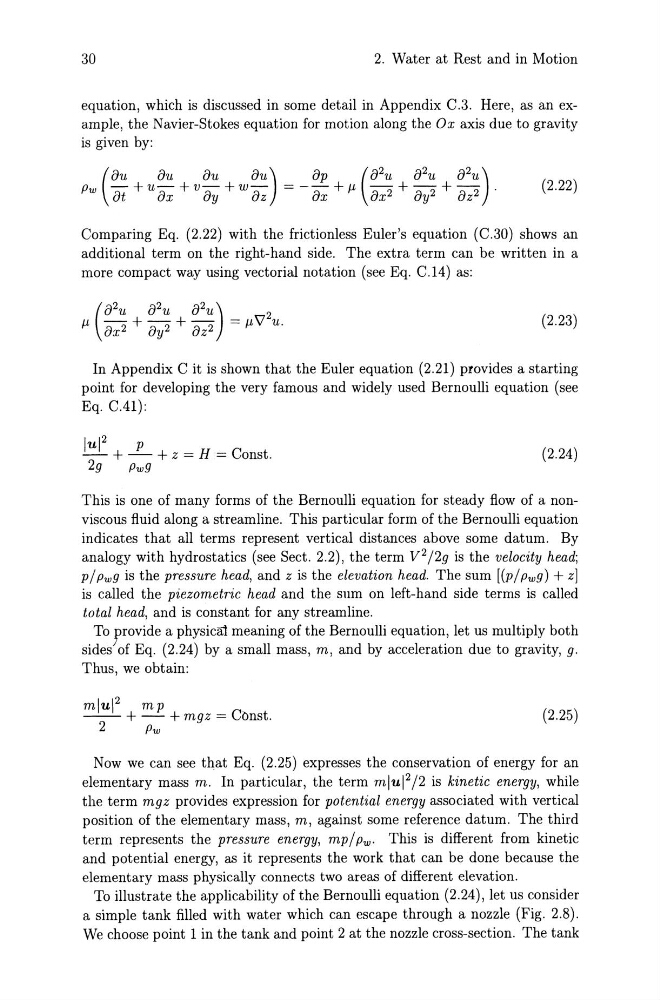
equation, which is discussed in some detail in Appendix C.3. Here, as an example, the Navier-Stokes equation for motion along the Ox axis due to gravity
is given by:
(
ou
ou
ou
ou)
op
(02u
02u
02u)
Pw -+U-+V-+W- =--+/1 - + - + - .
ot
ox
oy
oz
ox
ox 2 oy2
oz2
(2.22)
Comparing Eq. (2.22) with the frictionless Euler's equation (C.30) shows an
additional term on the right-hand side. The extra term can be written in a
more compact way using vectorial notation (see Eq. C.14) as:
(2.23)
In Appendix C it is shown that the Euler equation (2.21) provides a starting
point for developing the very famous and widely used Bernoulli equation (see
Eq. C.41):
lul 2 P
- + - + z = H = Const.
2g
Pwg
(2.24)
This is one of many forms of the Bernoulli equation for steady flow of a nonviscous fluid along a streamline. This particular form of the Bernoulli equation
indicates that all terms represent vertical distances above some datum. By
analogy with hydrostatics (see Sect. 2.2), the term V 2 /2g is the velocity head;
p / Pw9 is the pressure head, and z is the elevation head. The sum [(p / Pwg) + z 1
is called the piezometric head and the sum on left-hand side terms is called
total head, and is constant for any streamline.
To 'provide a physical meaning of the Bernoulli equation, let us multiply both
sides of Eq. (2.24) by a small mass, m, and by acceleration due to gravity, g.
Thus, we obtain:
mlul 2 mp
- - + - + mgz = Canst.
2
Pw
(2.25)
Now we can see that Eq. (2.25) expresses the conservation of energy for an
elementary mass m. In particular, the term mlul 2 /2 is kinetic energy, while
the term mgz provides expression for potential energy associated with vertical
position of the elementary mass, m, against some reference datum. The third
term represents the pressure energy, mp/ Pw' This is different from kinetic
and potential energy, as it represents the work that can be done because the
elementary mass physically connects two areas of different elevation.
To illustrate the applicability of the Bernoulli equation (2.24), let us consider
a simple tank filled with water which can escape through a nozzle (Fig. 2.8).
We choose point 1 in the tank and point 2 at the nozzle cross-section. The tank
2. Water at Rest and in Motion
equation, which is discussed in some detail in Appendix C.3. Here, as an example, the Navier-Stokes equation for motion along the Ox axis due to gravity
is given by:
(
ou
ou
ou
ou)
op
(02u
02u
02u)
Pw -+U-+V-+W- =--+/1 - + - + - .
ot
ox
oy
oz
ox
ox 2 oy2
oz2
(2.22)
Comparing Eq. (2.22) with the frictionless Euler's equation (C.30) shows an
additional term on the right-hand side. The extra term can be written in a
more compact way using vectorial notation (see Eq. C.14) as:
(2.23)
In Appendix C it is shown that the Euler equation (2.21) provides a starting
point for developing the very famous and widely used Bernoulli equation (see
Eq. C.41):
lul 2 P
- + - + z = H = Const.
2g
Pwg
(2.24)
This is one of many forms of the Bernoulli equation for steady flow of a nonviscous fluid along a streamline. This particular form of the Bernoulli equation
indicates that all terms represent vertical distances above some datum. By
analogy with hydrostatics (see Sect. 2.2), the term V 2 /2g is the velocity head;
p / Pw9 is the pressure head, and z is the elevation head. The sum [(p / Pwg) + z 1
is called the piezometric head and the sum on left-hand side terms is called
total head, and is constant for any streamline.
To 'provide a physical meaning of the Bernoulli equation, let us multiply both
sides of Eq. (2.24) by a small mass, m, and by acceleration due to gravity, g.
Thus, we obtain:
mlul 2 mp
- - + - + mgz = Canst.
2
Pw
(2.25)
Now we can see that Eq. (2.25) expresses the conservation of energy for an
elementary mass m. In particular, the term mlul 2 /2 is kinetic energy, while
the term mgz provides expression for potential energy associated with vertical
position of the elementary mass, m, against some reference datum. The third
term represents the pressure energy, mp/ Pw' This is different from kinetic
and potential energy, as it represents the work that can be done because the
elementary mass physically connects two areas of different elevation.
To illustrate the applicability of the Bernoulli equation (2.24), let us consider
a simple tank filled with water which can escape through a nozzle (Fig. 2.8).
We choose point 1 in the tank and point 2 at the nozzle cross-section. The tank