

406
13 Transport and Mixing in Coastal Ecosystems
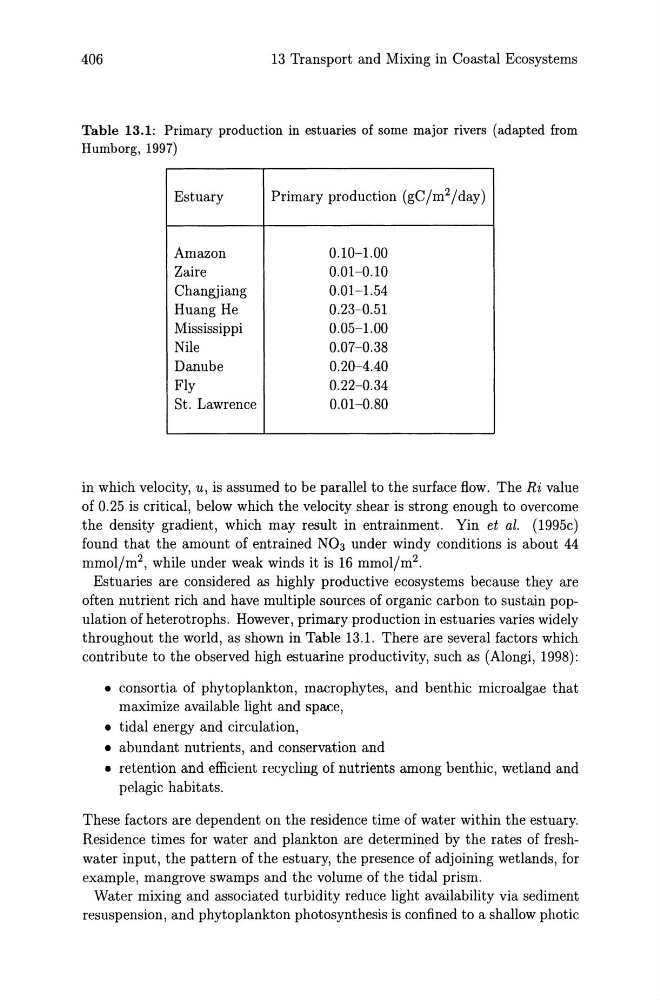
Table 13.1: Primary production in estuaries of some major rivers (adapted from
Humborg, 1997)
Estuary
Primary production (gC/m 2 /day)
Amazon
0.10-1.00
Zaire
0.01-0.10
Changjiang
0.01-1.54
Huang He
0.23-0.51
Mississippi
0.05-1.00
Nile
0.07-0.38
Danube
0.20-4.40
Fly
0.22-0.34
St. Lawrence
0.01-0.80
in which velocity, u, is assumed to be parallel to the surface flow. The Ri value
of 0.25 is critical, below which the velocity shear is strong enough to overcome
the density gradient, which may result in entrainment. Yin et al. (1995c)
found that the amount of entrained N03 under windy conditions is about 44
mmol/m 2 , while under weak winds it is 16 mmol/m 2 .
Estuaries are considered as highly productive ecosystems because they are
often nutrient rich and have multiple sources of organic carbon to sustain population of heterotrophs. However, primary production in estuaries varies widely
throughout the world, as shown in Table 13.1. There are several factors which
contribute to the observed high estuarine productivity, such as (Alongi, 1998):
• consortia of phytoplankton, macrophytes, and benthic micro algae that
maximize available light and space,
• tidal energy and circulation,
• abundant nutrients, and conservation and
• retention and efficient recycling of nutrients among benthic, wetland and
pelagic habitats.
These factors are dependent on the residence time of water within the estuary.
Residence times for water and plankton are determined by the rates of freshwater input, the pattern of the estuary, the presence of adjoining wetlands, for
example, mangrove swamps and the volume of the tidal prism.
Water mixing and associated turbidity reduce light availability via sediment
resuspension, and phytoplankton photosynthesis is confined to a shallow photic
13 Transport and Mixing in Coastal Ecosystems
Table 13.1: Primary production in estuaries of some major rivers (adapted from
Humborg, 1997)
Estuary
Primary production (gC/m 2 /day)
Amazon
0.10-1.00
Zaire
0.01-0.10
Changjiang
0.01-1.54
Huang He
0.23-0.51
Mississippi
0.05-1.00
Nile
0.07-0.38
Danube
0.20-4.40
Fly
0.22-0.34
St. Lawrence
0.01-0.80
in which velocity, u, is assumed to be parallel to the surface flow. The Ri value
of 0.25 is critical, below which the velocity shear is strong enough to overcome
the density gradient, which may result in entrainment. Yin et al. (1995c)
found that the amount of entrained N03 under windy conditions is about 44
mmol/m 2 , while under weak winds it is 16 mmol/m 2 .
Estuaries are considered as highly productive ecosystems because they are
often nutrient rich and have multiple sources of organic carbon to sustain population of heterotrophs. However, primary production in estuaries varies widely
throughout the world, as shown in Table 13.1. There are several factors which
contribute to the observed high estuarine productivity, such as (Alongi, 1998):
• consortia of phytoplankton, macrophytes, and benthic micro algae that
maximize available light and space,
• tidal energy and circulation,
• abundant nutrients, and conservation and
• retention and efficient recycling of nutrients among benthic, wetland and
pelagic habitats.
These factors are dependent on the residence time of water within the estuary.
Residence times for water and plankton are determined by the rates of freshwater input, the pattern of the estuary, the presence of adjoining wetlands, for
example, mangrove swamps and the volume of the tidal prism.
Water mixing and associated turbidity reduce light availability via sediment
resuspension, and phytoplankton photosynthesis is confined to a shallow photic