

13.2 Transport and Mixing in Estuaries
405
a
estuarine plume
- - .
___ '----...:~ ......... ...L
halocline
b
. - - river
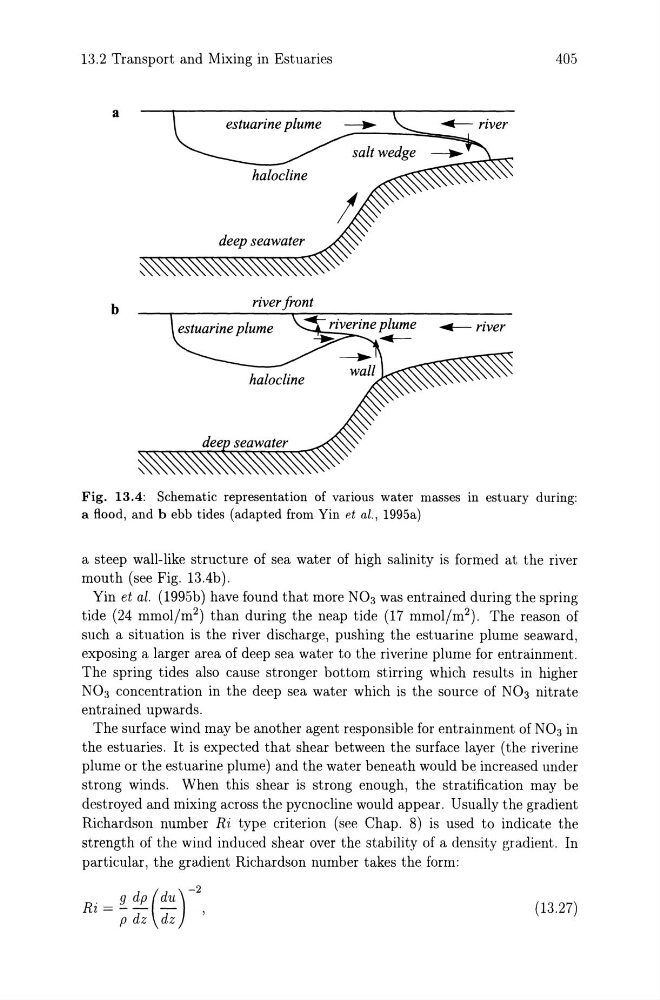
Fig. 13.4: Schematic representation of various water masses III estuary during:
a flood, and b ebb tides (adapted from Yin et al., 1995a)
a steep wall-like structure of sea water of high salinity is formed at the river
mouth (see Fig. 13.4b).
Yin et al. (1995b) have found that more N03 was entrained during the spring
tide (24 mmol/m 2 ) than during the neap tide (17 mmol/m 2 ). The reason of
such a situation is the river discharge, pushing the estuarine plume seaward,
exposing a larger area of deep sea water to the riverine plume for entrainment.
The spring tides also cause stronger bottom stirring which results in higher
N03 concentration in the deep sea water which is the source of N03 nitrate
entrained upwards.
The surface wind may be another agent responsible for entrainment of N03 in
the estuaries. It is expected that shear between the surface layer (the riverine
plume or the estuarine plume) and the water beneath would be increased under
strong winds. When this shear is strong enough, the stratification may be
destroyed and mixing across the pycnocline would appear. Usually the gradient
Richardson number Ri type criterion (see Chap. 8) is used to indicate the
strength of the wind induced shear over the stability of a density gradient. In
particular, the gradient Richardson number takes the form:
Ri = !!.- dp (dU) -2,
P dz dz
(13.27)
405
a
estuarine plume
- - .
___ '----...:~ ......... ...L
halocline
b
. - - river
Fig. 13.4: Schematic representation of various water masses III estuary during:
a flood, and b ebb tides (adapted from Yin et al., 1995a)
a steep wall-like structure of sea water of high salinity is formed at the river
mouth (see Fig. 13.4b).
Yin et al. (1995b) have found that more N03 was entrained during the spring
tide (24 mmol/m 2 ) than during the neap tide (17 mmol/m 2 ). The reason of
such a situation is the river discharge, pushing the estuarine plume seaward,
exposing a larger area of deep sea water to the riverine plume for entrainment.
The spring tides also cause stronger bottom stirring which results in higher
N03 concentration in the deep sea water which is the source of N03 nitrate
entrained upwards.
The surface wind may be another agent responsible for entrainment of N03 in
the estuaries. It is expected that shear between the surface layer (the riverine
plume or the estuarine plume) and the water beneath would be increased under
strong winds. When this shear is strong enough, the stratification may be
destroyed and mixing across the pycnocline would appear. Usually the gradient
Richardson number Ri type criterion (see Chap. 8) is used to indicate the
strength of the wind induced shear over the stability of a density gradient. In
particular, the gradient Richardson number takes the form:
Ri = !!.- dp (dU) -2,
P dz dz
(13.27)