

13.2 Transport and Mixing in Estuaries
407
zone. The phytoplankton biomass depends on the suspended particulate matter concentration and the light limitation prevents phytoplankton blooms when
sediment concentration exceeds 50 mg/l (Cloern, 1957). The influence of resuspension of estuarine sediments on the microphytobenthos in the Ems Estuary
was examined in detail by de Jonge (1992).
Ragueneau et al. (1996) have compared the dynamics of phytoplankton blooms
in two coastal ecosystems of Western Europe, which differ in the influence of
river discharge on the vertical stratification of the water column. In the Bay of
Brest (a semi-enclosed ecosystem connected to the adjacent ocean and entered
by two nutrient-rich rivers), where light is the triggering factor of production,
the plankton blooms occur during neap tides. A relaxation of vertical mixing
during those tides enables the utilization of nutrients originating from freshwater inputs. On the other hand, in the English Channel, the light is not a limiting
factor and increased mixing during spring tides enables nutrient replenishment
from the sea bottom. This difference in functioning of both ecosystems is reflected in the macrozoobenthos ecostructure, dominated by filter-feeders in the
English Channel and suspension-feeders in the Bay of Brest (Ragueneau et al.,
1996).
In salt-wedge type estuaries, where river discharge floats on the denser sea
water, light conditions in the upper layer improve. Nutrient concentrations
remain one order of magnitude higher than in mixed sea water, providing the
basis for substantial primary production. Humborg (1997) has found that the
Danube estuary, due to its shallowness of the upper layer and strong stratification and high nutrient concentration, provides favourable conditions for high
primary production. In fact, he obtained a long-term average value of about
0.5-1.0 gC/m 2 /day, and up to 4 gC/m 2 /day for the estuary plume (Table 13.1).
In the salt-wedge estuary Danube tides are negligible and circulation is mainly
governed by the river flow and prevailing winds. High nutrient concentration
and sufficient light conditions result in very high primary production in the
estuary, comparable to, for example, the Amazon estuary.
In contrast, the Zaire estuary is well mixed and the freshwater plume is
instantaneously mixed by tidal currents. Hence, the maximum primary production is moved to the outer edge of the estuary at high salinities. However,
there production is limited by nutrient concentrations from previous dilution
(Humborg, 1997).
Primary production in large estuaries varies between the seasons of high and
low nitrate concentrations, high and low river discharge, and shallow or deep
location of the pycnocline. During a particular season, the biomass and production of phytoplankton depend on the nutrient availability, temperature and
maintenance in the upper water column. Tremblay et al. (1997) have found
in the Lower St. Lawrence Estuary, Canada, a positive correlation between
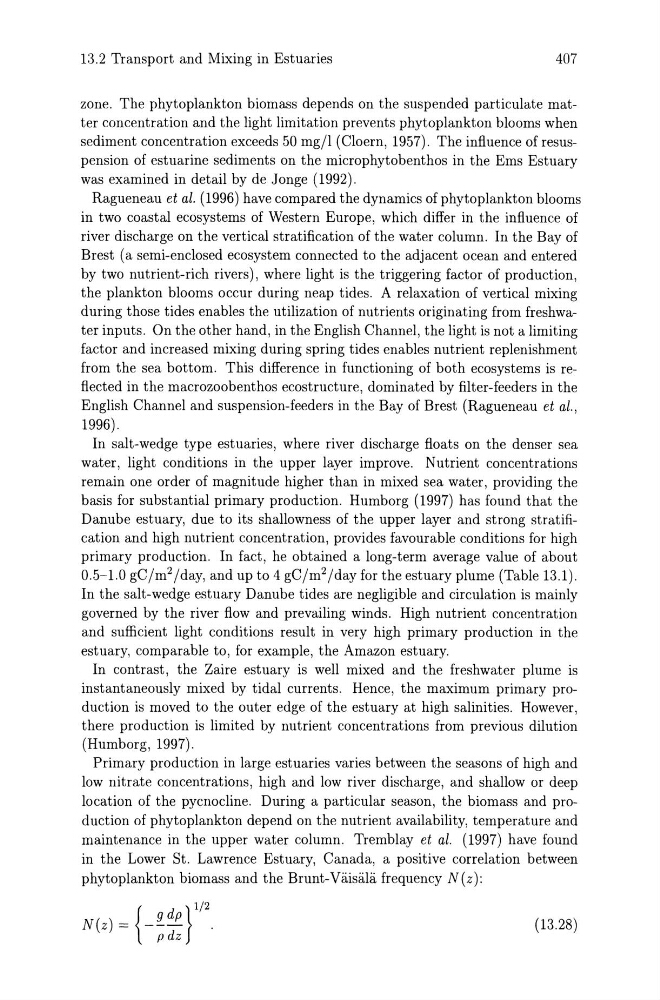
phytoplankton biomass and the Brunt-Viiisiilii frequency N (z):
{
d }1/2
N(z) = -¥....£
p dz
(13.28)
407
zone. The phytoplankton biomass depends on the suspended particulate matter concentration and the light limitation prevents phytoplankton blooms when
sediment concentration exceeds 50 mg/l (Cloern, 1957). The influence of resuspension of estuarine sediments on the microphytobenthos in the Ems Estuary
was examined in detail by de Jonge (1992).
Ragueneau et al. (1996) have compared the dynamics of phytoplankton blooms
in two coastal ecosystems of Western Europe, which differ in the influence of
river discharge on the vertical stratification of the water column. In the Bay of
Brest (a semi-enclosed ecosystem connected to the adjacent ocean and entered
by two nutrient-rich rivers), where light is the triggering factor of production,
the plankton blooms occur during neap tides. A relaxation of vertical mixing
during those tides enables the utilization of nutrients originating from freshwater inputs. On the other hand, in the English Channel, the light is not a limiting
factor and increased mixing during spring tides enables nutrient replenishment
from the sea bottom. This difference in functioning of both ecosystems is reflected in the macrozoobenthos ecostructure, dominated by filter-feeders in the
English Channel and suspension-feeders in the Bay of Brest (Ragueneau et al.,
1996).
In salt-wedge type estuaries, where river discharge floats on the denser sea
water, light conditions in the upper layer improve. Nutrient concentrations
remain one order of magnitude higher than in mixed sea water, providing the
basis for substantial primary production. Humborg (1997) has found that the
Danube estuary, due to its shallowness of the upper layer and strong stratification and high nutrient concentration, provides favourable conditions for high
primary production. In fact, he obtained a long-term average value of about
0.5-1.0 gC/m 2 /day, and up to 4 gC/m 2 /day for the estuary plume (Table 13.1).
In the salt-wedge estuary Danube tides are negligible and circulation is mainly
governed by the river flow and prevailing winds. High nutrient concentration
and sufficient light conditions result in very high primary production in the
estuary, comparable to, for example, the Amazon estuary.
In contrast, the Zaire estuary is well mixed and the freshwater plume is
instantaneously mixed by tidal currents. Hence, the maximum primary production is moved to the outer edge of the estuary at high salinities. However,
there production is limited by nutrient concentrations from previous dilution
(Humborg, 1997).
Primary production in large estuaries varies between the seasons of high and
low nitrate concentrations, high and low river discharge, and shallow or deep
location of the pycnocline. During a particular season, the biomass and production of phytoplankton depend on the nutrient availability, temperature and
maintenance in the upper water column. Tremblay et al. (1997) have found
in the Lower St. Lawrence Estuary, Canada, a positive correlation between
phytoplankton biomass and the Brunt-Viiisiilii frequency N (z):
{
d }1/2
N(z) = -¥....£
p dz
(13.28)