

388
12 Internal Flows in Marine Organisms
12.5 Oxygen Supply in Marine Animals
In this book we predominantly consider the flow of liquid, such as water or
blood. The flow of air is only mentioned occasionally. However, the metabolic
rate of an animal is maintained through the steady consumption of fuel and
oxygen. Therefore, in this section we will focus our attention on the hydrodynamic features of two gas-exchange organs, namely gills and lungs of aquatic
animals.
For most fish, gills are the major respiratory organ. As we have mentioned in
Sect. 12.2, the gills form a system of closely spaced and parallel flat plates of
rather small dimensions. Using data given in Schmidt-Nielsen (1989), the area
of gills was calculated and listed in Table 12.1. It can be seen that the gill area
of tuna is substantially higher than that of the other fish and it is very close
to the lung area of mammals. Tuna require a large gill area as they are a fast
swimming and very active fish.
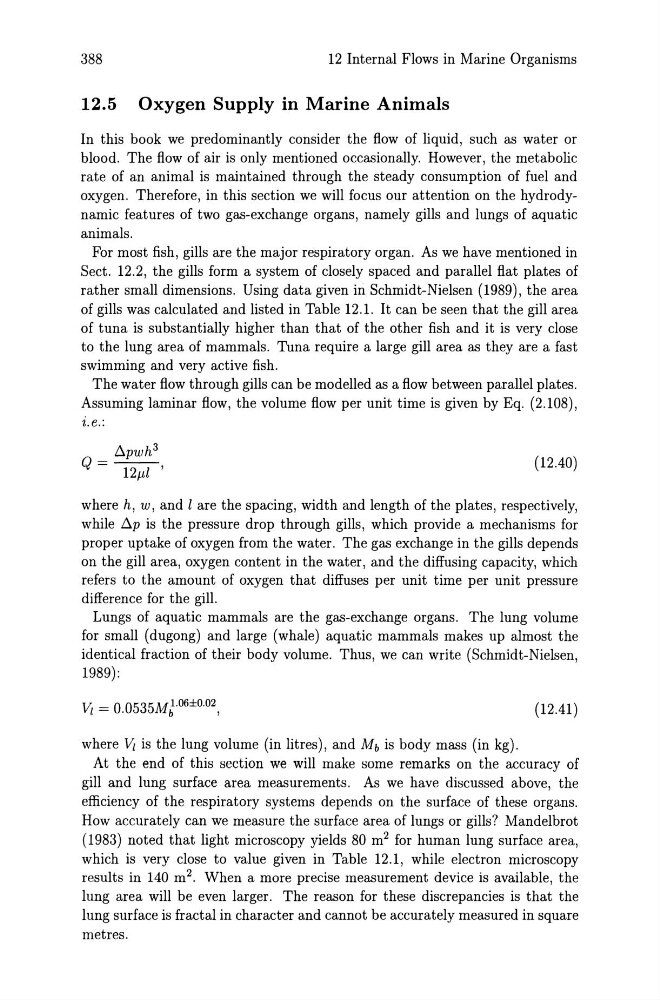
The water flow through gills can be modelled as a flow between parallel plates.
Assuming laminar flow, the volume flow per unit time is given by Eq. (2.108),
i.e.:
(12.40)
where h, w, and I are the spacing, width and length of the plates, respectively,
while b.p is the pressure drop through gills, which provide a mechanisms for
proper uptake of oxygen from the water. The gas exchange in the gills depends
on the gill area, oxygen content in the water, and the diffusing capacity, which
refers to the amount of oxygen that diffuses per unit time per unit pressure
difference for the gill.
Lungs of aquatic mammals are the gas-exchange organs. The lung volume
for small (dugong) and large (whale) aquatic mammals makes up almost the
identical fraction of their body volume. Thus, we can write (Schmidt-Nielsen,
1989):
(12.41 )
where Vi is the lung volume (in litres), and Mb is body mass (in kg).
At the end of this section we will make some remarks on the accuracy of
gill and lung surface area measurements. As we have discussed above, the
efficiency of the respiratory systems depends on the surface of these organs.
How accurately can we measure the surface area of lungs or gills? Mandelbrot
(1983) noted that light microscopy yields 80 m 2 for human lung surface area,
which is very close to value given in Table 12.1, while electron microscopy
results in 140 m 2 . When a more precise measurement device is available, the
lung area will be even larger. The reason for these discrepancies is that the
lung surface is fractal in character and cannot be accurately measured in square
metres.
12 Internal Flows in Marine Organisms
12.5 Oxygen Supply in Marine Animals
In this book we predominantly consider the flow of liquid, such as water or
blood. The flow of air is only mentioned occasionally. However, the metabolic
rate of an animal is maintained through the steady consumption of fuel and
oxygen. Therefore, in this section we will focus our attention on the hydrodynamic features of two gas-exchange organs, namely gills and lungs of aquatic
animals.
For most fish, gills are the major respiratory organ. As we have mentioned in
Sect. 12.2, the gills form a system of closely spaced and parallel flat plates of
rather small dimensions. Using data given in Schmidt-Nielsen (1989), the area
of gills was calculated and listed in Table 12.1. It can be seen that the gill area
of tuna is substantially higher than that of the other fish and it is very close
to the lung area of mammals. Tuna require a large gill area as they are a fast
swimming and very active fish.
The water flow through gills can be modelled as a flow between parallel plates.
Assuming laminar flow, the volume flow per unit time is given by Eq. (2.108),
i.e.:
(12.40)
where h, w, and I are the spacing, width and length of the plates, respectively,
while b.p is the pressure drop through gills, which provide a mechanisms for
proper uptake of oxygen from the water. The gas exchange in the gills depends
on the gill area, oxygen content in the water, and the diffusing capacity, which
refers to the amount of oxygen that diffuses per unit time per unit pressure
difference for the gill.
Lungs of aquatic mammals are the gas-exchange organs. The lung volume
for small (dugong) and large (whale) aquatic mammals makes up almost the
identical fraction of their body volume. Thus, we can write (Schmidt-Nielsen,
1989):
(12.41 )
where Vi is the lung volume (in litres), and Mb is body mass (in kg).
At the end of this section we will make some remarks on the accuracy of
gill and lung surface area measurements. As we have discussed above, the
efficiency of the respiratory systems depends on the surface of these organs.
How accurately can we measure the surface area of lungs or gills? Mandelbrot
(1983) noted that light microscopy yields 80 m 2 for human lung surface area,
which is very close to value given in Table 12.1, while electron microscopy
results in 140 m 2 . When a more precise measurement device is available, the
lung area will be even larger. The reason for these discrepancies is that the
lung surface is fractal in character and cannot be accurately measured in square
metres.